
Lieferung heute & morgen

Qualitätsgarantie

Willkommens-Angebote freischalten: KOSTENLOSE Lieferung | Bis zu 80 % RABATT | Kostenlose 30-Tage-JoyPlus-Testphase
App herunterladen
A slow feeder bowl for dogs and cats can make daily feeding more structured and help slow down hurried eating. However, it’s not just about the label “anti-gulping bowl”. The design, stability, ease of cleaning and appropriate height all determine whether the bowl is genuinely practical for everyday use.
An elevated dog bowl isn’t automatically ergonomically suitable. Some models offer only a fixed height, while others are adjustable but don’t sit stably at the right level for your pet’s size. For small to medium-sized dogs and cats, several clearly defined height settings are useful. This way, the height-adjustable feeding bowl can be tailored to your pet’s size and different usage situations.
Deep grooves and tight obstacles can reduce eating speed, but they quickly collect residue with wet food. Before buying, you should check whether the insert can be removed and whether the materials are suitable for hand washing or the dishwasher. With a stainless steel dog bowl, also pay attention to the specific material specification rather than assuming a certain quality based on the description alone.
A combined feeding bowl with a water bowl saves space, but can spill water onto the floor when your pet drinks messily. A non-slip feeding bowl, a wide base or a floating water insert can reduce this risk. The construction should still sit on a level surface and be checked regularly for damage.
Pay attention to the actual dimensions stated. With the height-adjustable models presented here, four settings are available: 10 cm, 23 cm, 27 cm and 31 cm. The lowest setting may be suitable for cats or smaller animals, while higher settings could work for larger pets. However, suitability depends on your pet’s body size, posture and eating behaviour.
A foldable dog bowl with collapsible legs is interesting if you need to store or transport the bowl after feeding. Before use, all parts must be fully locked into place. A weight of around 1,350 to 1,450 g and a base area of 42 × 27 cm can contribute to stability, but don’t replace a non-slip mat on smooth floors.
A slow feeding bowl shouldn’t completely block the food. The obstacles must be arranged so that your pet can pick up individual portions without constantly bumping its snout. For cats and small dogs, shallower structures are often easier to access than very deep mazes.
The eating speed may change depending on the bowl’s shape, but a specific effect can’t be guaranteed for every animal. Observe the first few meals and adjust the food amount, location and bowl as needed. If you notice unusual eating or drinking behaviour, a veterinary assessment is advisable.
Silicone mats can provide extra grip on smooth floors and can be folded away to save space. A stainless steel bowl is practical for water or regular food, provided it’s thoroughly cleaned after each use. With the Pecute model, food-grade silicone and stainless steel 201 are listed as the materials. The set includes two bowls, each with a 400 ml capacity.
Also check:
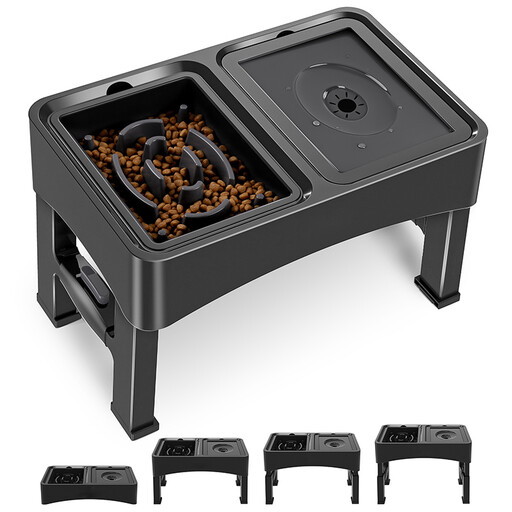
Why this product fits the profile: The 2-in-1 model combines a slow feeder with a floating water bowl, so it only needs one shared footprint.
The water insert is designed as a floating bowl, while the foldable stand offers four adjustable heights.
Two functions in one set, four height settings from 10 to 31 cm and foldable legs for storage.
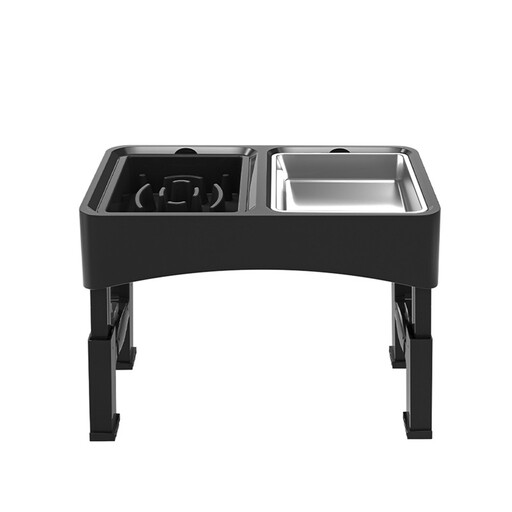
Why this product fits the profile: The combination of a slow feeder and a separate stainless steel bowl allows flexible use for food or water.
The water bowl isn’t limited to a single function and can be removed and cleaned separately when needed.
Stainless steel bowl, four height settings and a foldable construction with stated dimensions of 42 × 27 × 10 cm.
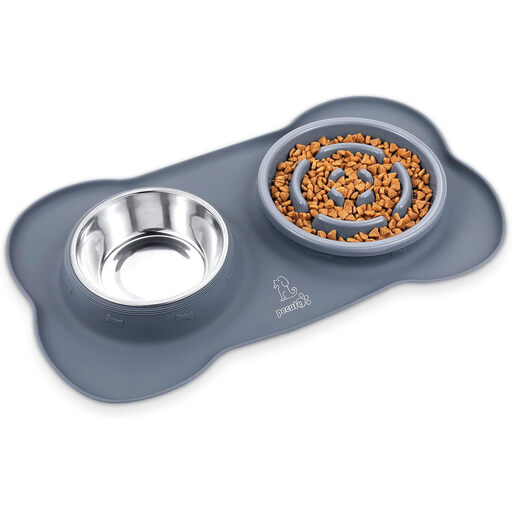
Why this product fits the profile: The set is suitable for small dogs and cats, as well as households where the bowl needs to be stored compactly when travelling.
The integrated silicone mat limits food and water splashes; the foldable design reduces storage space needed.
400 ml slow feeder, 400 ml water bowl, silicone mat and, according to the product information, suitable for hand washing or the dishwasher.
We’ve put together a complete, regularly updated list of products that fully meet these strict selection criteria and the safety regulations in force in the EU.
Place the bowl on a flat, dry surface and start with the lowest suitable height. Check that your pet can comfortably reach both food and water. The bowls should be emptied and cleaned after each meal. With silicone mats, it’s worth checking regularly for cracks, discolouration or stubborn residue.
A slow feeder is not a substitute for an appropriate food amount or veterinary advice. Supervise your pet during the first use and don’t continue using damaged bowls.
The height should be chosen so that your dog can eat without lowering or stretching its neck excessively. Adjustable models with multiple settings make it easier to find the right fit. There’s no one-size-fits-all height, as body size, breed and posture all need to be considered.
The lifespan depends on the material, cleaning method and daily wear and tear. Stainless steel and intact silicone can last a long time with regular care. Check the bowl regularly for sharp edges, cracks, warping and loose stand parts.
A combined set doesn’t need extra energy, but both sections require regular cleaning. Particularly with the floating water bowl and integrated mats, food residue, hair and water deposits should be removed daily.