
Lieferung heute & morgen

Qualitätsgarantie

Willkommens-Angebote freischalten: KOSTENLOSE Lieferung | Bis zu 80 % RABATT | Kostenlose 30-Tage-JoyPlus-Testphase
App herunterladen
As a Joybuy Product Recommendation Officer, I see every day how customers are confused by vague product descriptions and exaggerated marketing promises. Especially with kitchen appliances like the slow juicer, the wrong choice can lead to frustration and an unused device that just takes up space. The goal of this guide is to provide you with objective criteria to make an informed decision and avoid the typical pitfalls of purchasing.
Many appliances look promising at first glance but prove to be impractical in daily use. Pay special attention to these three points to avoid buyer's remorse:
Instead of being guided by advertising slogans, you should base your decision on verifiable, technical features. These three parameters are crucial for daily use.
A juicer with a large feed chute is not a luxury, but a necessity for time-saving use. Models with a diameter of 80 mm or more allow you to process whole apples, peeled oranges, or larger pieces of vegetables directly. This significantly reduces preparation time and makes the juicer a practical everyday helper. Look for precise millimetre specifications for the feed chute in the product data.
The key to a juicer that is easy to clean often lies in the design of its filter system.
A cold press juicer, also known as a slow juicer, works with a slowly rotating auger (typically 50-80 RPM). This method gently grinds and presses the produce, which reduces oxidation and, according to manufacturers, preserves more nutrients in the juice. The quality of the motor is crucial for a consistently high juice yield with both hard and soft fruits and vegetables. A Pure Copper Motor is considered an indicator of durability and stable performance.
Based on the objective criteria mentioned above, we have identified a few models that are particularly well-suited for different user profiles.
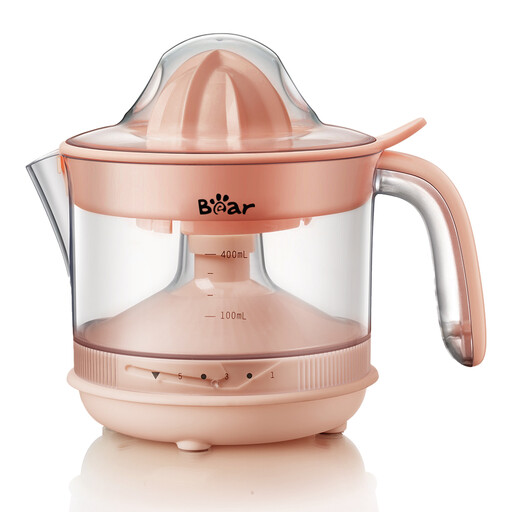
Why it's a good fit: Ideal for anyone who wants to quickly and easily press fresh orange or lemon juice for daily needs. The device focuses on a single task and performs it efficiently.
The device doesn't promise all-in-one functionality. Its simple, bladeless design is genuinely easy to clean, as there are no complex sieves that could clog.
The detachable parts are designed for straightforward cleaning. The bladeless design increases safety, especially in households with children.
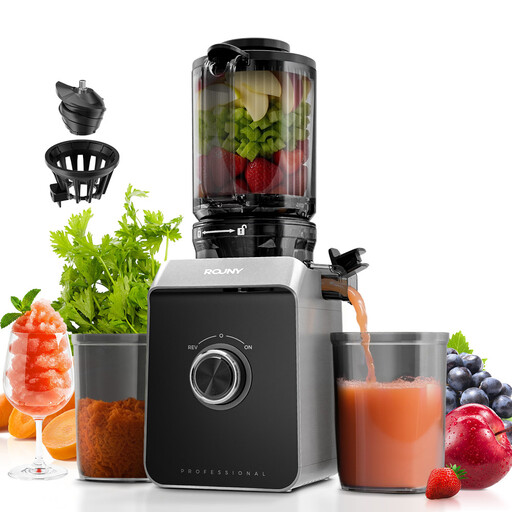
Why it's a good fit: Designed for daily, versatile use. The combination of a very large feed chute and easy cleaning makes it ideal for families who regularly prepare a variety of juices.
This model directly addresses two main problems: The 130 mm wide feed chute minimises prep work, and the filter-free design actually delivers on the promise of quick cleaning.
The ability to make a sorbet-like cream from frozen fruits offers an additional function beyond just juicing. The pure copper motor promises stable performance.
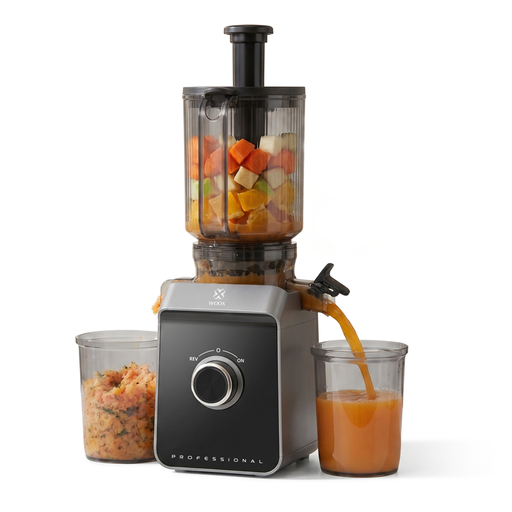
Why it's a good fit: For users who value high efficiency, durability, and quiet operation. The device combines a powerful motor with a large feed chute in a compact design.
The performance claims are backed by clear specifications: a 150W pure copper DC motor and a noise level of <72dB. The 130 mm feed chute also prevents excessive preparation time.
The DC motor ensures quieter operation compared to many other models. Integrated overheat protection contributes to the motor's safety and longevity.
We have compiled a full list of products that meet our selection criteria and are suitable for the UK market.
1. How long does a slow juicer last with daily use? The lifespan of a slow juicer largely depends on the quality of the motor, the materials used, and its maintenance. Models with pure copper motors and robust, BPA-free plastic parts are generally more durable. With daily use and consistent cleaning immediately after each session, a high-quality device can function reliably for several years.
2. Can a slow juicer also process frozen fruits for sorbet? This feature is not standard on all slow juicers. Only certain models, like the ROUNY juicer mentioned above, are explicitly designed for it. Attempting to process hard, frozen fruits in a device not intended for it can cause severe damage to the auger or motor. Therefore, always check the manufacturer's specifications in the product data sheet.
3. What is the difference between a slow juicer and a centrifugal juicer? The main difference lies in the operating principle. A cold press juicer (slow juicer) slowly grinds and presses fruits and vegetables with an auger. This generates little heat, which protects nutrients, and often results in a higher juice yield, especially with leafy greens. A centrifugal juicer shreds the produce with fast-spinning blades and flings the juice out through a sieve. This process is faster but also louder and generates heat that can degrade delicate vitamins and enzymes.