
Lieferung heute & morgen

Qualitätsgarantie

Willkommens-Angebote freischalten: KOSTENLOSE Lieferung | Bis zu 80 % RABATT | Kostenlose 30-Tage-JoyPlus-Testphase
App herunterladen
A slow juicer should make fresh juice from fruit and vegetables with minimal effort. In practice, however, everyday usability depends on more than just motor power or marketing promises. A feed chute that is too small, hard-to-reach components or unclear operating limits can mean that the appliance soon ends up barely being used.
This buying guide explains what German households should look for when purchasing a cold-press juicer and which models suit different usage profiles.
A juicer with a large feed chute can reduce preparation time. Even so, hard stones, stalks and unsuitable ingredients must still be removed. A diameter of 130 or 135 mm does not automatically mean that every fruit can be processed whole. The user manual remains the deciding factor.
Phrases such as “over 90 per cent” or “up to 99 per cent” often come from the relevant brand’s product specifications. The result depends on factors including variety, ripeness, water content, piece size and pressing time. If you are looking for a juicer with a high juice yield, you should also consider the pressing system, pulp removal and suitability for different ingredients.
A filter design without a conventional sieve can make rinsing easier. Other appliances use several filter stages, which can produce a finer juice texture but may require additional cleaning steps. Check how many parts need to be removed and whether a brush, juice container and pulp container are included.
For families and regular users, a juicer with a large feed chute can save time. Models with a diameter of 130 mm or 135 mm can accommodate larger pieces. Even so, fibrous vegetables such as celery should be cut up beforehand. Stones from plums, peaches and similar fruit must be removed.
A whole-fruit juicer is therefore particularly practical when the ingredients being used are confirmed as suitable in the instructions. “Whole fruit” should not be confused with “unchecked ingredients”.
A 1.8-litre juicer is generally suitable for several portions or a family household. It is important to distinguish between the chamber capacity, juice container and pulp container. A large feed chamber does not necessarily prevent frequent emptying.
You should also check the permitted operating time. For example, the Bear YZJ-F01D6 is specified for a maximum of 15 minutes’ use per cycle. The WOOX MX0289 is stated to have a maximum continuous operating time of 10 minutes, followed by a cooling period.
Noise is measured in decibels, but it depends on the distance, surface and ingredients. A quiet juicer should therefore not be chosen solely on the basis of a single dB figure. The available product specifications list less than 72 dB for the WOOX MX0289 and a maximum of 75 dB for the ROUNY model.
For a BPA-free juicer, check the material specification for the parts that come into contact with food. BPA-free describes a material property, but it does not prove a particular juice quality or health benefit. The motor housing should never be immersed in water when cleaning.
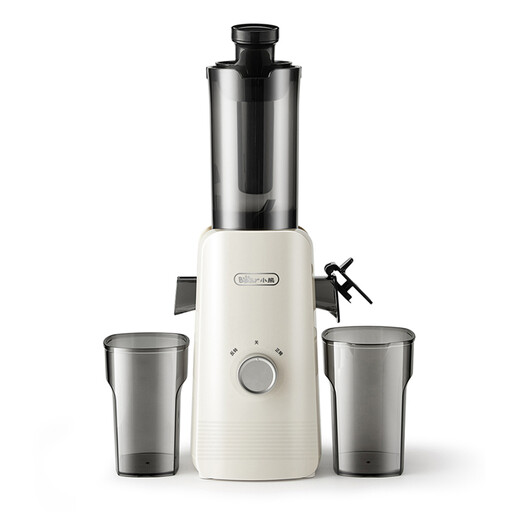
Why this product suits the profile: Its compact design and three main components make it appealing to households that prepare fresh juice occasionally and need to save space on the worktop. The product name states 1 litre, while the technical specifications list a capacity of 0.8 litres.
The 80mm opening is larger than those on many compact appliances. The differing capacity specification should be checked before purchase.
130W motor, 220–240 V operating voltage, plus juice and pulp containers included.
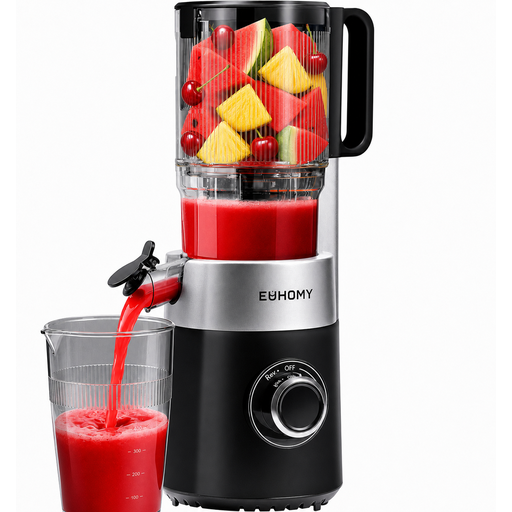
Why this product suits the profile: This model is aimed at users who want to combine a large chamber, a 135 mm feed chute and multi-stage filtration in one appliance.
The capacity and feed-chute size are clearly specified. The juice-yield claim should be treated as the manufacturer’s specification, not as a universal point of comparison.
1.8-litre capacity, 135 mm feed chute and three-stage filter system according to the product description.
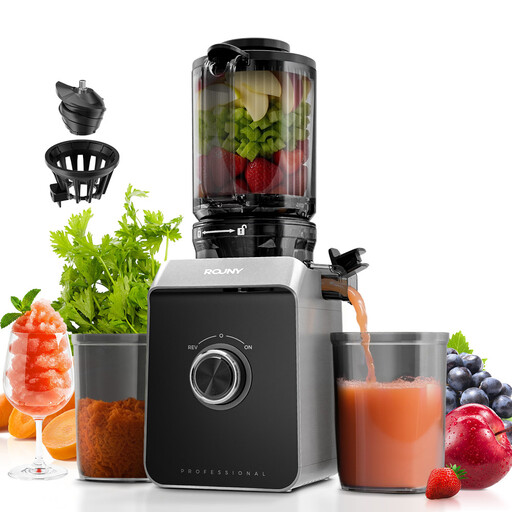
Why this product suits the profile: The large feed chute and reverse function are useful for households that regularly process different types of fruit and vegetables. According to the product description, it can also process suitable frozen fruit into an ice-like mixture.
According to the product description, the filter-free design is intended to make rinsing easier. The specified maximum noise level of 75 dB should be considered alongside your own expectations of a quiet juicer.
150W motor, 1.8-litre capacity, 130 mm feed chute and BPA-free material specification.
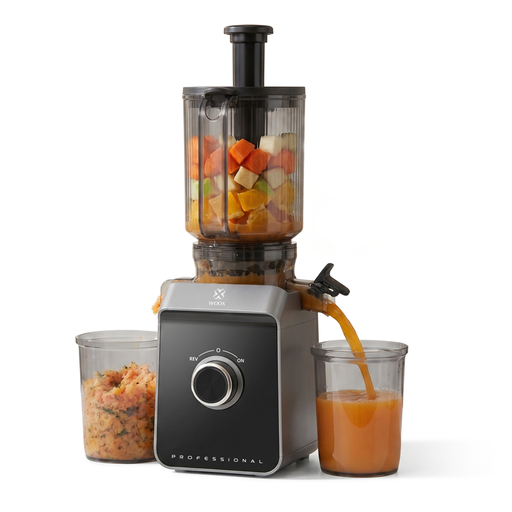
Why this product suits the profile: This model combines a compact footprint with a 1.8-litre chamber and separate containers for juice and pulp. Its operating-time specifications are relevant for regular but portioned use.
The product specifications state both the noise level and the recommended cooling break. According to the instructions, frozen fruit and ice cubes are not intended for juicing.
150W motor, less than 72 dB according to the product specification, 600ml juice container and overheating protection.
We have put together a complete, regularly updated list of products that fully meet these strict selection criteria and the safety regulations applicable in the EU.
For smooth operation, wash fruit and vegetables first and remove any unsuitable stones. Cut fibrous ingredients into smaller pieces. If a blockage occurs, the reverse function, where available, can help. If the problem persists, switch off the appliance, unplug it and only then take it apart.
Also bear the following points in mind:
Yes, these appliances are generally designed for many types of fruit and vegetables. Their suitability for specific ingredients depends on the pressing system and the user manual. Very fibrous, hard or oily ingredients may be subject to special requirements.
It is not possible to give a reliable general lifespan. This depends on how often the appliance is used, the ingredients, cleaning and compliance with the operating times. A motor with overheating protection and regular cleaning can support proper operation, but they do not replace the manufacturer’s maintenance instructions.
The models listed have power ratings of around 130 to 220 watts. Actual consumption depends on the operating time. As a slow-masticating juicer is usually operated in portions, you should consider not only the motor power but also how long you use it each day.