
Lieferung heute & morgen

Qualitätsgarantie

Willkommens-Angebote freischalten: KOSTENLOSE Lieferung | Bis zu 80 % RABATT | Kostenlose 30-Tage-JoyPlus-Testphase
App herunterladen
A slow juicer processes fruit and vegetables slowly, usually using an auger. This sets it apart from centrifugal juicers, which chop produce at high speed. But if you want to make fresh juice regularly at home, motor power and marketing claims aren’t the only things to consider. The right appliance needs to suit the quantity you want to make, your kitchen and the ingredients you like to use.
A juicer with a large feed chute can take apples, oranges and smaller pieces of vegetables. Even so, you may need to remove hard stones, stalks and peel, depending on the ingredient. A chute measuring 80 to 135 mm is handy, but it’s no substitute for checking the instruction manual.
Also check whether the manufacturer actually recommends processing whole fruit, or simply states that the appliance has a wide feed chute. Some appliances still require hard or fibrous ingredients to be cut up first.
A centrifugal juicer rated at 600 or 1,000 watts can work quickly, while a cold press juicer often needs considerably less power. Wattage mainly indicates electrical power consumption; it doesn’t automatically tell you about juice yield, noise levels or how suitable the appliance is for particular ingredients.
The pressing mechanism, permitted operating time, whether it has a reverse function, and the design of the filter or auger are more important.
Removable parts, a cleaning brush and dishwasher-safe components can make everyday use easier. However, fruit fibres can build up around fine filters and narrow outlets. If you leave cleaning until long after juicing, expect it to take more effort.
So check:
A slow juicer is generally suitable for many types of fruit and vegetables. However, soft fruit, apples, carrots, cucumbers and leafy greens all place different demands on the appliance. Ingredients with a high starch content, such as bananas or avocados, are usually unsuitable for traditional juicers, as they tend to produce purée rather than clear juice.
It’s a good idea to cut fibrous vegetables such as celery or parsley into smaller pieces. Remove stones and hard pips. Citrus fruit should generally be peeled too, as the peel can affect the flavour and put extra strain on the appliance.
A 1.8-litre juicer can be handy when you want to make several glasses in a row. Be sure to distinguish between the capacity of the pressing chamber, juice container and pulp container. A large pressing chamber doesn’t necessarily mean you can collect 1.8 litres of juice.
For a two-person household, 600 to 800 ml of juice is often enough. Families should also look for a large pulp container and a continuous feed system. This means you’ll need to stop less often during juicing.
A quiet juicer is particularly welcome in open-plan kitchens or early in the morning. However, the specific decibel rating should be listed in the product specifications, rather than described only as ‘especially quiet’. A stated rating of 60 to 72 dB gives you a much clearer idea than a vague marketing claim.
For a stainless steel juicer, check which parts are actually made of stainless steel. This often applies only to the filter, blades or pressing components, while the housing and containers are made of plastic. A stable base, a safety lock and overheating protection are also important for everyday use.
The term ‘vitamin-rich juice’ isn’t a blanket guarantee of quality. Vitamins and flavour depend on factors including freshness, storage, ingredients and how long the juice sits before you drink it. Gentle pressing can reduce foaming and heat, but it doesn’t replace proper food storage.
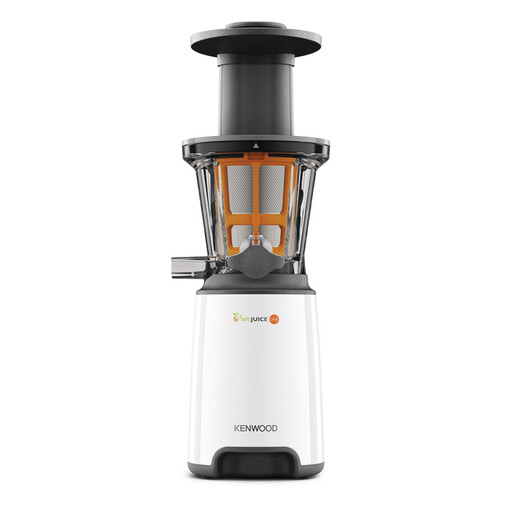
Why this product suits this type of user: This compact appliance has a 700 ml juice container, a 1.3-litre pulp container and a slim design that’s ideal for smaller kitchens.
The specifications state that it runs at 55 rpm and has a rinse function and cleaning brush. This means key convenience features are clearly set out.
Compact dimensions, anti-drip stopper and 140-watt motor, according to the product specifications.
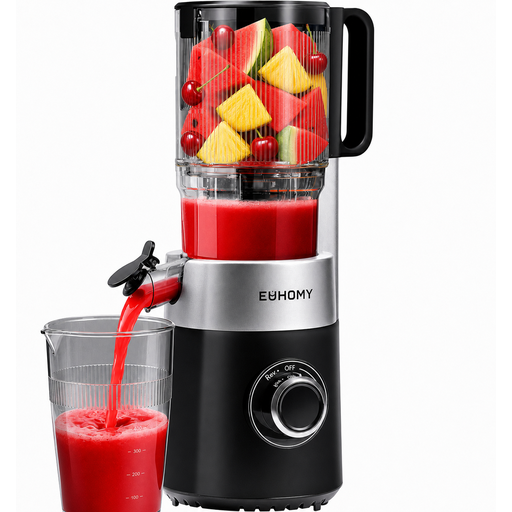
Why this product suits this type of user: The extra-wide feed chute and stated 1.8-litre capacity are designed for making larger quantities for the family.
Rather than focusing solely on high motor power, the product description specifies 220 watts, 60 dB, three cleaning steps and a filter system with several mesh sizes.
135 mm feed chute, two glasses included and stainless steel augers, according to the product specifications.
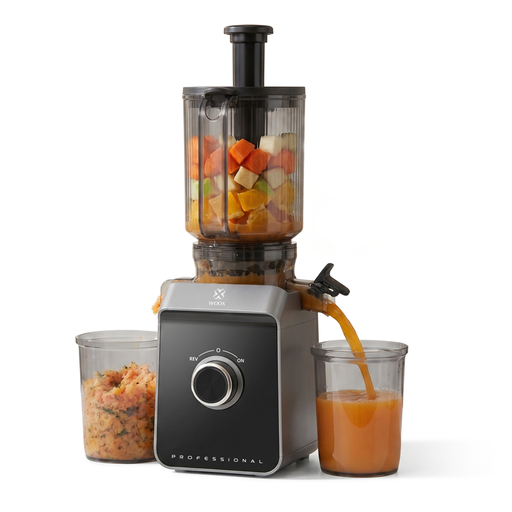
Why this product suits this type of user: The 1.8-litre pressing chamber, 130 mm feed chute and overheating protection make it a good fit for households that regularly prepare larger quantities.
The ten-minute operating limit and the need to let the appliance cool down afterwards are clearly stated. This makes it easier to plan when juicing larger quantities.
150-watt motor, stated noise level below 72 dB and removable parts that are dishwasher-safe, according to the product specifications.
We’ve put together a complete, regularly updated list of products that meet these strict selection criteria and the safety regulations in force in the EU.
Its lifespan depends on the materials, motor, cleaning and how often you use it. Stick to the permitted operating time, avoid hard stones and clean the auger and filter straight after use. Overheating protection can provide extra peace of mind, but it doesn’t replace taking breaks when making larger quantities.
There’s no one-size-fits-all answer. A slow juicer often uses less power, but takes longer to make each portion. Running costs depend on the wattage, how long you use it and your electricity tariff. The main differences often lie in the pressing method, noise levels and cleaning effort.
Yes. ‘For whole fruit’ usually refers to the size of the feed chute, not the fact that no preparation is needed. Wash your fruit and vegetables, remove hard stones and inedible peel, and cut very fibrous ingredients as directed. This can help reduce the risk of blockages.