
Lieferung heute & morgen

Qualitätsgarantie

Willkommens-Angebote freischalten: KOSTENLOSE Lieferung | Bis zu 80 % RABATT | Kostenlose 30-Tage-JoyPlus-Testphase
App herunterladen
A slow juicer processes fruit and vegetables using a slowly rotating auger. Unlike a classic centrifugal juicer, the focus is not on a high rotational speed, but on gradually crushing and pressing the ingredients. For households that want to prepare fresh juices regularly, however, juice quality and yield are not the only important factors. The feed chute, noise level, cleaning requirements and capacity all determine whether the appliance will actually be used in everyday life.
A juicer with a large feed chute can make preparation easier. However, the width alone does not indicate which ingredients can be processed without cutting. Pips, hard skins, very fibrous pieces or particularly large fruit may still cause problems. Always check the manufacturer’s instructions and cut ingredients into suitable pieces where necessary.
Claims such as “up to 99 per cent” generally refer to specific ingredients and conditions. The actual yield depends on factors including ripeness, water content, the size of the pieces and pressing time. When choosing a fruit and vegetable juicer, you should therefore also consider the pressing system, how easy the filter is to clean and whether it is suitable for fibrous ingredients.
A quiet juicer is practical in a flat or when used in the morning. However, the decibel rating should be considered under comparable conditions. A model rated at 60 dB and one rated at less than 72 dB may be described differently by the manufacturer; the actual perceived noise also depends on the surface, ingredients and operating time.
A chute measuring around 130 to 135 mm can save time when processing apples, pears or larger pieces of vegetables. Nevertheless, hard pips and unsuitable parts must still be removed. A whole-fruit juicer should only be marketed as such if the instructions explicitly state which fruits may actually be added whole.
A juicer with a 1.8 l capacity is generally suitable for several portions. Check whether the stated capacity refers to the pressing chamber, the juice container or the total capacity. Some models have separate containers for juice and pulp. This reduces interruptions, but also means there are more individual parts to wash.
An easy-to-clean juicer should be possible to take apart without complicated tools. Filter-free designs can make rinsing easier, while conventional filter screens often require a brush. Clear material information is helpful for plastic components. When buying a BPA-free slow juicer, this feature should be stated explicitly in the product details rather than inferred from a general advertising claim.
The following points are also important for everyday use:
The following models are assigned to different everyday situations based on specific product details. The stated values come from the respective product descriptions.
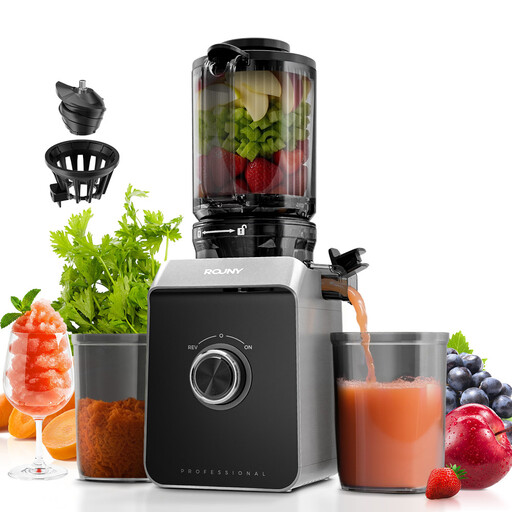
Why this product suits the profile: The 130 mm feed chute and 1.8 l capacity support daily preparation without the need for constant refilling. The product details also specify a BPA-free design.
According to the product description, the filter-free design is intended to make rinsing easier and reduce blockages. The reverse function can be used if ingredients become stuck.
1.8 l capacity, reverse function, 50 revolutions per minute and suitability for fruit, vegetables and frozen fruit for dessert-style preparation.
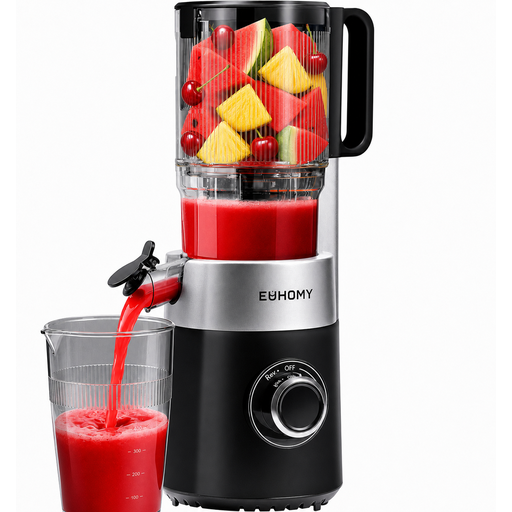
Why this product suits the profile: The combination of a 220 W motor, a stated noise level of 60 dB and a triple filtration system is aimed at users who value clearly defined technical specifications and a consistent juice texture.
According to the product description, the 135 mm opening reduces preparation time. The stated noise level and filtration system make the advertised features easier to compare with those of other models.
135 mm XXL feed chute, 1.8 l capacity, triple filtration system and two included glasses. The juice yield is stated by the manufacturer as “up to 99 per cent”.
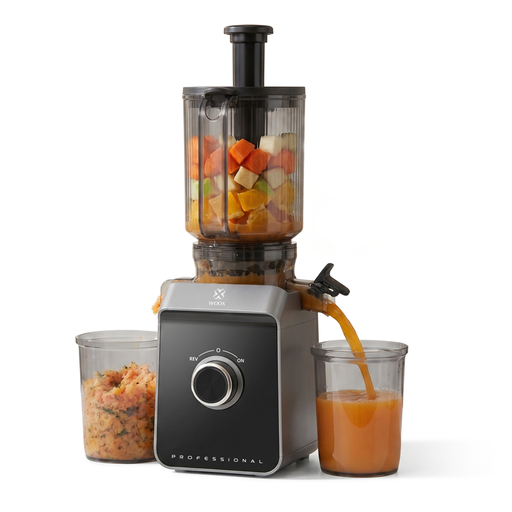
Why this product suits the profile: The compact design, 1.8 l pressing chamber and overheating protection are useful for regular use in a family household. The 130 mm feed chute can make preparation easier.
The product description specifies a maximum uninterrupted operating time of ten minutes, followed by a rest period. This makes it easier to adapt use to several portions.
150 W copper motor with overheating protection, stated noise level below 72 dB, 600 ml juice cup and 836 ml pulp container.
Wash fruit and vegetables before juicing and remove hard pips, unsuitable skins and ingredients that are not approved for use. Fibrous foods such as celery should be cut into smaller pieces in accordance with the instructions. Add ingredients slowly and only use the pusher if it is designed for the appliance in question.
After use, rinse the removable parts promptly. Pulp residue dries quickly and makes cleaning more difficult. Do not immerse the motor unit in water. Also observe the operating limits for the model in question, particularly when making several juices consecutively.
We have put together a complete, regularly updated list of products that fully meet these strict selection criteria and the safety regulations applicable in the EU.
That depends on the intended operating time, container size and cleaning effort. For several people, a pressing chamber or juice container of around 1.8 l or more and a larger feed chute are practical. If you use the appliance frequently, you should also look for easy dismantling and overheating protection.
It is not possible to give a reliable blanket lifespan. This is influenced by material quality, frequency of use, suitable ingredients and care. Follow the operating and rest times in the instructions, remove stuck ingredients using the reverse function and clean the removable parts after every use.
Power consumption depends on the motor rating and the actual operating time. An appliance rated at 150 or 220 W uses comparatively little energy per use when running for short pressing cycles. For a realistic estimate, you can multiply the wattage by the operating time. The motor rating is therefore not the only important factor; you should also consider how long the electric juicer needs to run to prepare your desired quantity.