
Lieferung heute & morgen

Qualitätsgarantie

Willkommens-Angebote freischalten: KOSTENLOSE Lieferung | Bis zu 80 % RABATT | Kostenlose 30-Tage-JoyPlus-Testphase
App herunterladen
Choosing a slow juicer is often the first step toward a more health-conscious diet. The idea of preparing fresh, nutrient-rich juices right in your own kitchen is appealing. However, the market is flooded with appliances whose marketing claims often fall short in practice. Many well-intentioned purchases end up as dust collectors in the kitchen cabinet. As your Joybuy Product Recommendation Officer, I'll help you identify the typical pitfalls and find a model that truly fits your daily routine.
Before you invest, you should be aware of the design flaws that can quickly render a good appliance useless. These three points most frequently lead to user frustration:
To avoid these traps, you should focus on three core technical features. These determine whether a slow juicer will be an asset or a burden to your kitchen.
A slow juicer is also known as a cold press juicer. Unlike centrifugal juicers, which operate at high speeds (often over 10,000 RPM) and generate heat, a slow juicer uses a slowly rotating auger (typically 50–80 RPM).
The user-friendliness in daily life largely depends on two design aspects:
A robust motor is the heart of every slow juicer. A pure copper motor is considered an indicator of durability and stable performance, even with hard produce like carrots or beetroot. At the same time, the appliance should be a quiet juicer (noise level below 75 dB), so that morning prep doesn't wake up the whole family.
Some models also offer the ability to make fruit sorbet with the juicer. For this, frozen fruits are pressed through a special attachment, creating a sorbet-like dessert with no added sugar. This versatility makes the appliance a year-round asset to the kitchen.
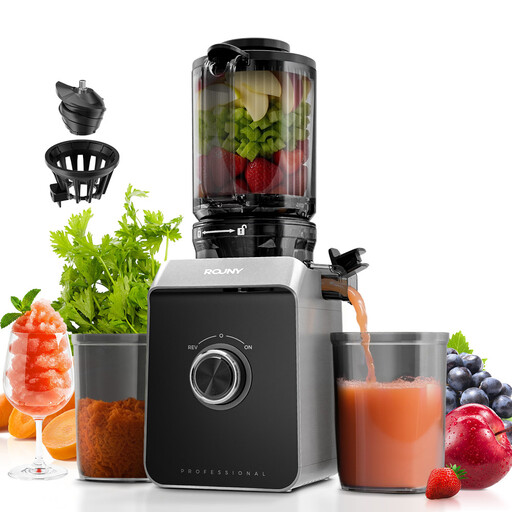
Why this model is a great fit: This appliance is designed for people who value a healthy diet but don't have time for complex preparation and cleaning. It solves the biggest hurdles of daily juicing and also offers a useful extra function.
The 130 mm feed chute bypasses the "preparation trap," as whole apples can be processed directly. The filter-free design solves the problem of tedious cleaning—the parts can be simply rinsed off.
High juice yield thanks to cold press technology. Versatile, as the device is also suitable for making fruit sorbet from frozen fruits. Stable operation due to a pure copper motor.
A good juicer is only half the battle. For nutrient-rich and flavourful juices, you need high-quality, fresh ingredients. Discover our carefully selected range.
1. What's the fastest way to clean a slow juicer? The key is to rinse the parts immediately after use before the fruit residue dries. Models with a filter-free design have a clear advantage here, as they have no pores that can clog. A quick rinse under running water is usually sufficient. With many devices, it also helps to briefly activate the reverse function before disassembly to remove excess pulp from the auger.
2. Can you really make ice cream with a slow juicer? Yes, certain models are designed for it. They use slightly thawed, frozen fruits like bananas, mangoes, or berries. These are pressed through a special attachment without a sieve. The result is a creamy mixture with the consistency of sorbet—a simple way to make a healthy dessert without added sugar.
3. What is the difference between a slow juicer and a centrifugal juicer? The main difference lies in the technology. A slow juicer (cold press juicer) slowly crushes and presses fruits and vegetables with an auger, which preserves nutrients and delivers a high juice yield. A centrifugal juicer shreds the ingredients with a fast-spinning cutting disc and flings the juice outwards through a sieve. This process generates more heat and oxygen exposure, which can lead to lower nutrient density and a lower juice yield, especially with leafy greens.