
Lieferung heute & morgen

Qualitätsgarantie

Willkommens-Angebote freischalten: KOSTENLOSE Lieferung | Bis zu 80 % RABATT | Kostenlose 30-Tage-JoyPlus-Testphase
App herunterladen
Choosing a slow juicer is often the first step toward a more nutrient-rich diet. Fresh, cold-pressed juices promise vitality. However, the market is flooded with appliances whose marketing promises quickly fade in practice. Many well-intentioned purchases end up as dust collectors in the kitchen cabinet. It doesn't have to be this way. As your Joybuy Product Recommendation Officer, I'll show you which critical features to look for and how to avoid the typical pitfalls to find a device you'll actually use every day.
Before we talk about models, let's shed light on the three most common reasons why juicers are abandoned after a short time. Recognising these problems is the key to making the right choice.
To avoid the traps mentioned above, focus on three technical features that directly impact user convenience and efficiency.
A whole fruit juicer is not an exaggeration but a crucial convenience feature. Pay attention to the diameter of the feed chute. While standard models often have an opening of only 65-75 mm, models with a juicer with a large feed chute (130 mm or more) allow you to process whole apples or large pieces of vegetables without pre-cutting. This drastically reduces preparation time and makes the juicer suitable for everyday use.
The term Cold Press Juicer (or Slow Juicer) describes the operating principle. Instead of shredding fruits and vegetables at high speed, an auger slowly and powerfully crushes them against a sieve. This process operates at low speeds (typically 50-80 RPM), which has two advantages:
An easy-to-clean juicer is worth its weight in gold. Modern devices increasingly rely on filter-free designs or coarse strainers that can be rinsed under running water in seconds. Check how many parts the device consists of and whether they are dishwasher-safe. A small number of robust, easy-to-assemble parts is an indicator of a well-thought-out design.
Based on these criteria, we have identified some models that are particularly suitable for different user profiles.
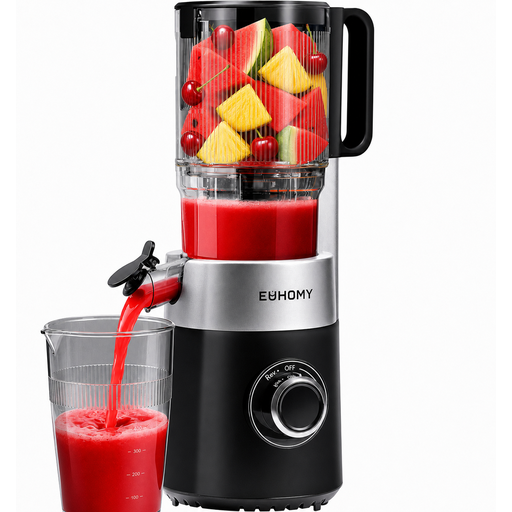
Why This Fits Their Persona: Ideal for families who need to get things done quickly in the morning. The large capacity and huge feed chute allow for making juice for several people in one go, without constant refilling or pre-cutting.
The 135 mm feed chute completely bypasses the prep-work trap. Whole fruits can be processed directly, which massively lowers the barrier to use.
High juice yield thanks to a 7-stage extraction process. The large 1.8-litre capacity is perfect for family needs. The quiet 60 dB operation is non-disruptive.
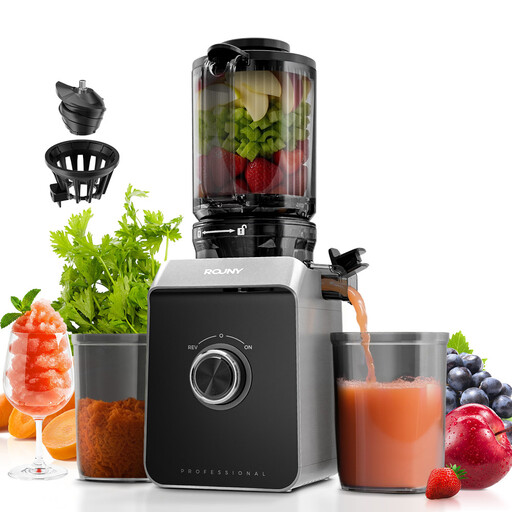
Why This Fits Their Persona: Perfect for health-conscious individuals who value minimal effort. This device combines the benefits of a large feed chute with an innovative cleaning system for maximum everyday usability.
The filter-free design is the direct answer to the cleaning trap. Instead of tediously scrubbing a fine-mesh sieve, simply rinsing the parts under water is sufficient.
Combines a 130 mm feed chute with the filter-free design. The additional function for making sorbet from frozen fruits offers real added value.

Why This Fits Their Persona: A great option for anyone who wants to try juicing while prioritising speed and a smaller budget. This centrifugal model delivers juice quickly and is easy to operate.
The device addresses the cleaning trap with a filter-free structure and disassemblable parts. It's a compromise that prioritises speed over maximum juice yield.
Very fast juicing due to centrifugal technology. The compact, vertical design is space-saving, and the automatic pulp separation simplifies the process.
We have compiled a complete, up-to-date list of products that fully meet these strict selection criteria and German safety regulations.
The most effective method is to clean it immediately after use. Rinse all removable parts directly under warm water before fruit residues harden. Use the included brush to clean the sieve (if any). Models with a filter-free design or few, dishwasher-safe parts significantly reduce the effort.
The main difference lies in the technology. A centrifugal juicer shreds fruits and vegetables with a fast-rotating blade (several thousand RPM) and flings the juice through a sieve. This is fast but generates more heat and noise. A slow juicer (cold press juicer) slowly crushes the ingredients with an auger (approx. 50-80 RPM). This method is gentler, quieter, and typically results in a higher juice yield and less foam.
Yes, that is one of the strengths of slow juicers. Their powerful, high-torque pressing mechanism is ideally designed to efficiently juice fibrous and hard produce like carrots, beetroot, ginger, or celery. With centrifugal juicers, this can be more difficult and may result in a lower yield.