
Lieferung heute & morgen

Qualitätsgarantie

Willkommens-Angebote freischalten: KOSTENLOSE Lieferung | Bis zu 80 % RABATT | Kostenlose 30-Tage-JoyPlus-Testphase
App herunterladen
Freshly squeezed juice is a cornerstone of a healthy lifestyle. But the reality of daily juicing often looks different: tedious chopping of fruits and vegetables, complicated cleaning, and a disappointingly low juice yield in the end. Especially when searching for a slow juicer with a wide feed chute, there are several pitfalls that can quickly turn your purchase into a bad investment.
As your Joybuy Product Recommendation Officer, I'll help you identify the crucial features and distinguish marketing promises from genuine benefits. This guide will show you what to look for to find an appliance that truly makes your daily routine easier.
Many appliances promise convenience, but their weaknesses are often hidden in the details. Pay attention to these three points to avoid disappointment:
To avoid the pitfalls mentioned above, you should check three technical features before buying. These significantly define the performance and user-friendliness of a cold press juicer.
The decisive factor for quick preparation is the feed chute. Look for a diameter of at least 80 mm, ideally even over 100 mm. This allows for processing whole small to medium-sized apples, peeled oranges, or larger pieces of vegetables without pre-cutting. A round opening is more advantageous than a narrow, elongated shape.
Cleaning is the most common reason a juicer ends up unused in a cupboard. An easy-to-clean juicer forgoes traditional, fine-mesh sieves. So-called filter-free systems instead use components made of robust plastic or stainless steel with larger openings that minimize fiber adhesion. These parts can usually be cleaned in a few seconds under running water.
A cold press juicer operates at low speeds (typically 40–80 RPM) to minimize oxidation and preserve nutrients. A high-quality copper motor ensures quiet and stable operation, even when processing hard vegetables like carrots or beets. Some models also offer additional functions that go beyond simple juicing. For example, a slow juicer for ice cream can process frozen fruits into a healthy sorbet, making it a more versatile kitchen appliance.
Here are two models that offer specific solutions for common user profiles and meet the criteria mentioned above.
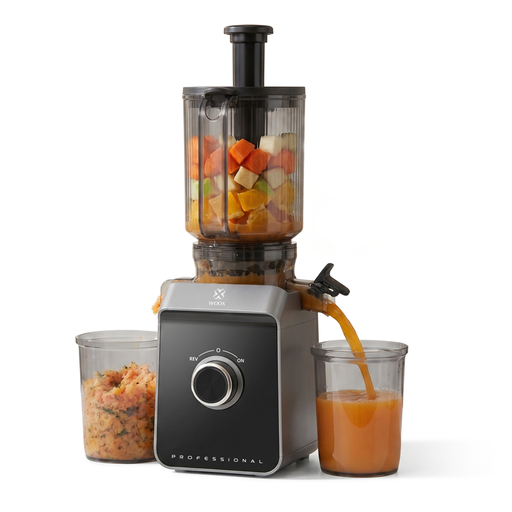
Why it's a great fit: Ideal for families who need to get things done quickly in the morning. The extremely wide feed chute and easy cleaning save valuable time, while the quiet motor won't disturb the rest of the family.
With a 130 mm diameter, this model delivers on the promise of a true XXL feed chute, avoiding the trap of constant pre-cutting. The "Easy Clean" design directly targets and prevents the cleaning trap.
Very large ?130mm feed chute for whole fruits. Quiet operation at under 72 dB, according to the manufacturer.
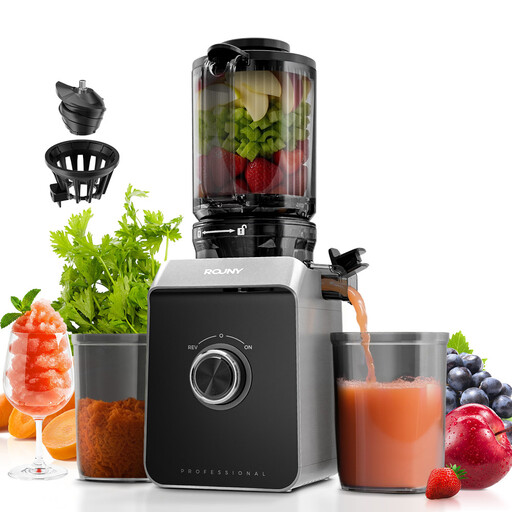
Why it's a great fit: For anyone who wants more than just juice. The additional function for making fruit sorbet from frozen fruits turns this appliance into a versatile tool for healthy desserts and snacks.
The explicitly advertised filter-free design directly addresses the cleaning trap. The 130 mm feed chute also ensures minimal prep time here.
Multifunctional: Can be used as a juicer for fruits and vegetables as well as for making fruit sorbet. BPA-free materials according to the manufacturer.
We have compiled a complete, up-to-date list of products that fully meet these strict selection criteria and German safety regulations.
1. What's the fastest way to clean a filter-free juicer? Cleaning is usually straightforward. Disassemble the few removable parts immediately after use and rinse them under lukewarm, running water. Most fruit residues can be removed this way without scrubbing. For more stubborn residues, such as from beets, a soft brush can be helpful. The motor housing should only be wiped with a damp cloth.
2. Can slow juicers really make ice cream? Yes, some models are designed for this. This function uses the masticating auger to process slightly thawed, frozen fruits (like bananas, berries, or mangoes) into a smooth, sorbet-like consistency. It's important to only use seedless fruits and follow the manufacturer's instructions to avoid damaging the appliance.
3. How does the juice yield of a cold press juicer compare to a centrifugal juicer? A cold press juicer (slow juicer) generally achieves a higher juice yield than a centrifugal juicer. The slow, powerful pressing action extracts more liquid from the cells of fruits and vegetables. The result is drier pulp and thus more juice from the same amount of ingredients. This is especially true for leafy greens like spinach or kale, where centrifugal juicers are often less efficient.