
Lieferung heute & morgen

Qualitätsgarantie

Willkommens-Angebote freischalten: KOSTENLOSE Lieferung | Bis zu 80 % RABATT | Kostenlose 30-Tage-JoyPlus-Testphase
App herunterladen
A small 2-seater sofa should be comfortable without overwhelming the room. But in flats, student accommodation, bedrooms and offices, unclear measurements and bold comfort claims can easily lead to the wrong purchase. It’s not just about looks or price: the footprint, seat height, cushioning and actual assembly involved all matter.
A sofa that’s 160 or 165 cm wide may fit into an alcove, but you’ll also need to allow for the armrests, space behind the sofa and room to move around it. Depth matters too: a 2-seater with a depth of 95 cm takes up considerably more room than a mini sofa that’s around 63 to 81 cm deep.
Before you buy, measure:
Terms such as cloud sofa, lounge sofa and boneless sofa usually describe the shape or feel of the seat, rather than a consistent technical standard. A frameless model may feel soft and flexible, while a sofa with a wooden frame, springs or pocket springs can offer a more defined seat.
Look for specific details about foam density, frame material, seat height and seat width. A specification such as 32D foam is more informative than a general promise of comfort. It tells you something about the foam’s density, but doesn’t tell you everything about the overall construction.
A sofa that requires no assembly can be a practical choice for renters, students or anyone who moves frequently. Vacuum-packed models often need 24 to 72 hours after unpacking to regain their intended shape. A traditional loveseat with legs and a frame, on the other hand, will require tools and time to assemble.
The number of parcels matters too. A large L-shaped sofa may arrive in several parcels, which aren’t necessarily delivered at the same time.
A compact sofa for a small room should not only fit the available space; it should also let you sit comfortably. Pay particular attention to:
A sofa for a flat or bedroom can be compact, but it shouldn’t be so deep that it blocks cupboards, desks or doors.
When choosing between chenille, corduroy, faux leather and microfibre, consider how you’ll use the sofa and how much care it will need. Chenille and corduroy have a textured finish; according to product descriptions, faux leather can often be wiped clean with a damp cloth. Fabric upholstery usually needs regular vacuuming.
If you’re considering a frameless sofa, check the foam density and weight capacity. For a model with a wooden frame, the frame, feet and connectors are all worth checking. The manufacturer’s stated static weight capacity applies only when the sofa is used as intended and must not be exceeded.
A mini sofa that requires no assembly, or a modular sofa, can work well in a rented home or a space that changes frequently. If you have children or pets, consider rounded corners, easy-care upholstery and a stable base. Removable seat cushions can make cleaning easier, but they’re no substitute for following the manufacturer’s care instructions.
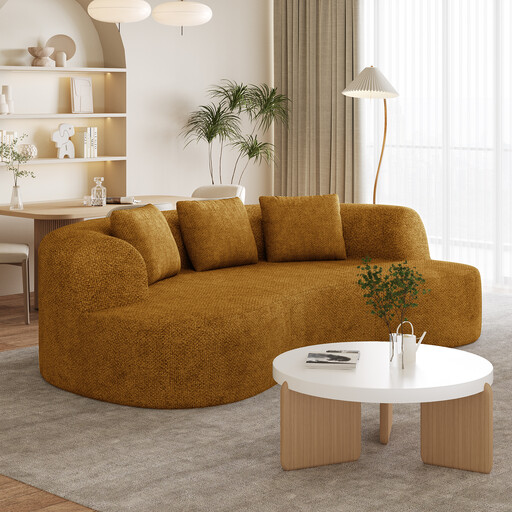
Why it suits this buyer: Its compact dimensions make it a good fit for small living rooms, flats and alcoves. According to the product description, it arrives ready to use with no assembly required and is available in chenille upholstery.
The product description gives specific dimensions, a static weight capacity of 270 kg and a recovery time of around 24 to 72 hours after unpacking.
168 cm wide, chenille upholstery, three scatter cushions and no assembly required, according to the seller.
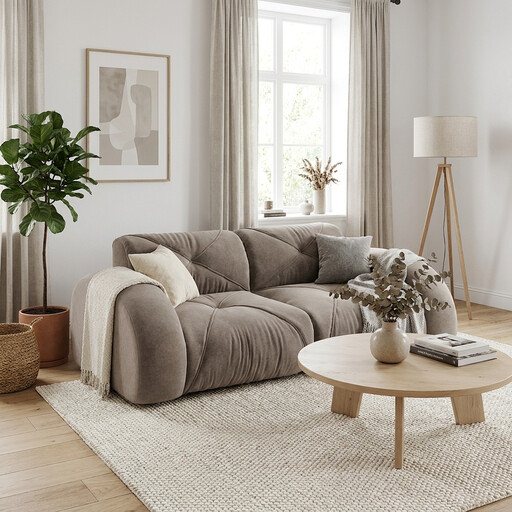
Why it suits this buyer: Its modular design is ideal for households looking for flexible seating in a living room or multifunctional space. The chenille upholstery and a single block of 32D foam are clearly specified.
The description states a maximum weight capacity of 200 kg per seat, as well as a recovery time of around 72 hours after opening the packaging.
Modular design, a single block of 32D foam, chenille upholstery and rounded corners, according to the product details.
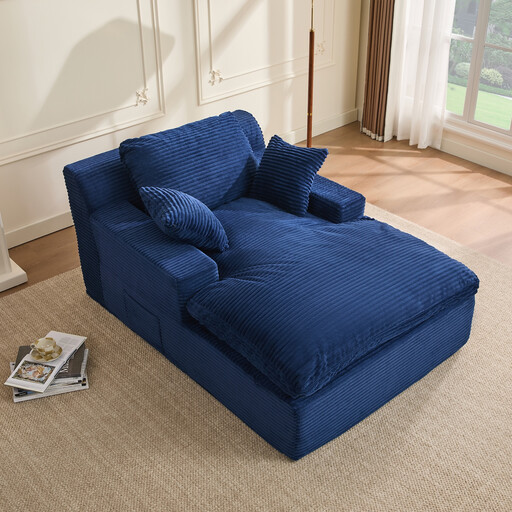
Why it suits this buyer: This model combines a place to sit, lounge and sleep occasionally. It’s designed for anyone looking for a sofa for a bedroom, studio or flat that can be used in more than one way.
The product description gives the unfolded dimensions as 160 × 110 × 40 cm, a seat height of 48 cm and a recovery time of around 72 hours.
No assembly required, according to the seller; corduroy upholstery, side pockets on the armrests and a bed function.
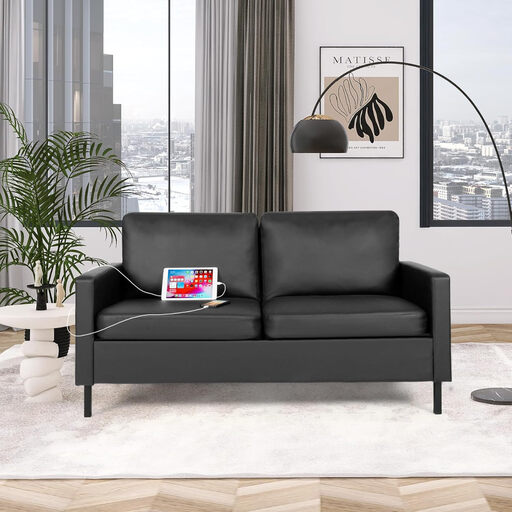
Why it suits this buyer: At 143 cm wide, it’s a good option for bedrooms, offices, flats and small living rooms. USB and USB-C charging ports are handy when you’re sitting at a desk or relaxing in a cosy corner.
The product details specify dimensions of 143 × 63 × 86 cm, a seat height of 42.5 cm, a wooden frame and a maximum weight capacity of 263 kg.
Very compact width, two charging ports and a choice of faux leather or microfibre upholstery, according to the product description.
We’ve put together a complete, regularly updated list of products that meet these strict selection criteria and fully comply with the safety regulations in force in the EU.
As well as allowing for the sofa’s footprint, make sure there’s enough room to walk past it. A useful rule of thumb is to leave around 60 cm in front of frequently used areas such as doors or cupboards. If the sofa extends, remember to measure its depth when fully opened too.
Its lifespan depends on the frame, upholstery, fabric, how often it’s used and how well it’s cared for. A specific number of years isn’t meaningful without consistent conditions of use. Check the stated weight capacity, avoid putting too much weight on one spot and follow the cleaning and assembly instructions.
A sofa bed can provide an extra sleeping space for guests or occasional use. Whether it’s suitable for everyday sleeping depends on the sleeping area, cushioning and the manufacturer’s guidance. Before you buy, check the unfolded dimensions and the quality of the sleeping surface.