If you only need to freeze a few bread rolls, a separate chest freezer is rarely worthwhile: it takes up extra space and uses electricity continuously. If you regularly freeze larger quantities, first check the full space available, including clearance from the wall and room to open the lid. Then compare usable capacity with annual energy consumption in kWh. The consumer advice centre recommends choosing freezer capacity to suit your actual needs.
Who is a small chest freezer suitable for?
Households with limited floor space
You need extra freezer space, but can only spare a small area of floor. For the Exquisit GT100-050E in white, check the depth including wall clearance as well as the appliance depth. Make sure you factor the full space required into your plans.
People who regularly stock up on bread rolls
If you often freeze several portions, you’ll want to find the rolls you need quickly. Freezer-safe packaging and labels make it easier to identify each portion. The Federal Centre for Nutrition recommends using suitable bags or containers.
Energy-conscious buyers looking for a second appliance
If you need extra freezer space, compare usable capacity and the stated annual energy consumption in kWh. The consumer advice centre points out that an oversized freezer can use more electricity than necessary. The EU energy label lists details including energy consumption and capacity.
What should you look for when buying?
Use your existing freezer compartment
A good fit if: it can hold a few portions of bread rolls and you don’t plan to stock up on larger quantities.
The trade-off: You won’t need an additional freestanding appliance, but you’ll have to make do with the space you already have.
Compact chest freezer
A good fit if: you regularly freeze larger quantities of bread rolls or other food.
The trade-off: The extra capacity needs its own space and uses electricity continuously. You’ll also need to be able to open the lid fully.
Upright freezer
A good fit if: front access works better in your space or makes it easier to sort smaller portions regularly.
The trade-off: This appliance also needs space and uses electricity. Compare the figures for the specific model with your needs.
| Buying priority |
What to check |
Who is this particularly important to? |
| A suitable place for the appliance |
Measure the width, depth and height, clearance around the appliance, the route it will take into your home, and the space above the lid for the specific model. |
If I can only spare a little floor space in a small kitchen, I also need to allow for wall clearance and opening the lid. Around 33% of consumers focus on finding a space that will genuinely work. |
| Enough usable capacity |
Estimate how much room your usual packaged portions of bread rolls and any other planned frozen food will need, then compare usable capacity. |
If I regularly freeze bread rolls, I want enough space for my portions without choosing an unnecessarily large appliance. Around 27% of consumers put the amount they can store first. |
| Ongoing electricity use |
Compare annual energy consumption in kWh and usable capacity on the energy label. For a personal estimate of running costs, use your own electricity tariff. |
For an additional appliance that runs continuously, I want to compare its stated annual energy consumption with my tariff. Around 20% of consumers prioritise ongoing electricity use. |
| Access and organisation |
Check whether baskets are included, and package and label bread rolls in freezer-safe portions. |
If I take out individual portions frequently, I want to store them separately and find them easily. Around 20% of consumers prioritise access and organisation. |
Avoid common buying mistakes
-
Measuring only the appliance width
You’ll need to allow extra room for wall clearance and opening the lid. The exact requirements depend on the model.
Measure the full space available and the route the appliance will take into your home, then check both against the specifications for the model you’re considering.
-
Buying a large chest freezer just in case, when you only need to freeze a few bread rolls
A larger appliance takes up more space and may use more electricity than necessary if you don’t need the capacity. The consumer advice centre recommends matching freezer capacity to your needs.
First check whether your existing freezer compartment can hold your usual portions.
-
Looking at the energy efficiency rating or annual consumption in isolation
The stated annual energy consumption in kWh is useful when comparing specific appliances, but actual consumption can vary depending on where and how the appliance is used.
Compare the kWh per year figures on a like-for-like basis and use your own electricity tariff to work out what they mean for you.
Notable brands and model features
Exquisit
The GT100-050E in white is a freestanding chest freezer with 99 l of usable capacity.
- Exquisit gives the dimensions as 54.5 × 83.5 × 48 cm (W × H × D), with energy consumption of 169 kWh/year and a depth of 58 cm including wall clearance. These are manufacturer specifications, not independent measurements.
- If space is tight, allow for the stated depth including wall clearance, as well as room to open the lid.
Amica
According to Amica, the GT 311 105 W is a chest freezer with a capacity of 99 l.
- Amica gives the dimensions as 54.5 × 83.5 × 47.6 cm and the energy efficiency rating as E.
- The appliance dimensions alone don’t show the full space required. Check the model-specific clearance instructions in the manual before installation.
Bomann
The GT 7355 is a freestanding chest freezer with 100 l of usable capacity and a removable basket.
- Bomann gives energy consumption as 135 kWh/year, noise level as 40 dB and freezing capacity as 4.5 kg/24 h.
- The stated appliance depth of 55 cm is greater than the published dimensions for the Exquisit and Amica models considered here. This is a comparison of manufacturer specifications, not a practical test.
Beko
Beko lists the CF100EWN as a freestanding chest freezer.
- Beko gives the freezer capacity as 98 l, the width as 54.5 cm, the depth as 54.5 cm and the energy efficiency rating as E.
- As the model page title states 100 l, use the listed freezer capacity rather than the rounded figure in the title when comparing models.
Joybuy product selection
This selection includes compact chest freezers for regular stock-ups, as well as an upright freezer for when front access is a better fit for your space.
 No image available
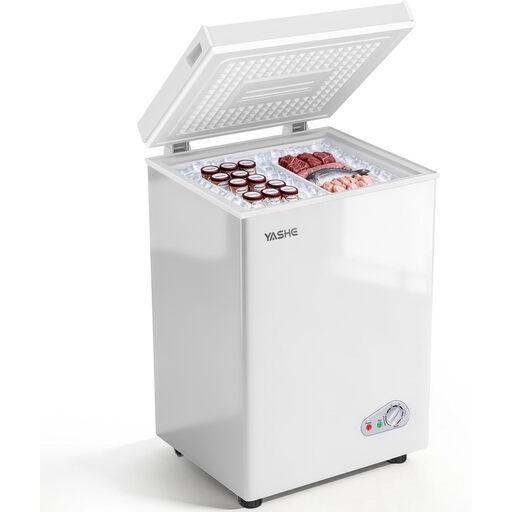
YASHE BC-100Q-EU chest freezer, 100 l
For regular portions of bread rolls, if you’d like to keep them in separate baskets.
Freestanding model with a 100 l capacity, two removable baskets and six temperature settings.
As a chest freezer, it needs an accessible spot with room to open the lid.
View at Joybuy
 No image available
AUCMA chest freezer, 141 l, convertible
For regular, larger stock-ups, if you’re looking for more usable capacity than a smaller model offers.
Switches between fridge and freezer modes. Specifications include a capacity of 141 l, energy efficiency rating E, seven temperature settings, a removable basket and a drain for defrosting.
Check that there’s enough space for the appliance and to open the lid in your kitchen.
View at Joybuy
 No image available
AUCMA chest freezer, 95 l, convertible
For portions of bread rolls and other food, if a removable basket would help you keep things organised.
Switches between fridge and freezer modes. Specifications include a capacity of 95 l, energy efficiency rating E, seven temperature settings, a removable basket and a drain for defrosting.
As this chest freezer opens from the top, you’ll need to allow space for the lid.
View at Joybuy
 No image available
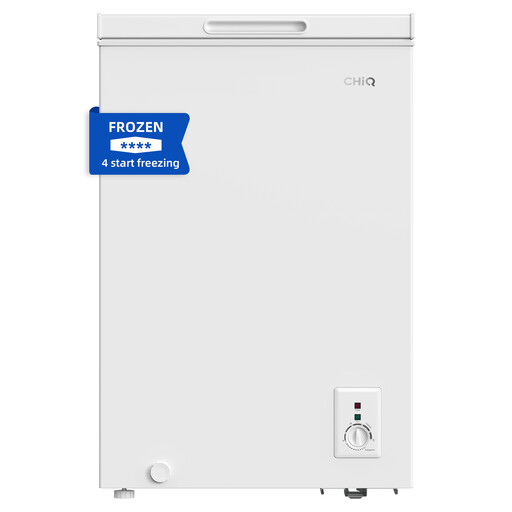
CHiQ chest freezer, 99 l, 4-star freezing
For stocking up on bread rolls, if you’d like to consider a model with a wire basket to help keep things organised.
Specifications include a capacity of 99 l, 4-star freezing, energy efficiency rating E, a wire basket and a floating door.
Compare the full space required with the space available, and allow room to open the freezer.
View at Joybuy
 No image available
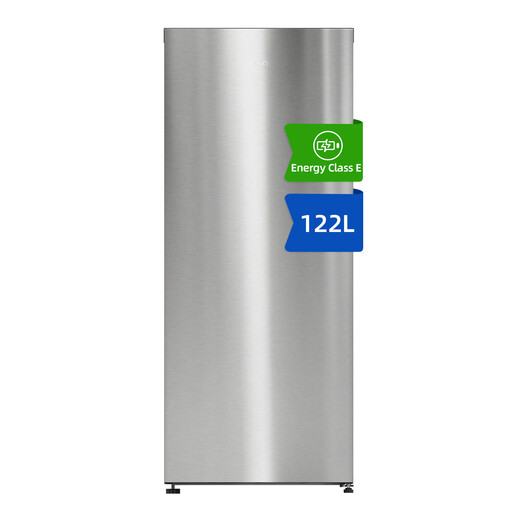
CHiQ JR122WSD upright freezer, 122 l
An alternative to a chest freezer if an upright model is a better fit for your space.
Specifications include a capacity of 122 l, 4-star freezing, a convertible fridge mode, No Frost, Multi Airflow, a noise level of 39 dB and energy efficiency rating E.
Compare the dimensions and stated energy consumption of the specific model with your needs.
View at Joybuy
Frequently asked questions
What temperature is best for frozen bread rolls?
The consumer advice centre recommends −18 °C as the ideal temperature for freezers. The Federal Centre for Nutrition confirms that bread rolls can be frozen. Use freezer-safe packaging and label each portion.
Are the external dimensions enough to check whether a chest freezer will fit in my kitchen?
No. You should also follow the installation instructions for the specific model and make sure the lid can be opened freely. For the Exquisit GT100-050E in white, for example, Exquisit gives an appliance depth of 48 cm and a depth of 58 cm including wall clearance.
How can I estimate the ongoing electricity cost?
Multiply the kWh/year figure on the EU energy label by your own electricity tariff per kWh. This gives you an estimate based on the stated appliance figure. Installation and use can affect actual energy consumption.
How can I make portions of bread rolls easier to find in the freezer?
Pack the rolls in individual portions in freezer-safe bags or containers, and label them. The Federal Centre for Nutrition recommends using labelled film, bags or freezer containers.


