Batch cooks with limited floor space
If you regularly cook several portions in advance, make sure the freezer and its open lid will fit in your small kitchen.


A small chest freezer could be a good investment if you regularly freeze several portions of cooled vegetable soup and have room for the appliance and its open lid. For individual portions, your existing freezer compartment may be enough. If you’re considering an additional appliance, compare its footprint, usable capacity, freezing capacity and ongoing electricity consumption.
If you regularly cook several portions in advance, make sure the freezer and its open lid will fit in your small kitchen.
If you only freeze the odd leftover portion, first check whether your existing freezer has enough room.
If you need extra freezer space, compare the stated annual energy consumption with the capacity and how you plan to use it.
A good fit if: you regularly freeze several portions of cooled soup at once and have enough floor space and clearance above the lid.
Consider: An additional appliance takes up space and uses electricity continuously. The capacity in litres alone won’t tell you how many of your containers will fit inside.
A good fit if: you only freeze a few portions occasionally and your existing freezer has enough room for them.
Consider: You won’t need another freestanding appliance, but you’ll have to make do with the available space when freezing larger batches.
A good fit if: a chest freezer isn’t practical because of the space available or the room needed to open the lid, and you want to store individual portions separately for easy access.
Consider: Compare the design and annual energy consumption of specific models rather than assuming one type will always use less electricity.
| What matters | What to check before buying | Who should pay particular attention |
|---|---|---|
| Floor space and lid clearance | Check the width, depth and height, delivery route, and clearance above the open lid for the specific model. | If I need to fit a chest freezer into a small kitchen, I also need to consider the delivery route and space above the lid. Around 36% of consumers say floor space is their main concern. |
| Portions and freezing capacity | Compare the dimensions and number of containers with the internal space and basket. Check the freezing capacity in kg/24 h on the product data sheet. | If I want to freeze several already-cooled portions at once, I check the container sizes and freezing capacity rather than just the number of litres. Around 29% of consumers say batch size is their main concern. |
| Energy consumption | Compare the kWh/year and usable capacity of specific models. Calculate the running cost using your own price per kWh. | If the extra freezer will be running all the time, I want to weigh up its annual energy consumption and usable capacity against my electricity tariff. Around 21% of consumers say ongoing electricity costs are their main concern. |
| Access and noise | Check the interior and basket, and compare the noise rating in dB(A), particularly if the appliance will be near your living area. | If I’ll be taking out individual portions often, or the appliance will be near my living area, organisation and noise levels matter to me. Around 14% of consumers prioritise access and noise. |
The usable capacity won’t tell you whether your soup containers will fit or be easy to take out.
Measure the space, delivery route and clearance above the open lid. Also check how your containers fit inside the specific model.
The energy rating alone doesn’t show the annual energy consumption of a specific appliance, so it isn’t enough to calculate your running costs.
Compare the stated annual energy consumption with the capacity you need. Calculate the cost using the consumption in kWh/year and your own electricity tariff.
Liquid soup expands as it freezes, so a completely full container may split.
Verbraucherzentrale recommends filling containers with liquid food to only three-quarters full. Freeze the soup in portions in suitable containers and label them.
A damaged container could leak soup and contaminate other food.
Amica lists the GT 311 105 W chest freezer as having a 99 l capacity and external dimensions of 54,5 × 83,5 × 47,6 cm.
The Exquisit GT100-010E white is described as having a removable basket and external dimensions of 54,6 × 85,4 × 47,9 cm.
Hanseatic’s product data sheet for the HGT8550EE chest freezer lists a capacity of 99 l.
Liebherr lists the CFc 1875 Plus as a larger model, with a capacity of 192 l and a footprint of 104 × 71 cm.
The range includes chest freezers for storing several portions, as well as smaller freezers with an alternative design. Check the dimensions, capacity and ease of access against your kitchen and storage needs.
 No image available
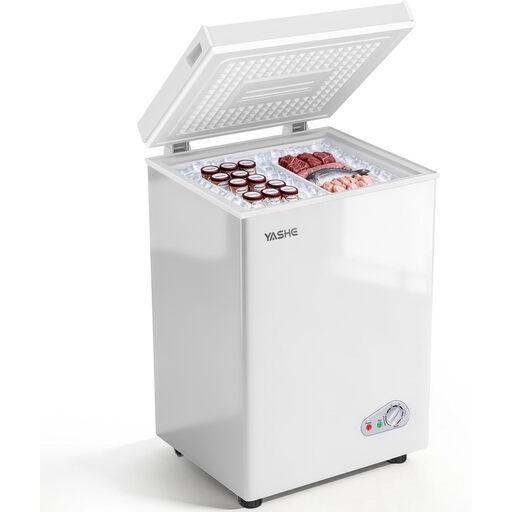
A chest freezer could suit you if you’re storing several portions of soup, provided there’s enough room for the appliance and its open lid.
It’s listed as having a capacity of 100 l, two removable baskets and six temperature settings.
 No image available
With its larger stated capacity, this model is only worth considering if you have enough room for the freezer and its open lid.
The product name lists a capacity of 197 l, switchable fridge and freezer modes, five digital temperature settings and a removable basket.
 No image available
A small freezer with an alternative design could be a good option if a chest freezer won’t work in your kitchen.
It’s listed as having a capacity of 31 l, a 4-star freezer rating, a reversible door, adjustable feet, 147 kWh/year energy consumption and an E energy rating.
 No image available
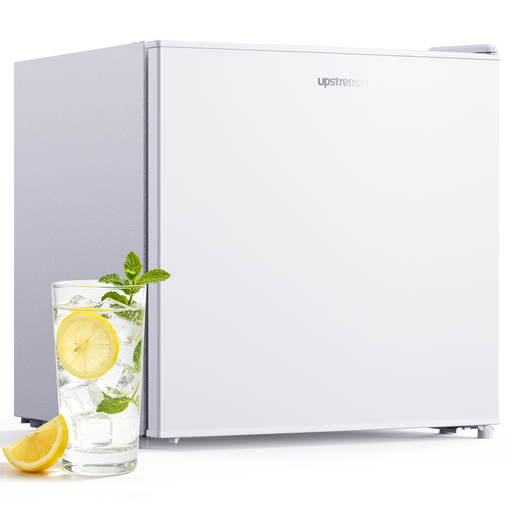
This mini freezer offers an alternative design if a chest freezer won’t fit in the space available.
It’s listed as having a capacity of 35 l, a 4-star freezer rating, a reversible door and a noise level of 41 dB.
Verbraucherzentrale recommends −18 °C as the ideal temperature for an upright freezer or chest freezer. Check your appliance’s setting; this doesn’t replace the need to cool and pack the soup carefully.
Use suitable containers and label each portion. Verbraucherzentrale recommends filling containers with liquid soup to only three-quarters full, leaving room for it to expand as it freezes. The Federal Centre for Nutrition recommends using suitable containers or freezer bags for this type of food.
The EU energy label shows, among other things, annual energy consumption in kWh, freezing capacity and noise emissions. Compare the figures for specific models that suit your space and storage needs.
According to information from the Federal Ministry for the Environment dated 28 July 2022, old electrical appliances must be taken to an authorised collection point and not put in household rubbish. If you’re buying a new appliance, check the retailer’s specific take-back and collection arrangements.