
Lieferung heute & morgen

Qualitätsgarantie

Willkommens-Angebote freischalten: KOSTENLOSE Lieferung | Bis zu 80 % RABATT | Kostenlose 30-Tage-JoyPlus-Testphase
App herunterladen
A functional workspace is crucial for productivity, but space is often limited in small apartments, dorm rooms, or compact home offices. Finding a desk that blends seamlessly into the room without overwhelming it can be a challenge. This article serves as a practical guide. It introduces different types of small desks and explains which criteria are most important when choosing a desk for small spaces.
The right model for you depends on your individual needs and the layout of your space. The following points will help you make an informed choice.
The materials define not only the look of your desk but also its durability and stability. Models made from E1-grade MDF (Medium-Density Fibreboard) are a common and cost-effective choice, offering a smooth, easy-to-clean surface. A sturdy metal frame, often made of iron or steel, provides the necessary stability. Pay attention to the manufacturer's specified maximum load capacity to ensure the desk can safely support the weight of your equipment, such as a computer, monitor, and books.
A tidy workspace promotes concentration. Consider how much storage you need. A desk with drawers is excellent for stowing stationery, documents, and cables out of sight. Open shelves provide quick access to frequently used items. For a minimalist approach, a simple compact computer desk without additional storage may be sufficient, especially if you already have other storage options in the room.
Different types of desks are suitable depending on your floor plan and available space:
Here is a selection of models that are suitable for various needs, distinguished by their functionality and space-saving design.
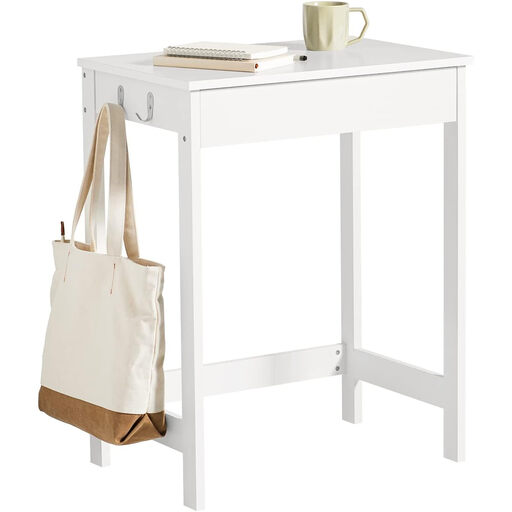
Key Features With its dimensions of 60 x 40 cm, this compact desk is specifically designed for very limited spaces. Despite its small size, it offers thoughtful details: a smooth-gliding drawer creates space for office supplies, while two side metal hooks are perfect for hanging bags or headphones. According to the manufacturer, the sturdy iron frame allows for a total load capacity of up to 60 kg.
Benefits at a Glance
Best for Individuals looking to set up a functional workspace in a bedroom, a small living room alcove, or a dorm room.
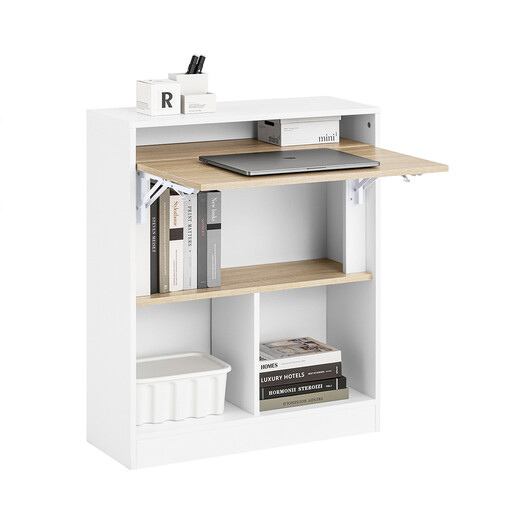
Key Features This wall-mounted folding desk is a clever solution for creating a full-fledged workspace on demand without permanently occupying floor space. When folded, it serves as a discreet wall shelf. When unfolded, it provides a stable work surface. The integrated shelves offer permanent storage for books, binders, or decorative items. According to the manufacturer, the structure's maximum load capacity is 81 kg.
Benefits at a Glance
Best for Residents of studio apartments, lofts, or multi-purpose rooms where flexibility is key.

Key Features This L-shaped desk is designed to make optimal use of corners and create a generous work surface. The model is reversible, meaning the longer section can be assembled on the left or right depending on your room's layout. With three drawers (one of which is for file folders) and two open shelves, this home office desk offers ample storage. The industrial design, featuring a rustic wood finish and a black metal frame, adds a modern touch.
Benefits at a Glance
Best for Home office professionals or students who want to set up a dedicated work corner with plenty of space for equipment and materials.
The models featured here cover a range of needs but represent just a fraction of the available options. If you are looking for other designs or specific features, you can find a wider selection in our Compact Student Desk with Storage category.
The ideal depth depends on how you use it. For working exclusively on a laptop, a depth of 40 to 50 cm is often sufficient. If you use an external monitor, a separate keyboard, and a mouse, a depth of 50 to 60 cm provides more comfort and a better viewing distance from the screen.
Measure your available space carefully before making a decision. Compact desks start at a width of around 60 cm. Models with a width of 80 to 100 cm offer significantly more work surface without dominating the room. Also, consider the space needed for an office chair.
Utilise vertical space with wall shelves or a shelf above the desk. Good lighting, such as from a slim desk lamp, is essential. Choose a desk type that fits the shape of your room—a small corner desk or a wall-mounted folding desk can be particularly advantageous here. Keep the work surface itself as clear as possible to create a calm and productive atmosphere.