If your PC needs to sit on a small desk, a gaming mini PC is an obvious choice — provided its exact specification meets the requirements of your chosen game. If there’s more room beside or under the desk, or you want to upgrade your PC later, a compact desktop or tower could be a better fit. Compare the requirements of the specific game with the full PC specification, and measure the space available, room for cables and clearance needed for ventilation.
Which form factor is right for you?
Gamers with very little desk space
If you want your PC on a small desk, check its actual dimensions and whether it can be positioned horizontally or vertically. ASUS ROG lists a 2.5-litre case for its ROG NUC product range, which can be set up in either orientation.
Gamers with a particular city-building game in mind
If you’re choosing a PC for a specific game, compare its requirements with the processor, graphics card and RAM in the exact PC model you’re considering. Manor Lords is one example of a medieval city-building game, but it may not be the game you’re buying for; Steam describes it as a strategy game with city-building features.
Gamers looking for comfort or upgrade options
If the PC will be within earshot or you’d like to replace components later, pay attention to cooling, connections and the exact model specification. MSI offers different configurations within its MPG Trident AS AI 2nd range; a manufacturer’s description of its cooling system is no substitute for noise measurements.
What should you look for when buying?
Gaming mini PC
A good fit if: Every centimetre counts and the specific graphics card meets the requirements of your chosen game.
Things to consider: Check the model variant, connections and available airflow. A small case doesn’t guarantee quiet operation or enough performance for your games.
Compact gaming desktop
A good fit if: You have room on or beside your desk for a larger case and want a desktop PC.
Things to consider: MSI lists a 10-litre case for the MPG Trident AS AI 2nd range. Graphics cards and storage vary by model number.
Gaming tower
A good fit if: Your PC doesn’t need to sit on your limited desk space and upgrade options matter more to you than having the smallest possible case.
Things to consider: Lenovo lists the Legion Tower 5 Gen 10 as a 30-litre tower. Check the specific configuration and its availability separately.
As the game, resolution and desk dimensions haven’t been specified, you can only narrow down the right configuration by considering your particular requirements.
| What matters to you |
What to check before buying |
Who is this particularly important for? |
| Space and positioning |
Compare the exact model’s dimensions and recommended orientation with the space available for the PC, cables and airflow. |
If there’s barely room beside my mouse and screen, I want to know whether the PC will actually fit there. Around 32% of consumers prioritise space and positioning. |
| Suitability for your game |
Compare the CPU, exact GPU, installed RAM and operating system with the requirements of your chosen game and preferred resolution. |
If I want to play a particular city-building game, I choose a specification to suit that specific title. Around 31% of consumers prioritise gaming performance. |
| Noise and cooling |
Look for measurements for the exact configuration under the relevant workload, and make sure the air vents won’t be obstructed where you place the PC. |
If my PC is right next to where I sit, I want to consider noise and airflow when deciding where to put it. Around 25% of consumers prioritise comfort at their desk. |
| Upgradability and specification |
Check the full model number, installed RAM, available slots, connections and what’s included with the specific model on offer. |
If I want to add storage or other components later, I need to know what’s included and what I can upgrade. Around 12% of consumers put this first. |
Common buying mistakes
-
Assuming ‘mini PC’ means ‘good for gaming’
The size of the case tells you nothing about the processor, graphics card or RAM in a particular model. Corsair lists specific CPU, GPU and RAM requirements for Manor Lords; these don’t automatically apply to other games.
Choose your game and preferred resolution, then compare its requirements with the full PC specification. If the components aren’t suitable, you may need different hardware.
-
Assuming the case volume tells you how much space you’ll need
A case’s volume in litres describes the case itself, not the room you’ll need for your screen, cables, peripherals or airflow.
Check the exact PC’s dimensions and recommended orientation against the space available, and leave clearance around the air vents.
-
Confusing a product range with a specific model
Graphics cards, installed storage and other features can vary across models in the same product range.
Check the full model number and specification of the exact version on offer.
Brands to consider
ASUS ROG
The ROG NUC range is a mini PC option for desks with very little space.
- ASUS lists a 2.5-litre case for the ROG NUC, which can be positioned horizontally or vertically.
- These details don’t apply to every ROG PC. Check the GPU and other components against the full model number.
MSI
The MPG Trident AS AI 2nd range is a compact desktop alternative between a mini PC and a larger tower.
- MSI lists a 10-litre case for this product range.
- Graphics cards, RAM and warranty length can vary by model. The cooling system described in the product information isn’t an independent noise measurement.
Lenovo Legion
The Legion Tower 5 Gen 10 is a tower option if you have room away from your small desk.
- Lenovo describes the range as a 30-litre tower.
- Check the specification of the exact configuration. Details for one model shouldn’t be assumed to apply to another.
Joybuy products
The selection below includes compact gaming mini PCs and a gaming laptop with a built-in display, for desks where space is at a premium. Compare each configuration with the requirements of your specific game.
 No image available
FIREBAT Mini PC AMD Ryzen 7 7735HS
A mini PC could be a good option if you have little desk space. Check that its specification meets the requirements of your game.
Radeon 680M, 16 GB RAM and 512 GB SSD; two M.2 slots.
View at Joybuy
 No image available
MSI Katana A15 AI B8VG-459
A built-in display could be useful if you don’t have much room on your desk for a separate monitor. Check that a laptop suits the way you plan to use it.
15.6-inch FHD display with 144 Hz, AMD Ryzen 9 8945HS, GeForce RTX 4070, 16 GB RAM and 1 TB SSD. German keyboard layout; Windows 11 Home.
View at Joybuy
 No image available
FIREBAT F1 Mini PC Ryzen 5 7640HS
This compact mini PC could suit you if you want your computer to take up very little space. Check its specification against the requirements of your game.
Radeon 760M, 24 GB LPDDR5 and 512 GB PCIe 4.0 SSD. The product information lists 4K output for up to three displays, as well as USB 4.0 and HDMI 2.1.
View at Joybuy
 No image available
FIREBAT A8 Mini PC Ryzen AI 9 365
This mini PC could be a good fit if you’re short on desk space. Whether it’s suitable for a particular game depends on the game’s requirements and the full PC specification.
Radeon 880M, 24 GB DDR5 RAM and 1 TB PCIe 4.0 SSD. The product information lists 4K output for up to four displays, as well as USB4 and HDMI 2.1.
View at Joybuy
 No image available
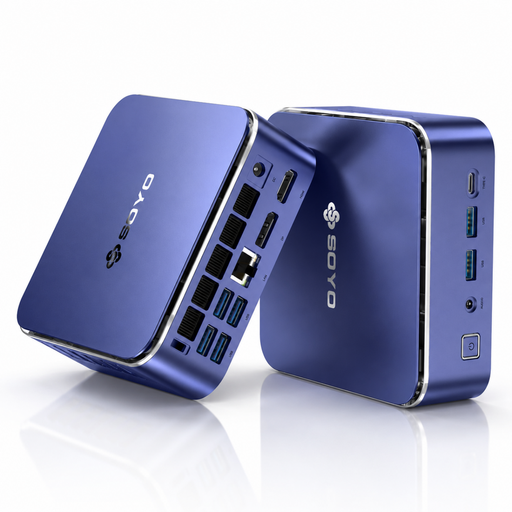
SOYO S5Air Mini PC Ryzen 5 7535HS
The listed case dimensions of 128 × 128 × 47,6 mm can help you check whether it will fit in a tight space. The product description specifically positions this PC for light gaming.
Radeon 660M, 16 GB LPDDR5 and 512 GB NVMe SSD; three video outputs.
View at Joybuy
Frequently asked questions
Will any mini PC run a medieval city-building game?
No. A compact design alone doesn’t tell you whether a PC is suitable for a particular game. Choose your game first, then compare its requirements with the full PC specification. For example, Corsair lists specific CPU, GPU and RAM requirements for Manor Lords. These don’t automatically apply to other games.
How should I position a compact PC on a small desk?
Measure the space you plan to use, including room for cables and clear air vents. ASUS says the ROG NUC can be positioned horizontally or vertically; don’t assume that other PCs offer the same option without checking.
What are my rights in Germany if a product is faulty or I want to cancel?
When you buy as a consumer, you have statutory rights against the seller if goods are faulty. Under § 438 BGB, the limitation period for ordinary purchases is generally two years from delivery. For goods ordered online, the Verbraucherzentrale says you’ll usually have 14 days from receipt to cancel. These rights are separate from any additional manufacturer’s warranty.
Where can I take my old PC in Germany?
Take electrical waste to a suitable collection point or recycling centre rather than putting it in your household rubbish. The stiftung elektro-altgeräte register explains your return options and provides a collection-point finder. Conditions may apply when returning items to a retailer.


