If you want to listen through headphones instead of your laptop speakers, start by selecting the right audio output and testing the headphones you already own. You don’t necessarily need an additional amplifier. A USB DAC with a headphone output gives you a dedicated digital signal path from your laptop; a purely analogue amplifier is more suitable if you already have an appropriate analogue output. Before buying, check the connections, power supply and space required. An amplifier on its own won’t necessarily eliminate interference in the audio signal.
Who might need a headphone amplifier?
Laptop listeners who don’t use speakers
You want to listen through wired headphones and first check whether selecting the right audio output is all you need. Microsoft Support recommends choosing your preferred device when several output devices are available.
Listeners short on desk space
You’re looking for a dedicated audio output for your laptop and need to allow for the space taken up by the device and cables, as well as a possible extra power supply. FiiO describes the original E10K as a compact model powered via Micro-USB.
Listeners who need several connection options
You want to connect headphones and possibly active speakers. Check the specific inputs and outputs, and whether you can adjust the level on the device. On the iFi ZEN DAC 3, control of the rear output depends on whether it is set to “Fixed” or “Variable”.
What should you look for when buying?
Use your existing audio output
Best if: You simply want to bypass your laptop speakers and your headphones already work.
The trade-off: This option won’t give you a new DAC or extra connections, and it won’t automatically fix interference in the audio signal.
USB DAC with headphone amplifier
Best if: You want to route your laptop audio via USB to a dedicated headphone output.
The trade-off: You’ll need a spare USB port and room for the device and cable. A larger desktop unit may offer extra connections, but will also take up more space.
Purely analogue amplifier
Best if: You already have a suitable analogue audio output and want to amplify its signal.
The trade-off: A USB power cable isn’t the same as a USB audio input. Depending on the device, you may need a separate audio cable and an additional power supply.
First check the signal path, then check the connections and power requirements of the specific device version.
| What you need |
What to check before buying |
Who is this important to? |
| Bypass the speakers |
Before buying anything, connect your headphones and select the desired audio output in your operating system. For a USB signal path, the USB port must specifically support audio transmission. |
If I just want to listen through headphones instead of my laptop speakers, I’ll test the existing output first. Consumers who put this need first are estimated to account for around 36%. |
| Space and power supply |
Check the dimensions, available USB ports and cable routing, and whether the specific model version requires an external power supply. FiiO lists the original E10K as measuring 79 × 49,1 × 21 mm and using Micro-USB for power. |
If you want to save desk space and avoid extra cables, pay particular attention to the unit’s size and power supply. Consumers with this need are estimated to account for around 29%. |
| Headphones and volume |
The amplifier’s output must match your headphone plug. Compare power specifications only for the relevant output and stated load. With the iFi ZEN DAC 3, turn the volume down before changing the gain setting. |
If I want to connect my existing headphones and adjust the volume carefully, I’ll check the plug and volume control first. Consumers whose main concern is headphone compatibility are estimated to account for around 21%. |
| Other sources or speakers |
Check that the inputs, headphone output and line output meet your needs. On the iFi ZEN DAC 3, the rear output bypasses the volume control when set to “Fixed”. |
If I might want to connect other sources or active speakers later, I’ll need suitable inputs and outputs, and must check how the level is controlled. Consumers who prioritise extra connections are estimated to account for around 14%. |
Common buying misconceptions
-
Buying an amplifier just because your laptop speakers are on
If the wrong audio output is selected, that could explain why sound isn’t coming through your connected headphones.
First, select the output you want in your operating system and test the headphones you already own.
-
Assuming a USB power cable is a USB audio input
According to the manufacturer, the analogue Douk Audio U3 uses RCA for audio input; its USB-to-DC cable is for power.
Check the manual to see which connections carry audio and which supply power only.
Depending on the connections, you may also need a suitable audio cable.
-
Treating a fixed line output like an adjustable speaker output
On the iFi ZEN DAC 3, the rear output level isn’t controlled by the volume dial when set to “Fixed”.
Before connecting active speakers, check how you want to control the level and start at a low volume.
-
Assuming similarly named model versions are identical
The FiiO E10K and E10K Type-C are different versions. Check that the connections and exact model name match the product listing.
Before buying, compare the full model name, connections and what’s included.
Key brands at a glance
FiiO
The E10K and K11 cater for different desktop setups and connection needs. Specifications for one model don’t automatically apply to the other.
- FiiO describes the original E10K as a compact device powered via Micro-USB.
- For the K11, FiiO lists USB, optical and coaxial inputs, as well as several audio outputs.
- The K11’s advertised power output doesn’t apply to every output or every pair of headphones.
iFi audio
The ZEN DAC 3 is designed for USB-based headphone listening and can also be connected to other audio equipment.
- According to the manufacturer’s manual, it has 6,35-mm and 4,4-mm headphone outputs, plus rear outputs with fixed or variable levels.
- The manual states that a separate 5-V DC power supply isn’t included. When set to “Fixed”, the rear output level isn’t controlled by the volume dial.
Fosi Audio
The DAC-Q4 combines digital inputs with a headphone output and an RCA output.
- The manufacturer’s manual lists USB, optical and coaxial inputs, along with 3,5-mm headphone and RCA outputs.
- The manual also lists bass and treble controls.
- Compare power specifications carefully and only consider them for the stated output and load.
Douk Audio
The U3 Mini is an analogue amplifier option for an existing analogue audio source.
- The manufacturer lists a stereo RCA audio input and a 6,35-mm headphone output.
- The USB-to-DC cable isn’t listed as a USB audio input, and the manufacturer says a power adapter isn’t included.
Joybuy products
This selection includes an analogue headphone amplifier and a USB DAC with headphone amplifier for your laptop desk setup.
 No image available
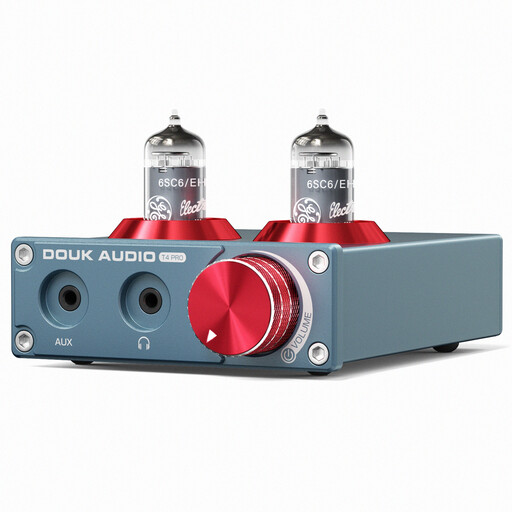
Douk Audio T4 PRO Mini Valve Tube MM Phono Amplifier
Could suit an analogue connection from your PC to your headphones, provided you have a suitable analogue output.
The product description lists a 3,5-mm AUX connection for a PC and a 12-V power supply. Check that the required power supply and analogue connections suit your setup.
An MM phono input and stereo RCA output are also listed.
Joybuy
 No image available
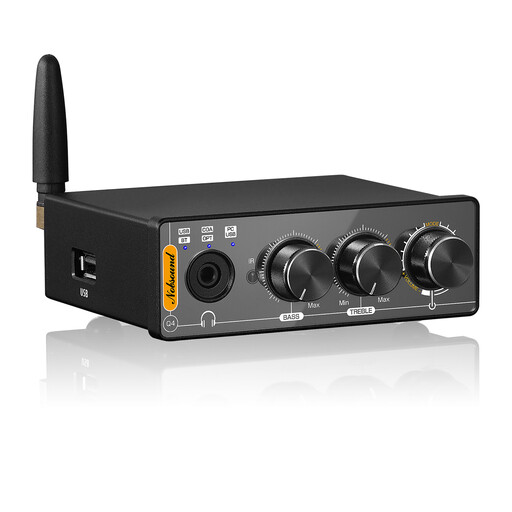
Nobsound Q4 USB Audio Gaming DAC
Could be a good option if you want to route your laptop audio digitally via USB and use the DAC’s headphone output.
Bluetooth, an optical input and 24-bit 192 kHz are listed in the product title. Check that the connections and formats suit your audio sources.
Joybuy
Frequently asked questions
Do I need to buy an amplifier to mute my laptop speakers?
No, not just for that. Connect your headphones or an existing USB audio device and select it as the audio output. Microsoft Support advises choosing your preferred output device when several devices are available.
What can I do if the sound is still coming from my laptop?
Check the connection and select your preferred output device in the sound settings. Also check that the sound isn’t muted and adjust the volume, starting with a low level on the amplifier.
Will I also need a power supply?
It depends on the model. The original FiiO E10K is powered via Micro-USB. The iFi ZEN DAC 3 manual lists USB or 5 V DC as power options; a separate DC power supply isn’t included. The manufacturer also says that a power adapter isn’t included with the analogue Douk Audio U3.
What are my rights in Germany if a product is faulty, and how should I dispose of it?
Your statutory consumer rights are separate from a voluntary manufacturer’s warranty; the Verbraucherzentrale explains your rights when goods are faulty. The German Environment Agency states that waste electrical equipment must be collected separately and must not be disposed of with household rubbish.
Does a CE mark automatically mean a product has an independent safety certificate?
No. According to information from the European Union, CE marking is only required for products covered by relevant harmonised EU rules that require it. It isn’t a blanket approval from a central EU certification body; the requirements depend on the specific product.


