Which option is right for you?

Presenters with limited space

If your product, hands, camera and light all need to fit on a small desk, start by checking the softbox’s open dimensions and the position of its mount. SmallRig and Godox list the dimensions of their respective light modifiers in their product information.

Regular video presenters

For repeat recordings or changing daylight, you’ll need a light source that stays on throughout the recording. Adobe points out that natural light can vary with the weather and time of day.

Presenters showing shiny products

Shadows and visible reflections can obscure details on shiny surfaces. Rollei explains that diffusion fabric scatters light, while SmallRig’s product information also describes diffusers and a grid for a specific model.

What should you look for when choosing?

Compact softbox for an existing continuous light

A good fit if: You already have a compatible LED continuous light and want to control the direction of the light and the shadows during your demonstration. Check the connection type, open dimensions and the mount’s load capacity.

Bear in mind: The light modifier, light and stable mounting aren’t necessarily sold together as a set. A grid can limit spill light, but it also changes the area illuminated.

Continuous-light kit with softbox

A good fit if: You don’t yet have a light or mount and want to film in changing daylight. Check exactly what’s included and how much space the kit takes up when assembled.

Bear in mind: A kit may take up more space; also check that the specific light suits your camera settings.

Window light with a reflector

A good fit if: Daylight stays bright and even enough throughout your recording, and you mainly want to brighten the darker side of the product.

Bear in mind: Weather and time of day can change the lighting conditions; Adobe highlights these variations in natural light.

Photo box for small items

A good fit if: You’re showing individual small products against a simple background and can photograph them inside the photo box.

Bear in mind: A photo box limits how freely you can position your hands and camera or show larger products. Check the openings against the framing you have in mind.

Concern What to check before buying Who is this especially relevant to?
Space and freedom of movement Check the open width and depth, as well as the position and stability of the mount in your own setup. When the product, your hands and the camera all need to fit in a small space, every bit of room counts; consumers who see space as their top buying priority are estimated to account for around 33%.
Consistent light for video Check whether the listing includes a continuous light, and look at the adjustment options and electrical specifications for the specific model. For repeat demonstrations or changing daylight, the light needs to remain available throughout the recording; consumers who prioritise consistent video lighting are estimated to account for around 27%.
Shadows and reflections Consider the product’s surface and the size of the subject; adjust the diffuser and, if needed, the grid to keep details visible in your setup. If I’m showing shiny products, I want to control reflections and shadows so the details remain visible; consumers whose top priority is controlling reflections are estimated to account for around 20%.
Connection and what’s included Compare model names and connections; check the list of included items for the light, stand, diffusers, grid and, if applicable, power supply. If you want to keep using your existing equipment, you’ll need a compatible connection and a clear list of what’s included; consumers whose main concern is compatibility and completeness are estimated to account for around 20%.

Avoid common buying mistakes

  • Assuming a softbox is a complete lighting kit

    A light modifier may be designed for a specific light or connection type. It doesn’t automatically include a light and mount.

    Before buying, compare the list of included items with everything your setup needs.

    Depending on the equipment you already have, you may also need a compatible continuous light, power supply and mount.

  • Measuring only the folded light modifier

    On a small desk, the open softbox needs to fit alongside your product, hands and camera.

    Mark out the open dimensions and the planned position of the light at your workspace to see how they fit.

  • Relying on a flash softbox as your only video light

    Video needs continuous light. Rollei’s 50 cm parabolic softbox is designed for hot-shoe flashes and doesn’t have a Bowens S-Type connection.

    Check the light source and connection type for the specific model first, rather than comparing only its shape and size.

Relevant brands and light modifiers

SmallRig

The RA-R4545 is a model-specific light modifier for lights in the SmallRig RC-60 and RC-100 series.

  • SmallRig lists two diffusers and a grid; the user manual gives a lighting area of 45 × 45 cm.
  • The light modifier isn’t a complete kit with a light.

Godox

The EazyFlow range includes different shapes; Rect 40*40 is a rectangular option for a compact setup.

  • Godox lists an open area of 40 × 40 cm for Rect 40*40, with a Bowens speed ring included as standard.
  • Check that the speed ring is compatible with your existing light.

NEEWER

The NS1P is a compact Bowens softbox for a compatible light head.

  • The manufacturer’s German website lists an opening of 45 × 30 cm, two diffusers and a grid.
  • The light modifier alone is no substitute for a continuous light or a suitable mount.

Aputure

The Quick Dome 60 is a foldable Bowens softbox for a compatible continuous-light setup, provided you have room for a 60 cm diameter on your desk.

  • Aputure lists a quick-release mechanism and a diameter of 60 cm.
  • Aputure says the older Light Dome Mini III is no longer in production and has been replaced by the Quick Dome 60.

Rollei

Rollei offers light modifiers for different flash and continuous-light systems; the specific connection type is key when choosing one.

  • The manufacturer explains how diffusion fabric scatters light and softens harsh shadow edges.
  • The documented 50 cm parabolic softbox is designed for hot-shoe flashes and doesn’t have a Bowens S-Type connection, so it isn’t necessarily suitable for LED product videos.

Joybuy product selection

This selection features photo boxes for individual small products that can be shown inside a box.
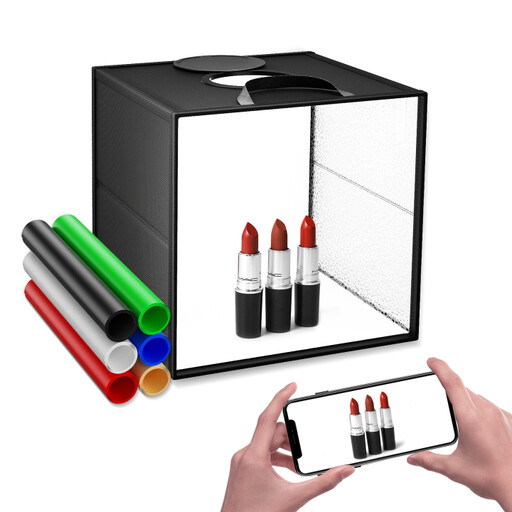
Foldable 30 × 30 cm mini photo studio in black Oxford fabric

Foldable 30 × 30 cm mini photo studio in black Oxford fabric

For individual small products that can be photographed inside a photo box.

The product title lists a size of 30 × 30 cm, dimmable lighting, six coloured backgrounds and a foldable design.

Joybuy

Frequently asked questions

Is a softbox without a light enough for my product video?

No. A softbox sold separately shapes the light from a compatible light source. Video needs continuous light, so check whether the light and mount are actually included in the listing.

How can I get more light on the darker side of a product?

Aim the main light at the product and check the image on your camera. A white card or reflector can bounce light back onto the darker side. Adjust the position and diffusion so important details remain visible. Canon Europe also recommends considering a reflector or large white surface if one side is too dark.

How should I store a foldable softbox?

Take it apart according to the instructions for the specific model, and store the diffusion fabric and rods without putting them under unnecessary strain. SmallRig describes a release mechanism for folding the RA-R4545 and lists a carrying bag as included.

Who should I contact if there’s a fault?

For your statutory consumer rights, the seller is generally your point of contact. A manufacturer’s guarantee is separate and is subject to its own terms. The Verbraucherzentrale explains the difference. If you’re buying a kit, also check which components the seller actually supplies.

Does softbox lighting need CE marking in Germany?

It depends on which regulations apply to the specific product: CE marking is required only when the applicable EU rules expressly call for it. So you shouldn’t assume that a passive fabric light modifier needs CE marking. The European Union describes CE as the manufacturer’s declaration of conformity, not an independent quality mark.

How should I dispose of an old LED light?

Electrical and electronic waste must not go in household rubbish. The Umweltbundesamt lists options including recycling centres and suitable take-back schemes at retailers; removable batteries must be disposed of separately.