People with limited worktop space
If you can’t spare much space permanently, the appliance’s width and depth, along with room to open the door, all matter. Bomann and Midea publish the external dimensions of their countertop models.


If you only have a few lunchboxes and no fixed water supply, a compact model with a water tank is a sensible place to start. If you need to wash several lunchboxes in one load, a countertop dishwasher with a higher stated capacity may be worth considering, but it will take up more space. Check the external and internal dimensions, make sure the water supply and drainage can be set up safely, and follow the care instructions for the lunchbox and lid. Place settings don’t tell you whether your lunchboxes will fit. To compare consumption, look at the Eco figures on the EU energy label on a like-for-like basis, and consider how full you expect to load the machine.
If you can’t spare much space permanently, the appliance’s width and depth, along with room to open the door, all matter. Bomann and Midea publish the external dimensions of their countertop models.
If there’s no fixed water supply where you plan to put the appliance, you can look at a model with a tank or one that connects to a tap. You’ll still need to drain the waste water safely. Bomann and Medion describe models that can be used with a tank.
If you want to wash lunchboxes, lids and other dishes together, the usable basket space is key. Bomann states that the TSG 7404 holds six place settings, but that doesn’t tell you how many of your lunchboxes will fit.
A good fit if: there’s no fixed appliance water supply where you plan to put it and you’ll mostly be washing small loads.
The trade-off: A tank means you don’t need a fixed water supply, but you’ll still need to fill it and drain the waste water safely.
A good fit if: you want to wash several lunchboxes and other dishes together, and you have enough space and a suitable connection.
The trade-off: A higher stated place-setting capacity calls for a suitable spot, but it doesn’t guarantee that the basket is the right shape for lunchboxes.
A good fit if: you can reach a suitable tap and drain, but don’t want a fixed appliance connection.
The trade-off: The Klarstein Aquatica is rated for two place settings, so check whether your lunchboxes and lids will fit in the basket.
Choose according to your main constraint: available space, water supply, number of lunchboxes, or your requirements for drying and consumption.
| What matters | What to check before buying | Who it matters most to |
|---|---|---|
| Space and fit | Measure the external dimensions and the clearance needed to open the door. Check that your largest lunchbox fits in the usable basket without obstructing the spray arm. | If there’s hardly any room left on the worktop, I want to know whether the appliance and its open door will fit in the space. Around 36% of consumers put available space and actual fit first. |
| Water supply and drainage | Check whether the appliance uses a tank or connects to a tap, and decide in advance where the drain hose will go. | If there’s no fixed water supply, I need to be able to fill the machine and drain the waste water safely. Around 29% of consumers prioritise water supply and drainage. |
| Number and shape of lunchboxes | Measure your lunchboxes and lids, then check whether they can be arranged in the basket and racks of the specific model. | If I want to wash several lunchboxes and their lids in one load, the usable basket space is what matters. Around 21% of consumers prioritise washing several lunchboxes together. |
| Drying and consumption | Consider drying features separately from performance claims, and compare Eco energy and water figures on a like-for-like basis. | If I want plastic items to come out as dry as possible and expect to use the appliance often, I want to assess drying and Eco consumption separately. Around 14% of consumers give these concerns top priority. |
A model with a tank can replace a fixed water supply, but it still needs to drain waste water safely.
Before buying, check access to the tank, the hose route and the drain at the intended location.
The Verbraucherzentrale explains that the symbol indicates suitability for contact with food, not for cleaning in a dishwasher.
Follow the separate care instructions for the lunchbox, lid and any removable parts.
The consumption figures on the energy label refer to the Eco programme. The Umweltbundesamt describes an advantage over handwashing when a machine is fully loaded and run on the Eco programme.
Compare label figures on the same basis, and take your usual load and chosen programmes into account.
Bomann offers compact models with tanks as well as larger countertop dishwashers.
The MDWMT0305EW-WE is listed as a mini dishwasher with capacity for three place settings.
According to Medion, the LIFE DWT30 (MD370022) is designed for three place settings.
According to Klarstein, the Aquatica is a compact countertop model for two place settings, with a direct tap connection.
This selection includes compact countertop models with water tanks, as well as one model rated for six place settings. The place-setting figures don’t confirm that your lunchboxes will fit in the respective baskets.
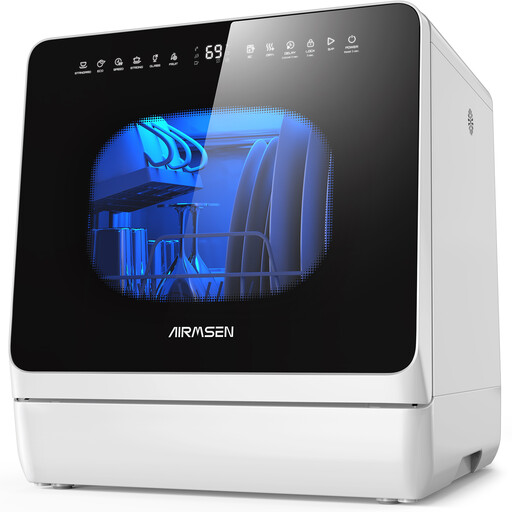 No image available
Designed for limited space and tank operation. Measure the available space and your largest lunchbox before buying.
The description lists an integrated 4,9-litre tank and dimensions of 42,8 × 42,5 × 45,7 cm. The product title lists 8 wash programmes.
 No image available
An option if you’re looking for tank operation and a narrow footprint. Check that it will also fit the available depth.
The product title lists an integrated 5-litre water tank, a width of 37 cm and a depth of 50 cm. The description lists capacity for four place settings.
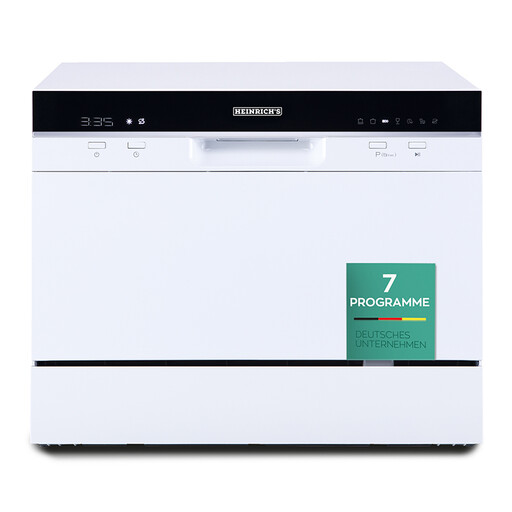 No image available
For households that want to wash several items together and can use a water connection where the appliance will be installed.
The product title lists six place settings. The description lists seven programmes and a water connection included in the box. Check that the basket shape suits your lunchboxes.
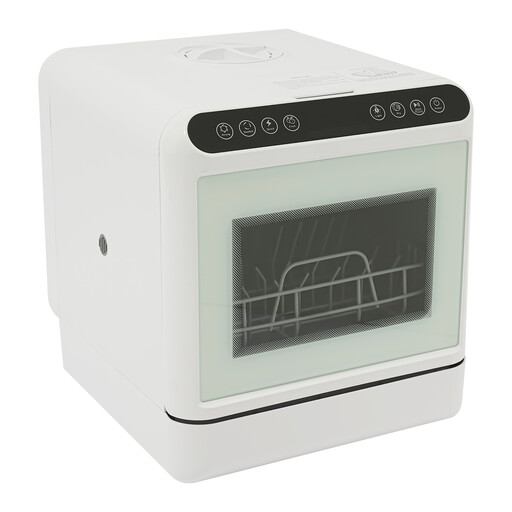 No image available
If tank operation and a compact countertop model suit your space, also check that there’s room for the drain hose.
The product title lists an integrated 1.32-gallon tank, hot-air drying and a 72-hour storage function. The description gives dimensions of 16,14 × 18,11 × 18,11 inches.
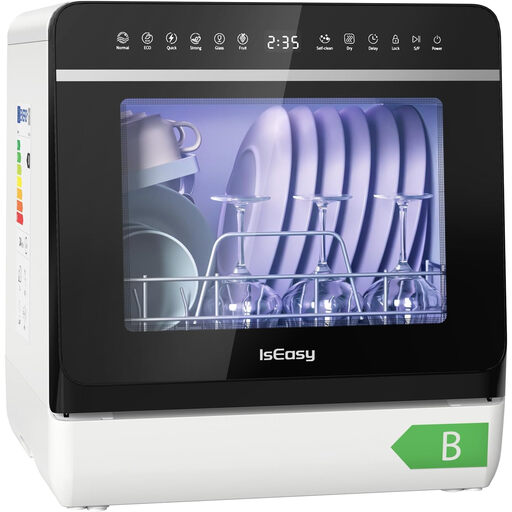 No image available
For a compact space without a fixed water supply. You’ll still need to plan for safe drainage.
The product title lists a 5-litre tank and operation without a water connection. The description lists three place settings, seven programmes, a drying function and dimensions of 43 × 43 × 46 cm.
No. The Verbraucherzentrale explains that the symbol indicates suitability for contact with food. Check the separate washing instructions for the lunchbox, lid and any other parts. The glass-and-fork symbol alone doesn’t mean an item is dishwasher-safe.
A tank model specified for this purpose can be used without a fixed water supply, but it still needs a safe way to drain the water. For the TSG 5702, Bomann lists a drain hose included in the box.
For appliances of a similar size, compare the label figures for kWh per 100 Eco cycles and litres per Eco cycle. To estimate your own costs, you’ll also need to consider how many cycles you expect to run and your electricity and water rates. Other programmes may use different amounts.
Household dishwashers covered by EU rules carry an energy label with ratings from A to G. The European Commission gives 1 March 2021 as the start date for the current label. Check the label for the specific model and look at its Eco consumption, capacity, programme duration and noise emissions.