
Lieferung heute & morgen

Qualitätsgarantie
App herunterladen
Kategorien
A small refrigerator is a functional solution for environments with limited space. Whether as a fridge for a single-person household, an office fridge for lunch breaks, or a practical tabletop refrigerator in a hobby room, selecting the right model depends on specific technical requirements. Key criteria include net capacity, energy efficiency, noise emissions, and whether an integrated freezer compartment is needed. This guide analyses the essential parameters to help you make an informed decision.
The selection of a compact refrigeration appliance should be based on an analysis of objective technical data. The following criteria are crucial for most use cases.
The external dimensions determine whether the appliance will fit into its intended space. A slim refrigerator with a width of less than 50 cm, for example, is suitable for niches. The net capacity, specified in litres, describes the actual storage space. For a one to two-person household, 80 to 150 litres are generally sufficient. It is important to distinguish between the total capacity and its division into refrigeration and freezer sections.
The choice between a small refrigerator with a freezer compartment or a small refrigerator without a freezer compartment depends on individual needs.
Since 1 March 2021, the new EU energy label with a scale from A (highest efficiency) to G (lowest efficiency) has been in effect. A small refrigerator in class E or F is common in the current market. The annual energy consumption in kilowatt-hours (kWh/annum) is a concrete indicator of running costs. A lower value means lower electricity costs and a reduced environmental impact.
For use in living rooms, studio apartments, or offices, a quiet refrigerator is essential. The volume is specified in decibels (dB(A)). Appliances with a value below 40 dB(A) are considered quiet. The EU energy label also indicates an airborne acoustical noise emission class (A to D), which allows for a quick assessment of the noise level compared to other appliances.
Most compact models are designed to be freestanding. This allows for flexible placement. However, it is imperative to ensure adequate ventilation on the sides and at the back to prevent heat build-up and damage to the compressor. A reversible door hinge offers additional flexibility in placement, as the door can be mounted on the left or right side depending on the room layout.
Based on an analysis of technical specifications and practical utility, we present two models that cater to different requirements.
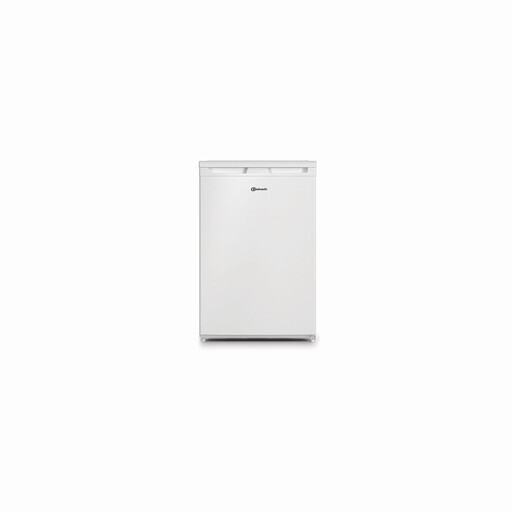
Why we recommend this product The Bauknecht K55V1 112W1 is a well-designed solution for users who need to both cool and freeze in a small space. With a 13-litre 4-star freezer compartment and 101 litres of cooling capacity, it covers the basic needs of a single-person household or a small office team. The automatic defrost in the cooling section reduces maintenance, while the low noise emission of 36 dB(A) makes it suitable for use in living areas.
Advantages
Who it's for This model is ideal for individuals looking for a space-saving, all-in-one solution. It is suitable as a first appliance for students, for small apartments, or as a fully-featured mini-fridge in holiday homes.
Technical Data | Feature | Specification | | :--- | :--- | | Type | Freestanding tabletop refrigerator with freezer compartment | | Total Net Capacity | 114 litres (101 L Cooling + 13 L Freezing) | | Energy Efficiency Class | E | | Annual Energy Consumption | 137 kWh/annum | | Noise Emission | 36 dB(A) (Class C) | | Freezing Capacity | 2 kg / 24 h | | Dimensions (H×W×D) | 840 × 540 × 590 mm | | Door Hinge | Right, reversible |
View Product: Bauknecht K55V1 112W1 on Joybuy.de
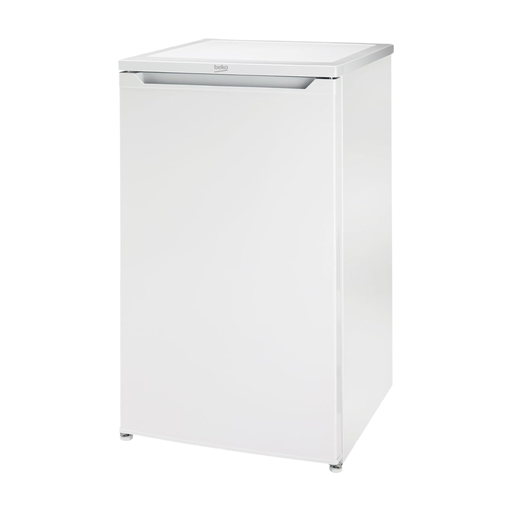
Why we recommend this product The Beko TS190040N stands out with its very slim design of just 47.5 cm. As a pure larder refrigerator, it maximises cooling space, making it an excellent choice for users who do not need a freezer section. The automatic defrost and robust interior layout with glass shelves make it a low-maintenance and practical appliance for niches, offices, or as a secondary fridge.
Advantages
Who it's for This model is the optimal choice for offices, agencies, hotel rooms, or as a drinks fridge in the living room. It is also suitable for households that already have a separate chest freezer and are looking for a dedicated, space-saving small refrigerator without a freezer compartment.
Technical Data | Feature | Specification | | :--- | :--- | | Type | Freestanding larder refrigerator | | Total Net Capacity | 88 litres | | Energy Efficiency Class | E | | Annual Energy Consumption | 85 kWh/annum | | Noise Emission | 38 dB(A) (Class C) | | Special Features | LED interior lighting, automatic defrost | | Dimensions (H×W×D) | 818 × 475 × 500 mm | | Door Hinge | Right, reversible |
View Product: Beko TS190040N on Joybuy.de
While a small refrigerator is indispensable for storing perishable foods and chilled drinks, other items require a different kind of storage. In small apartments or offices where every square centimetre counts, a thoughtful choice of furniture can significantly enhance the functionality of the space.
For the stylish presentation of glasses, dishes, or even non-refrigerated snacks and spirits, furniture pieces that combine storage and aesthetics are ideal. Discover our selection of glass cabinets to elegantly expand your storage options and create a sense of order.
Power consumption primarily depends on the energy efficiency class and net capacity. A model like the Beko TS190040N (Class E, 88 L) has a stated annual consumption of 85 kWh. The Bauknecht K55V1 112W1 (Class E, 114 L) is rated at 137 kWh/annum. Actual consumption is also influenced by ambient temperature, how full the fridge is, and how often the door is opened.
A refrigerator is considered quiet if its noise emission is below 40 dB(A). This is roughly equivalent to the volume of a whisper or soft background music. The models from Bauknecht (36 dB(A)) and Beko (38 dB(A)) fall into this category and are therefore well-suited for use in quiet environments like bedrooms or open-plan kitchens.