
Lieferung heute & morgen

Qualitätsgarantie

Willkommens-Angebote freischalten: KOSTENLOSE Lieferung | Bis zu 80 % RABATT | Kostenlose 30-Tage-JoyPlus-Testphase
App herunterladen
A small fridge can save a great deal of space in a studio flat, office or as an additional drinks fridge. However, its compact design alone says little about its practical benefits. The key factors are the interior layout, door hinge position, noise level, energy consumption and whether you need a freezer compartment.
A mini fridge with a narrow width may fit more easily under a worktop, but it often offers limited storage space. That is why you should check the net capacity in litres, rather than just the external dimensions. You should also take the depth including the door handle into account, as well as the distance required between the appliance and the wall.
A fridge with freezer compartment is versatile, but it consequently provides less fridge space. For drinks, fruit, vegetables and larger bottles, a fridge without freezer compartment may be the more practical solution. If you regularly store frozen food, you should instead check the size and labelling of the freezer section.
The EU energy label for refrigeration appliances uses a scale from A to G. The energy class should be considered alongside annual consumption. Despite having a similar rating, a larger appliance may use more electricity than a smaller model. For a rough cost estimate:
Annual consumption in kWh × your electricity price per kWh = annual electricity costs
The actual amount depends on your electricity tariff and how the appliance is used. Figures from the EU product information sheet provide a comparable guide.
For an office or guest room, around 40 to 100 litres is often sufficient. A compact fridge for several people or for use as a storage appliance should offer considerably more usable capacity. Adjustable glass shelves make it easier to accommodate tall bottles, containers and bowls. A salad drawer, door shelves and a bottle rack improve organisation.
A drinks fridge without a freezer compartment can be a sensible choice if you only want to chill bottles and cans. For mixed use with fresh food, a flexible interior layout is more important.
Measure the intended space at three points: width, height and depth. For an under-counter location, you must also take the worktop, plinth and door opening radius into account. Freestanding appliances require sufficient air circulation in accordance with the manufacturer’s instructions. Ventilation openings must not be blocked.
A reversible door hinge is particularly useful in small kitchens. It allows you to position the appliance more easily next to furniture or in a narrow alcove.
A quiet fridge is beneficial in bedrooms, student accommodation and offices. The noise level is given in decibels, abbreviated to dB. Values of around 40 to 41 dB may be suitable for many locations, although perceived noise depends on the room acoustics, the surface on which the appliance stands and its operating condition.
For food storage, the temperature should be set according to the operating instructions and checked against the recommended storage conditions. An appliance with mechanical temperature control is generally easy to operate, but it does not replace correct positioning and ventilation.
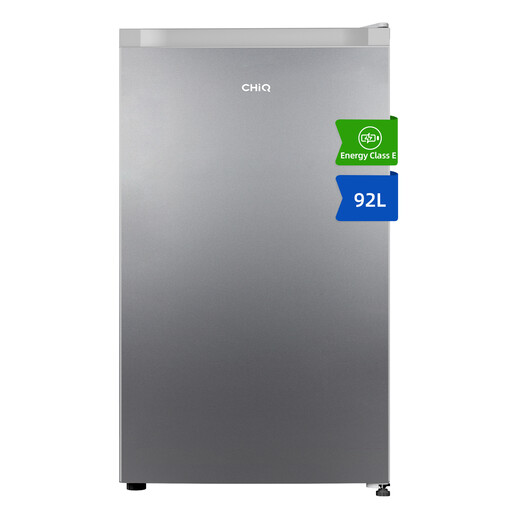
Why this product suits this profile: With 92 litres of usable capacity and a width of 47 cm, this appliance is suitable for small kitchens, offices, hotel rooms or student accommodation with limited floor space.
The narrow design is combined with a clearly stated usable capacity. Adjustable glass shelves and a salad drawer help ensure that the interior is not limited to drinks storage.
92 litres of usable capacity, 7-stage mechanical temperature control, reversible door hinge and energy efficiency class E according to the product details.
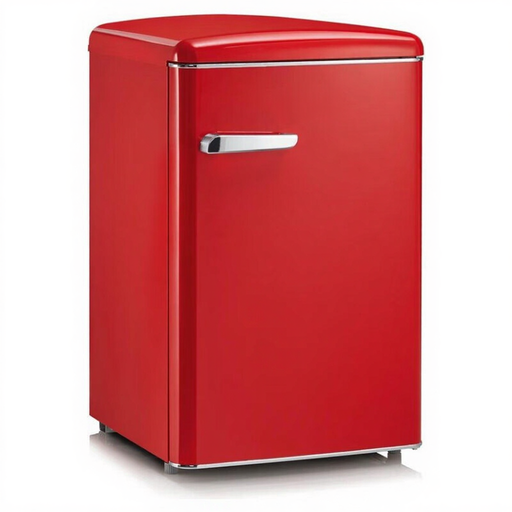
Why this product suits this profile: This freestanding table-height appliance combines a compact height of 89.5 cm with a fridge compartment and a separate freezer compartment. The red retro finish will appeal to users who value style as well as functionality.
The 13-litre freezer compartment is listed separately. This makes it easier to assess before buying how much space will actually remain for chilled food.
106 litres of total capacity, including a 93-litre fridge compartment and a 13-litre freezer compartment, operating noise of 41 dB, plus a salad drawer and bottle shelf according to the product description.
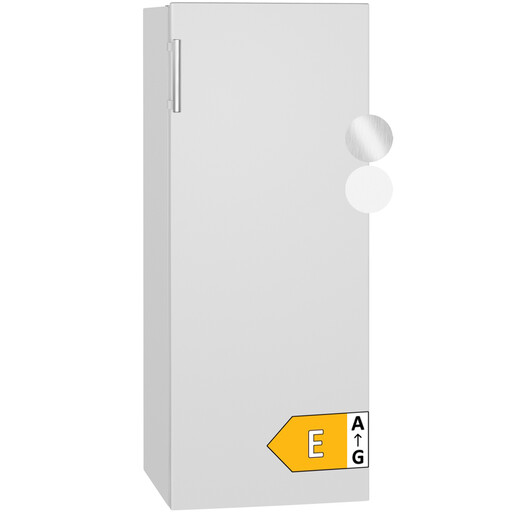
Why this product suits this profile: With a net capacity of 242 litres, this freestanding appliance is designed for larger households, offices or use as an additional drinks fridge with extensive storage space.
Not having a freezer compartment creates more usable fridge space. The stated dimensions, castors and adjustable feet make it easier to plan and level the appliance’s position.
242 litres of net capacity, 5 glass shelves, 4 height-adjustable shelves, operating noise of 40 dB and annual consumption of 104 kWh according to the EU product information sheet.
We have put together a complete, regularly updated list of products that fully meet these strict selection criteria and the safety regulations applicable in the EU.
Place the fridge on a level, stable surface that can support its weight. Adjustable feet help you level it correctly. Leave sufficient space between the appliance and heat sources such as a cooker or radiator. Direct sunlight can affect cooling performance and energy consumption.
Before switching the appliance on for the first time, it is advisable to read the manufacturer’s instructions. After transportation, you may need to wait before connecting the appliance to the mains. Food should be arranged so that air circulation is not completely blocked. Regularly cleaning the seals and interior surfaces helps maintain hygienic operation.
Consumption depends on the size, energy class, ambient temperature, temperature setting and how the appliance is used. Compare the annual consumption in kWh on the EU energy label or product information sheet. For an appliance with annual consumption of 104 kWh, you can estimate your individual costs by multiplying 104 by your electricity price per kilowatt-hour.
Lower dB values are generally preferable in quiet rooms. The product details for the models mentioned list noise levels of 40 to 41 dB. Actual perceived noise may be affected by vibrations, the condition of the floor and the distance from nearby furniture.
Yes, if you do not need freezer space and would prefer more room for fresh food, bottles or drinks. For regularly storing frozen food, a fridge with freezer compartment is the more suitable design. Your decision should be based on your everyday needs and the space available for the appliance.