What should you consider when choosing?
Slimline freestanding or integrated model
A good fit if: you have a suitable space for the appliance or cupboard, as well as the necessary connections.
The trade-off: Your worktop stays clear, but you’ll need space elsewhere. Germany’s Federal Environment Agency notes that, when used to capacity, 45 cm models have higher energy and water consumption per place setting than larger models.
Countertop model with mains water connection
A good fit if: there’s no floor space available, but you have a suitable worktop and water supply and drainage connections.
The trade-off: You won’t need to fit it into your kitchen units, but it will take up worktop space permanently.
Countertop model with water tank
A good fit if: you can’t use a mains water connection where you want to put it and usually have smaller amounts of crockery to wash.
The trade-off: The tank replaces the mains water connection, but you’ll need to fill it by hand before each wash. You’ll also need a suitable drainage solution.
First, work out where the appliance can go and how much crockery it needs to hold. To compare consumption and capacity, the German consumer advice centre recommends checking the energy label for Eco programme energy use per 100 cycles, water use per cycle and place settings.
| What you need |
What to check when buying |
Who is this most important to? |
| Worktop and floor space |
Check the appliance and alcove measurements, and allow for the door to open and connections at the planned location. |
If I need the worktop for cooking, I’d rather put the appliance somewhere suitable away from it. Around 36% of consumers rank keeping the worktop clear as their top priority. |
| Capacity for everyday crockery |
Compare your plates and cooking utensils with the basket layout, interior space and stated number of place settings. |
If I have washing up every day, I want to be able to judge whether my plates and cookware will fit. Around 29% of consumers prioritise a capacity that suits the amount of crockery they have. |
| Water supply and drainage |
Check the water supply type, supplied hoses and safe drainage arrangements for the specific model. |
If there’s no usable mains water connection where I plan to put it, I need a suitable solution for the water supply and drainage. Around 21% of consumers rank the lack of a mains connection as their top priority. |
| Energy use and noise |
Compare the energy label’s kWh per 100 Eco cycles, litres per Eco cycle, place settings and noise figures. |
Once I know the appliance will work in the space available, I also want to consider its energy use and noise. Around 14% of consumers rank running costs or noise among their top buying priorities. |
Slimline dishwashers at Joybuy
The following Joybuy listings are for slimline freestanding dishwashers, which can help keep your worktop clear if you have a suitable place for one.
 No image available
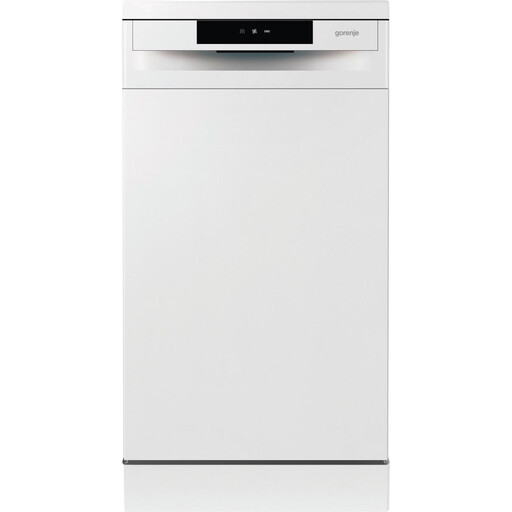
Gorenje GS520E15W, freestanding, 45 cm
For a suitable space away from the worktop; check that its capacity suits your everyday crockery.
Listed with 9 place settings and 5 programmes.
Dimensions: 84,5 × 44,8 × 60 cm.
View at Joybuy
 No image available
Beko BDFS26040XQ, freestanding, 45 cm
For households looking for a slimline freestanding model with a stated capacity they can compare with their everyday crockery.
Listed with 10 place settings, 6 programmes and an adjustable upper basket.
Energy efficiency class C; dimensions: 850 × 448 × 600 mm.
View at Joybuy
 No image available
Exquisit EGSP52109-E-030E, freestanding, silver
For a space away from the worktop; check the stated capacity against the amount you usually wash.
Listed with 9 place settings, 6 programmes, an adjustable upper basket and a cutlery drawer.
Width: 44,8 cm; depth: 55 cm.
View at Joybuy
 No image available
Bosch SPS4HKW49E Series 4, freestanding, 45 cm
For a suitable space away from the worktop; the description also says it can be installed under a worktop.
Listed with 10 place settings, 6 programmes, an adjustable upper basket and a cutlery drawer.
Dimensions: 84,5 × 45 × 60 cm; depth with the door open: 115,5 cm.
View at Joybuy
 No image available
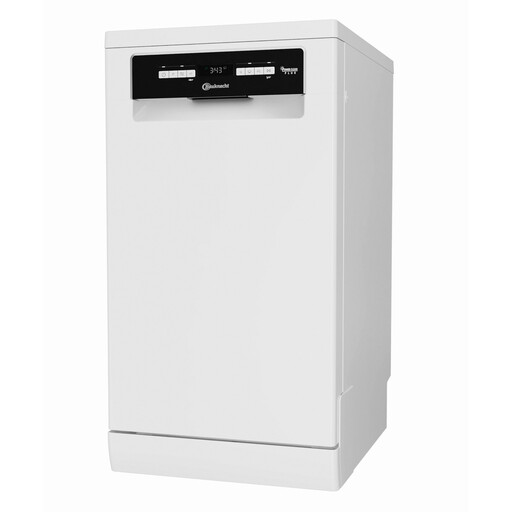
Bauknecht BSFO 3035 PF, freestanding, 45 cm
For a suitable space away from the worktop; check that the stated capacity suits your everyday crockery.
Listed with 10 place settings and a MultiZone option for a single basket.
Dimensions: 850 × 450 × 590 mm.
View at Joybuy
Frequently asked questions
Are place settings a reliable guide to whether pans and large plates will fit?
The number of place settings is useful for comparing stated capacity, but it won’t tell you whether your own plates and cooking utensils will fit. Check the basket layout and interior space of the specific model.
Can a dishwasher with a water tank go anywhere without a water connection?
No. A water tank can replace the mains water connection, but you’ll still need a suitable space, electricity and a safe way to drain the wastewater. Always follow the connection instructions for the model you choose.
Which programme and care routine work well for everyday use?
Germany’s Federal Environment Agency recommends running the machine on the Eco programme when it’s as full as possible, and not rinsing dishes with warm water first. Use detergent, rinse aid and dishwasher salt according to the manufacturer’s recommendations and your water hardness.
Which labelling applies to household dishwashers in Germany?
The EU energy label for household dishwashers uses classes A to G. Regulation (EU) 2019/2017 includes, among other things, energy use in kWh per 100 Eco cycles, water use per cycle, place settings and noise figures. Check that the details match the exact model on offer.
What should I consider beyond the purchase price when it comes to running costs and consumer rights?
Compare the stated Eco consumption with how often you expect to use the appliance, and check before buying whether you’ll need any connections or installation. In Germany, there is generally a two-year statutory liability for defects that were present at the time of delivery. The consumer advice centre distinguishes this statutory protection from a voluntary manufacturer’s warranty.


