Households short on space
If there’s little room between your furniture and a narrow walkway, check the appliance’s depth, door clearance and delivery route as well as its width.


Start by checking the available space, room for the door to open and how much fridge and freezer capacity you actually need. A narrow appliance alone doesn’t guarantee a good fit. For cooked chicken leftovers, the German Federal Institute for Risk Assessment (BfR) recommends cooling them hygienically, storing them chilled and eating them promptly. If you want to store food for longer, the freezer compartment and temperature specifications matter. Then compare each model’s annual energy consumption, noise level and defrosting requirements.
If there’s little room between your furniture and a narrow walkway, check the appliance’s depth, door clearance and delivery route as well as its width.
If you’ll be eating portions soon, easy-to-organise fridge space is important; freezer space can be useful for portions you’ll eat later. The BfR recommends keeping leftovers chilled and eating them within two to three days.
If you regularly freeze food, compare the separate compartment capacities and annual energy consumption. The German consumer advice centre notes that larger fridges can use more electricity.
A good fit if: a narrow appliance is important and you need both fridge and freezer compartments in one freestanding unit. Bomann and Exquisit list selected models that are 49,5 cm wide.
Consider: Check the depth, clearance from the wall and door swing too. Exquisit lists a depth of 101 cm with the door open for the KGC232-60-E-040C.
A good fit if: you have room for an appliance that’s 54 to 55 cm wide, plus the required clearance, and regularly store larger quantities of food. Amica lists dimensions of 54 × 144 × 55 cm for the KGCL 384 160 E; Liebherr gives a width of 55 cm for the CUe 2831.
Consider: Choose a capacity that suits your needs and compare annual energy consumption. The German consumer advice centre notes that larger fridges can use more electricity.
A good fit if: your kitchen units dictate a specific niche size and compatible door system. For the Liebherr ICSd 5102, the manufacturer specifies a niche height of 177,2–178,8 cm, a niche width of 56–57 cm and a sliding-door installation.
Consider: The niche dimensions, ventilation and door installation must suit the specific appliance. These measurements aren’t comparable with the external dimensions of a freestanding model.
| What matters when buying | What to look for | Who will find this particularly important? |
|---|---|---|
| Space and door clearance | Check the specific model’s external dimensions, clearance from the wall, door hinge, depth with the door open and delivery route. | If the kitchen walkway is narrow, I want to know whether the door will open without blocking the passage. Around 36% of consumers put available space and door clearance first. |
| Chilling cooked leftovers | Check there’s room for sealed containers and easy-to-organise shelves. The BfR recommends a temperature of no more than 7 °C, ideally below 5 °C, and regular temperature checks in different areas. | For cooked chicken leftovers, I need fridge space that’s easy to access, so portions can be stored neatly and eaten promptly. Around 29% of consumers prioritise short-term chilling for these leftovers. |
| Freezing portions | Compare the freezer capacity separately from the total capacity, along with the drawer layout, freezer rating and defrosting method. The German consumer advice centre gives −18 °C as the optimum temperature for the freezer compartment. | If I prepare several portions, I want a freezer compartment that suits the amount I’m storing. Around 21% of consumers prioritise freezer space for prepared portions. |
| Energy use and noise | Once you’ve found models with the right space and compartment capacity, compare kWh/year and dB(A) on the EU energy label. Consumption figures are based on standardised conditions. | For an appliance that runs continuously, I want to compare energy use and noise once I know the space and capacity are right. Around 14% of consumers put day-to-day running considerations first. |
An appliance might fit into the space but still restrict the walkway when you open the door.
Compare the available space, door swing and delivery route with the dimensions of the specific model.
A special compartment won’t replace proper cooling or a carefully monitored fridge temperature. The BfR recommends eating leftovers within two to three days.
Cool portions hygienically, keep them chilled and check the temperature inside the appliance.
Liebherr describes SmartFrost on the CUe 2831 as a technology that means you need to defrost less often, not as a way to avoid defrosting altogether.
Check the defrosting method for each compartment and allow for the necessary maintenance.
Even if you need to defrost less often, you’ll still need to set aside time for it.
The EU energy label lists fridge and freezer capacity separately, as well as annual energy consumption. The German consumer advice centre notes that larger fridges can use more electricity.
First work out how much space you need for chilled and frozen portions, then compare the compartment capacities and kWh/year.
The freestanding KG 320.2 fridge-freezer is one example of a narrow model.
According to the manufacturer, the freestanding KGC232-60-E-040C is 49,5 cm wide.
The freestanding KGCL 384 160 E is an example for spaces that can accommodate a wider appliance than the 49,5-cm models.
These examples show two different designs: the freestanding CUe 2831 and the integrated ICSd 5102.
These freestanding fridge-freezers have separate fridge and freezer compartments for smaller kitchens. Before choosing, check the dimensions, compartment capacities and door clearance against your needs.
 No image available
With separate fridge and freezer compartments, this freestanding model suits households that need both in one appliance.
Total usable capacity: 173 l; 4-star freezer compartment. Also check that there’s enough room for the door to open without obstructing the kitchen walkway.
 No image available
This freestanding fridge-freezer has separate compartments for households that want to store chilled leftovers and frozen portions separately.
Total capacity: 262 l; 54 cm wide and 176 cm high; Low Frost. The product description says manual defrosting is needed around once or twice a year.
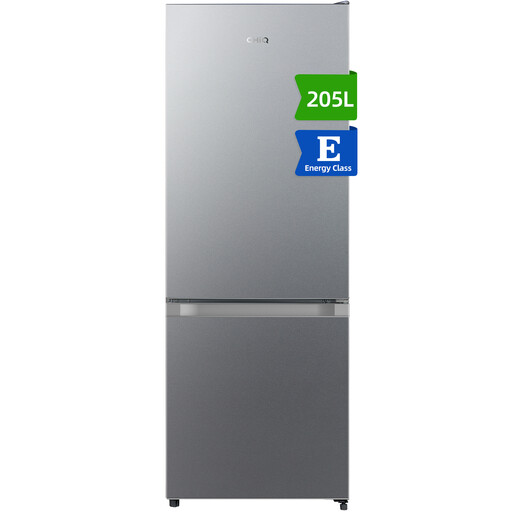 No image available
This freestanding model has separate fridge and freezer compartments for smaller kitchens that need both.
Total capacity: 205 l; Low Frost; fridge compartment: 153 l; freezer compartment: 52 l; energy class E.
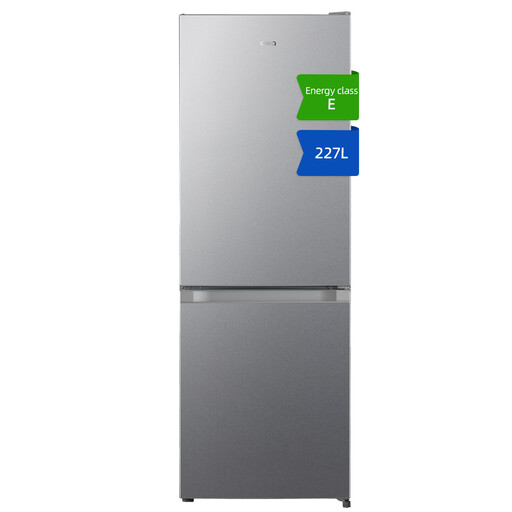 No image available
This freestanding fridge-freezer is an option if you need a separate freezer compartment for food stocks as well as fridge space.
Total capacity: 227 l; 54 cm wide; Low Frost; 4-star freezer compartment; fridge compartment: 153 l; freezer compartment: 74 l; energy class E.
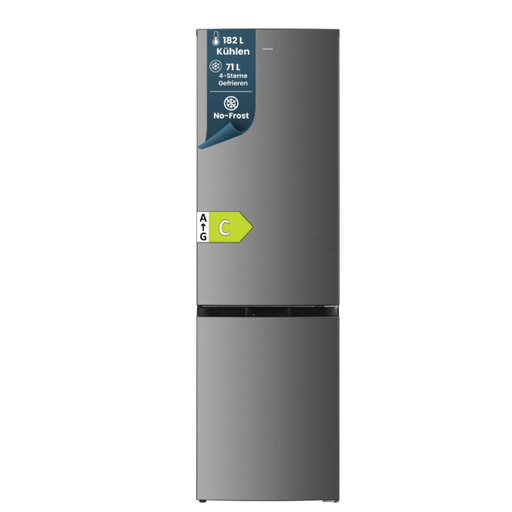 No image available
This freestanding model offers fridge and freezer space for households that want both in one appliance.
Total capacity: 253 l; No Frost; energy class C.
The BfR recommends eating leftovers at home within two to three days. Divide larger quantities into shallow portions and cool them to below 7 °C within a few hours. Buying a new fridge doesn’t automatically extend this recommendation.
No. What matters is the actual temperature inside the appliance. The BfR recommends a temperature of no more than 7 °C, ideally below 5 °C, and regular checks in different areas of the fridge.
Measure the depth, clearance from the wall, door opening space and delivery route too. Exquisit lists a width of 49,5 cm, a depth of 59 cm with clearance from the wall and a depth of 101 cm with the door open for the KGC232-60-E-040C; other models have their own dimensions.
The EU energy label shows kWh/year, compartment capacities and noise emissions in dB(A), among other information. Consumption figures are based on standardised test conditions; actual energy use also depends on how and where the appliance is used.