One- or two-person households with a modest appetite for bread
If you’d rather bake a small loaf than regularly use up larger quantities, look for a suitable loaf size that’s clearly specified. Panasonic Germany lists around 400 g for the SD-PN100.


If you regularly bake small loaves, a model that explicitly offers a small loaf size is a better place to start: Panasonic Germany lists around 400 g for the SD-PN100, while Tefal models PF210138 and PF240E38 offer loaf sizes from 500 g. Measure the space needed not only for the appliance itself, but also to open the lid and allow for ventilation. For new mains-powered appliances covered by the EU Low Voltage Directive, you should also check the safety requirements and the conformity documentation for the specific product listing.
If you’d rather bake a small loaf than regularly use up larger quantities, look for a suitable loaf size that’s clearly specified. Panasonic Germany lists around 400 g for the SD-PN100.
Allow for space to open the lid and for ventilation, as well as the appliance itself. Panasonic Germany lists the SD-PN100’s dimensions as 255 × 307 × 290 mm; a review by Technik zu Hause also highlights the space needed above the appliance.
If you sometimes need more than a small loaf, having a choice of loaf sizes can be useful. Tefal Germany lists sizes from 500 g for models PF210138 and PF240E38.
First check the smallest loaf size the machine is designed to make, then the space needed for the appliance and its operation, and finally the features you’ll actually use.
| What to look for | What should you check before buying? | Who is this especially important for? |
|---|---|---|
| Suitable loaf size | The smallest loaf size explicitly specified and the recipe quantities it suits; the weight of a bread mix is not automatically the weight of the finished loaf. | If I usually only get through a small loaf, I don’t want to have to plan for a larger one. That’s why around 34% of consumers put choosing the right loaf size first. |
| Space for the appliance and operation | Width, depth and height, as well as space for the lid when open, good ventilation and a stable surface. | If worktop space is limited, I want to know whether the lid will open and whether there’s enough room around the appliance for ventilation. Usable worktop space is the biggest concern for around 33% of consumers. |
| Controls and automatic features | Programmes for the types of bread you actually make, a timer and, where relevant, an automatic ingredient dispenser. | If I bake different recipes, I only want to pay for features that genuinely make the process easier. Around 20% of consumers prioritise ease of use and automation. |
| Overall costs | How often you bake, the cost of ingredients, the energy used by the programmes you choose and suitable replacement parts for the exact model number. | If I only bake occasionally, I want to weigh up whether the purchase price and ongoing costs suit the way I’ll use it. Around 13% of consumers put overall costs first. |
Additional ingredients are added to the dry mix. Rommelsbacher’s example of 500 g of bread mix and 350 ml of water corresponds to the 900 g setting on the BA 550.
Compare loaf size and recipe information on a like-for-like basis, rather than treating the weight of the mix as the weight of the finished bread.
An appliance might fit on your worktop, but there may not be room to open the lid or allow for the necessary ventilation. A review by Technik zu Hause notes that the Panasonic SD-PN100 needs extra space above it.
Check the full space needed for placing and operating the appliance in the instructions for the specific model.
A general verdict on an appliance doesn’t tell you whether its smallest intended loaf size suits your needs. Rommelsbacher lists 700 g and 900 g settings for the BA 550.
Check the smallest specified loaf size before weighing up other features.
The SD-PN100 and SD-PMC100 models are worth considering for smaller loaf sizes.
Models PF210138 and PF240E38 are options if 500 g is small enough for you and you’d like the flexibility to bake larger loaves occasionally.
The BA 550 could be a good choice if larger loaves and automatic ingredient dispensing matter more to you than a very small loaf size.
The Joybuy products below are bread makers. For each model, compare the smallest stated loaf size and the space it needs with your requirements.
 No image available
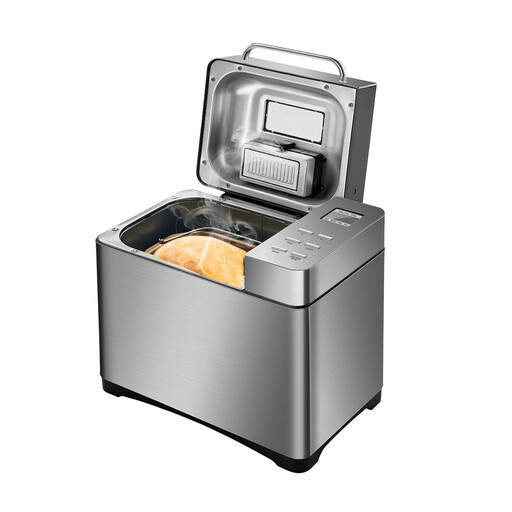
Worth considering if you want to choose between several loaf sizes and crust settings; check that the smallest setting suits the amount of bread you want to make.
The product title lists 19 programmes, three crust settings, three loaf sizes, a 15-hour timer and a one-hour keep-warm function.
 No image available
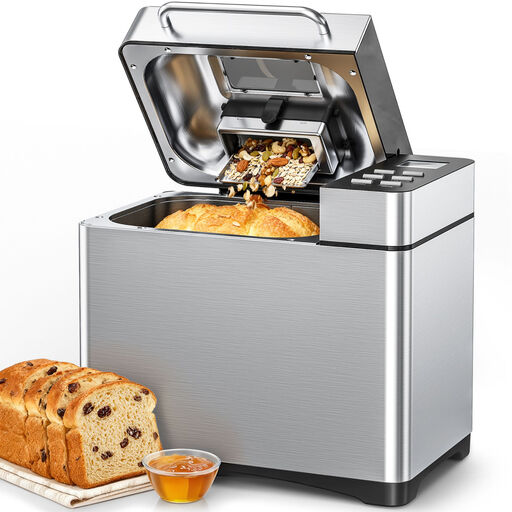
This could suit you if 500 g counts as a small loaf and you’d like to bake larger ones occasionally.
This model is listed with 500 g, 750 g and 1,000 g loaf sizes, an automatic ingredient dispenser and a 15-hour timer. A 400 g size isn’t listed.
 No image available
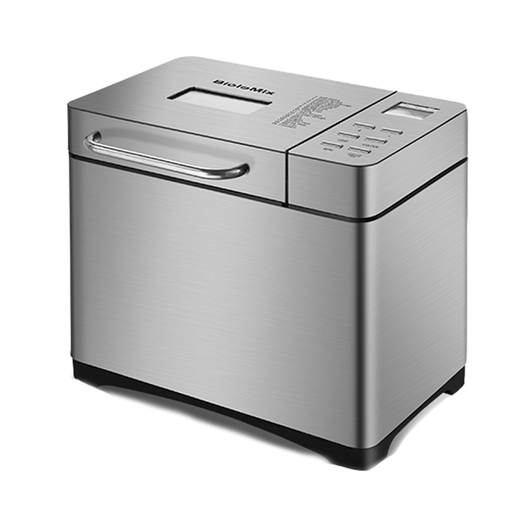
Worth considering if you want to add fruit and nuts automatically; check that the loaf size and worktop space suit your needs.
The product title lists 17 programmes, dual heating tubes, an automatic fruit and nut dispenser, a one-hour keep-warm function and a 15-hour delay timer.
Not without first checking that you have a suitable recipe and reading the instructions for the specific model. For example, a review by Technik zu Hause gives 200 to 280 g of flour as the recommended quantity for the Panasonic SD-PN100. For the BA 550, Rommelsbacher’s example of 500 g of bread mix and 350 ml of water corresponds to the 900 g setting.
First measure the appliance itself, then check that the lid can open and warm air can escape. For the SD-PN100, a review by Technik zu Hause recommends a stable worktop near a socket and advises against placing it on a cooker or tablecloth. Follow the instructions for the model you choose.
No. A programme doesn’t guarantee that the ingredients are gluten-free or prevent cross-contamination. Check the ingredients and how the appliance is used in your kitchen carefully; the German Coeliac Society highlights the risk of cross-contamination at home.
If a product is faulty, your statutory rights apply against the seller; a voluntary guarantee is separate. According to the Verbraucherzentrale, online purchases generally come with a 14-day right to cancel, starting from the day you receive the goods. Check the terms of your specific purchase; cancelling an order and exercising your rights over faulty goods are different things.
Mains-powered appliances covered by the EU Low Voltage Directive—those with a rated voltage of 50 to 1,000 V AC—must meet the relevant safety and conformity requirements, including CE marking and an EU Declaration of Conformity from the manufacturer. EUR-Lex explains the scope of the Directive; Your Europe notes that no central EU body issues an approval or certificate for CE marking. Check the markings and documentation for the specific model and product listing.