If you only make small batches
If you only want to fill a few jars, check the instructions for making smaller batches. For the JG 40, Rommelsbacher recommends filling any unused jars with water; Clatronic gives quantities per jar for the JM 3344.


For small, separate portions, the size and number of jars, along with the instructions for making smaller batches, are what matter most. A large overall capacity alone tells you little about whether a machine suits your needs. A timer and automatic shut-off can make fermentation easier to plan, but they don’t replace chilling the yoghurt afterwards or adding prepared ingredients in line with the model’s instructions.
If you only want to fill a few jars, check the instructions for making smaller batches. For the JG 40, Rommelsbacher recommends filling any unused jars with water; Clatronic gives quantities per jar for the JM 3344.
If you prepare a batch in advance and want to plan when fermentation finishes, look for a timer and automatic shut-off. You’ll also need to allow time and space for chilling afterwards; the Verbraucherzentrale explains how to store finished yoghurt in the fridge.
If you want to alternate between individual portions and larger batches, or try other preparations, compare the containers supplied and the programmes explicitly listed for each model. The JG 80 from Rommelsbacher comes with small cups, larger containers and programmes for uses including soft cheese.
First, check that the container sizes and instructions for smaller batches suit your needs. Then consider how you’ll plan the timing and which ingredients you actually want to ferment with the yoghurt.
| What matters | What to check before buying | Who is this especially important to? |
|---|---|---|
| Small batches | Compare the portion size, number of containers and instructions for making smaller batches. For the JG 40, Rommelsbacher recommends filling unused jars with water; Clatronic gives quantities for individual jars. | If I only want to make a few small jars, the batch size should suit my needs. Around 38% of consumers put small batches first. |
| Predictable finish time | Check whether the specific model has a timer with automatic shut-off. Also make room in the fridge for storing the yoghurt afterwards; the Verbraucherzentrale explains how to chill finished yoghurt. | If I plan my batch in advance, I want to be able to fit the end of the machine’s cycle into my day. Around 31% of consumers prioritise this kind of time planning. |
| Flexible recipes | Compare the container sizes and the programmes actually supported. For the JG 80, Rommelsbacher recommends adding sugar, fruit and flavourings to the finished yoghurt. | If I want to make different batches or use different container sizes, I want to prepare ingredients to suit each recipe. Around 31% of consumers prioritise flexibility with recipes and containers. |
Large containers don’t automatically mean you’ll get lots of small, individually portioned jars. For example, the Rommelsbacher JG 80 comes with four 125-ml cups and two 1.2-l containers, while the JG 40 is supplied with eight 150-ml jars.
Count the containers in the size you want and check they suit the batch you’re planning.
More containers and lids can take up extra space in your cupboards and make cleaning more time-consuming.
Automatic shut-off stops the machine, but it doesn’t chill the yoghurt. The Verbraucherzentrale explains that the jars should then be stored in the fridge.
Plan for the end of fermentation and chilling afterwards as two separate steps.
Once the programme has finished, you’ll still need time and space in the fridge.
For the JG 80, the manufacturer’s instructions recommend adding sugar, fruit and flavourings to the finished yoghurt. This advice applies to the model mentioned and shouldn’t be assumed to apply to other machines without checking first.
If needed, prepare additions separately and follow your machine’s recipe or instructions.
The JG 40 and JG 80 differ in their containers and preparation options; the details below apply to each specific model.
The JM 3344 is a straightforward model with portion jars; its instructions include guidance for smaller batches.
The features listed below relate to different models and shouldn’t be assumed to apply to all of them.
The JM 2 is designed for several larger individual jars.
This selection includes yoghurt makers with individual jars and a timer, as well as models with larger containers. If you’re planning to make only a few portions, compare the individual container sizes carefully and bear in mind that what’s supplied varies by model.
 No image available
The nine individual 100-ml jars are ideal if you want to make small portions separately.
Features listed include a 1.6-l stainless steel inner container, temperature control from 21–48 °C and a 1–99-hour timer with automatic shut-off.
 No image available
Nine individual 100-ml jars are a handy option if you want to prepare several small portions separately.
Details list a 1.6-l SUS304 inner container, temperature control from 21–48 °C and a 1–99-hour timer with automatic shut-off.
 No image available
Eight individual jars give you separate containers if you want to prepare several portions at once.
Product details list a total capacity of 1,440 ml, temperature control from 20–55 °C and a timer of up to 48 hours with automatic shut-off.
 No image available
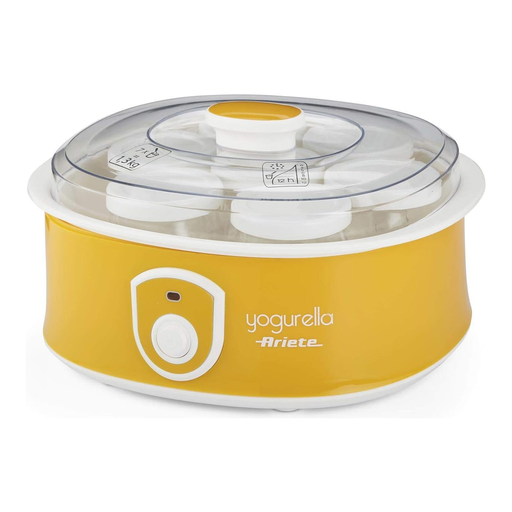
The seven individual jars with lids let you portion out the yoghurt separately.
Product details list a capacity of 1.3 l and a power rating of 20 W. The machine is listed as refurbished.
 No image available
The large containers are better suited to bigger batches. If you want individual small portions, you’ll need to divide the yoghurt up afterwards.
The listed contents include two glass containers with capacities of 2,000 ml and 1,400 ml.
It depends on the specific model. For the JM 3344, Clatronic gives quantities per jar for smaller batches; for the JG 40, Rommelsbacher recommends filling jars that aren’t being used for yoghurt with water. Follow the instructions for your particular machine.
For the JG 80, the manufacturer’s instructions recommend adding fruit, sugar and flavourings to the finished yoghurt. If needed, prepare these additions separately and check the instructions or recipes for other machines.
Yes, put the jars in the fridge afterwards. The Verbraucherzentrale recommends storing yoghurt on the middle shelf of the fridge; automatic shut-off doesn’t chill it for you.
The Federal Institute for Risk Assessment recommends boiling raw milk before drinking it. This also applies when making yoghurt at home if it won’t be heated sufficiently again before eating; fermentation in the machine doesn’t replace this step.
The Federal Network Agency lists CE marking, manufacturer details and German-language instructions among the checks carried out as part of its market surveillance. As the Verbraucherzentrale explains, statutory consumer rights are separate from a voluntary guarantee; a CE mark alone doesn’t mean that a public authority has tested the individual machine.