Choir music listeners with a regular listening spot
If you can position a speaker on each side of your listening spot, a separate stereo pair could be a good option. Genelec recommends a symmetrical setup for good stereo imaging.


If you can position two speakers on either side of your listening spot and the stereo imaging of your recordings matters to you, a stereo pair is a natural place to start. If you only have room for one speaker, or want to keep the setup as simple as possible, a single streaming speaker could be a good fit. Before you buy, check that your audio source matches the available connections, and find out whether you’ll need a second compatible device to add stereo later.
If you can position a speaker on each side of your listening spot, a separate stereo pair could be a good option. Genelec recommends a symmetrical setup for good stereo imaging.
If you switch between streaming, a computer and existing audio equipment, first check that your sources’ outputs match the speaker’s inputs. Connections vary by model.
If there’s only one suitable space in your small living room, a single compact speaker may be more practical. However, it’s not the same as having two speakers positioned apart for stereo sound.
A good fit if: You stream regularly and have space for two speakers on either side of your listening spot.
Things to consider: Check how the speakers connect to each other and whether the product actually includes a pair.
A good fit if: Your audio source can connect directly to one of the speaker’s inputs, such as USB audio, optical or analogue on the ELAC Debut ConneX DCB41.
Things to consider: The listed connections alone don’t confirm that the speakers have built-in Wi-Fi streaming.
A good fit if: You only have space for one speaker to begin with and want to stream without any fuss.
Things to consider: You’ll need a second compatible device to create a separate stereo pair with the Sonos Era 100.
| What matters when buying | What to check | Who it matters most to |
|---|---|---|
| Stereo imaging | Check whether two speakers can be positioned as symmetrically as possible around your listening spot, and whether the product includes a pair. | If I want to hear the left and right sides of choir recordings from my regular listening spot, I need room for two speakers. Around 40% of consumers say stereo imaging matters most to them. |
| Connecting your source | Check your source’s output against the specific speaker input. For the Era 100’s AUX connection, you’ll need a separate Sonos input adapter. | If I switch between streaming, a computer and existing audio equipment, the connection needs to work with my source. Around 30% of consumers say source compatibility is their main priority. |
| Space and positioning | Measure the space available and consider whether you can position a pair roughly symmetrically around your listening spot. | If space is limited in my small living room, I need to decide whether one speaker will do or whether I can make room for two. Around 20% of consumers say available space is the deciding factor. |
| Complete setup | Check whether the product includes one or two speakers, and which adapters or connection cables your source needs. | If I want separate stereo speakers, I compare the full setup I’ll need rather than just one device. Around 10% of consumers say the total cost of the setup matters most to them. |
One speaker on its own doesn’t make a separate stereo pair. KEF describes the LSX II LT as a pair; Sonos says you need two compatible speakers for a Sonos stereo pair.
First check how many speakers are included, then compare the setup you actually plan to use.
Even streaming speakers may need a connection between the speakers or an adapter for a wired source. Sonos specifies a separate input adapter for the Era 100’s AUX connection, while KEF describes a connection between the LSX II LT speakers.
Trace the signal from your audio source to both speakers and check what accessories you’ll need.
Speaker positioning and reflections in the room can affect the sound at your listening spot. A manufacturer’s sound description isn’t a measurement of how the speakers will perform in your living room.
Plan where you’ll position the speakers before buying, and don’t treat studio recommendations as fixed minimum distances for every living room.
According to the German manufacturer’s website, the LSX II LT is a streaming system sold as a pair for two separate speaker positions.
With a range of inputs, the Debut ConneX DCB41 is designed for people with existing computer and audio equipment.
The Era 100 is a compact option for Wi-Fi or Bluetooth playback if you’re starting with space for just one speaker.
According to the manufacturer, the S1000W combines Wi-Fi streaming and Bluetooth with several inputs.
The compact 8010A is a specialist option for use with a compatible analogue XLR source and a regular listening spot.
The Joybuy products below include active stereo pairs and compact systems for single or separate speaker positions. Compare the listed inputs with your source and check which devices are included for the setup you want.
 No image available
This active stereo pair could suit a source with a compatible input if you have space for two speakers.
40 W; Bluetooth; HDMI ARC, optical, USB, AUX and RCA inputs. Also listed are bass and treble controls, a dimmable LED display and a remote control.
 No image available
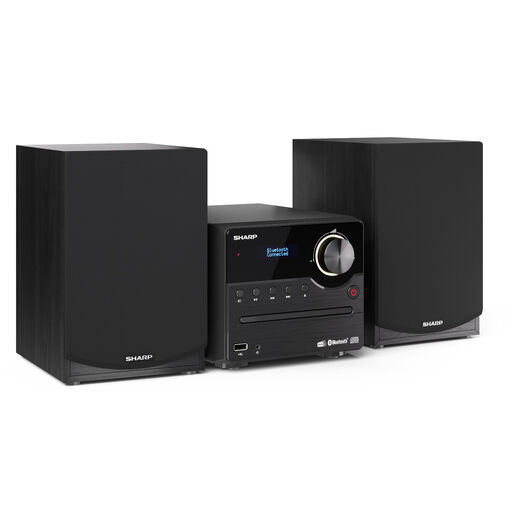
This system is an option if you want two separate speakers and a choice of playback methods.
45 W; Bluetooth, CD/MP3, USB and AUX. Also listed are DAB+, FM radio, a remote control and sound controls.
 No image available
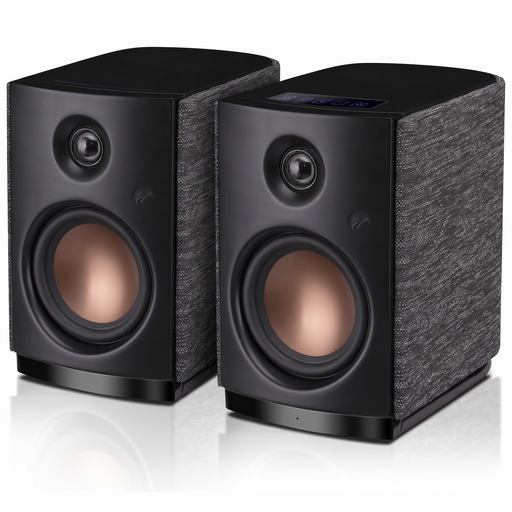
These active bookshelf stereo speakers could suit you if your source supports Bluetooth or AUX.
Bluetooth 5.0; AUX input; 4-inch woofer; 62 W RMS. Touch controls are also listed.
 No image available
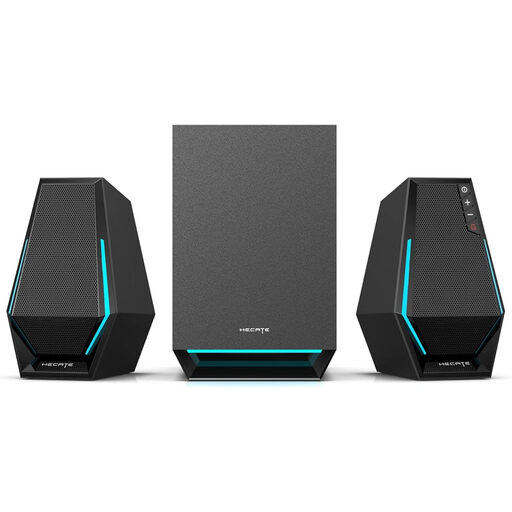
The system includes two satellites and a subwoofer. Check that this setup works with your available space and how you want to listen.
60 W; Bluetooth 5.3, USB, USB-C and 3.5 mm AUX input. A music mode is also listed.
 No image available
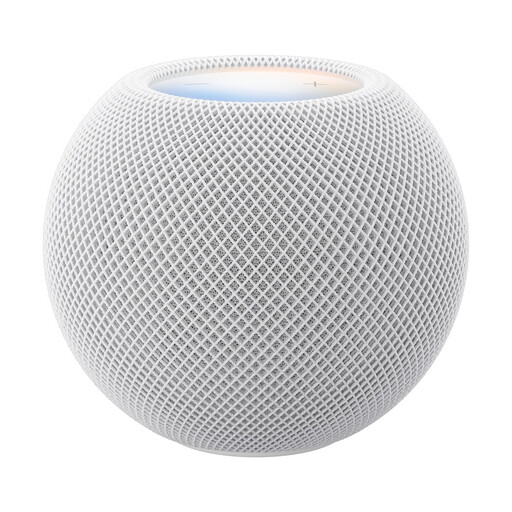
This compact smart speaker could be a good fit if you want to play audio over your network and start with just one speaker.
Wi-Fi and AirPlay; you’ll need another HomePod mini 2 for a stereo pair.
No. If you want to hear the left-to-right image of a stereo recording from your regular listening spot and have room for two speakers, a separate pair could be a good option. Sonos says you need two compatible speakers for a Sonos stereo pair.
Start by positioning the speakers as symmetrically as possible on either side of your listening spot, and at a similar height. Genelec notes that room reflections and different distances from the walls can affect stereo imaging. Studio positioning measurements aren’t a general minimum requirement for every living room.
Check your source’s output against an input specifically listed for the speaker you’re considering. For the Sonos Era 100’s AUX connection, Sonos specifies a separate input adapter.
For the electrical and radio equipment it covers, Germany’s Federal Network Agency lists points to check including CE marking, manufacturer details, necessary information in German and declarations of conformity. A CE claim in a product listing doesn’t, on its own, prove that a specific item complies.
In Germany, waste electrical equipment shouldn’t be put in household rubbish. The Federal Environment Agency lists recycling centres and suitable take-back points; removable batteries should be taken out and disposed of separately before you hand the speaker in.