Photographers using window light
If you photograph small sculptures by a window, try placing a reflector on the shadow side, or using a diffuser in direct sunlight. Westcott University describes both options for controlling the available light.


Start with the light from your window: a reflector can lighten shadows, while a diffuser can soften harsh sunlight – and neither requires an additional lamp. If the light isn’t consistent enough for repeatable shots, consider a softbox with a suitable light. Check the connection, space requirements and what’s included, as a light modifier on its own doesn’t produce light.
If you photograph small sculptures by a window, try placing a reflector on the shadow side, or using a diffuser in direct sunlight. Westcott University describes both options for controlling the available light.
If you’re shooting from several angles or on different occasions, an additional light that you can position precisely may be useful when the window light changes. Shopify Deutschland highlights how the time of day and the angle affect shots taken in natural light.
If you want to light surfaces and contours but have little room, or already own a light, check the size of the light modifier and that its connection is compatible. SmallRig lists the RA-D55 as having a diameter of 55 cm and a Bowens mount.
First, check whether a reflector or diffuser can shape the window light enough for your sculpture. Only then decide whether you need an additional light and a suitable modifier.
| What you need | What to look for when buying | Who is this particularly relevant to? |
|---|---|---|
| Controlling shadows | If there’s enough window light, try a white reflector on the shadow side; in direct sunlight, place a diffuser between the window and the subject. | If I want to lighten deep shadows without setting up another lamp straight away, I’ll try these options first. Around 36% of consumers put shadow control first. |
| Getting consistent light and colour | Check the light’s specific colour temperature settings and dimming options. Assess the effect alongside the current window light in a test shot. | If several views need to be lit as consistently as possible, I want to know how the additional light can be adjusted. Around 27% of consumers prioritise repeatable lighting and colour. |
| Showing surfaces and contours | Compare the shape and size of the light modifier, and the effect of a grid, with test shots from several angles. | If I want to control reflections and sculptural contours, I compare the quality of the light rather than just the softbox dimensions. Around 19% of consumers put this first. |
| Checking space and connections | Check the space available, the connection on your existing light and the contents listed for the specific model, including a stand and diffusers. | If I need to keep my set-up compact or want to reuse equipment I already own, the connection and included accessories are essential. Around 18% of consumers prioritise space, compatibility or what’s included. |
A light modifier can’t produce light on its own without a suitable light. The NEEWER SB-BW6090 doesn’t include a light or stand; according to BRESSER, the BRESSER BR-60S kit does include lights, stands and softboxes.
If you buy a light modifier on its own, you may also need to budget for a compatible light and stand.
Compare the contents listed for each specific model before weighing up individual items against kits.
Size, distance and diffusion all affect shadows and reflections. If shadows are lifted too much, a sculpture’s contours may look less defined.
Adjust the position of the light modifier gradually, and compare test shots taken from different distances and angles.
Window light can change. A light with a fixed colour temperature doesn’t offer the same adjustability as one with a variable colour temperature.
Check the specific settings on the light and assess both light sources together in a test shot.
Rectangular Bowens light modifiers are an option if you have a compatible light.
The RA-D55 is a compact light modifier for a space-conscious set-up with a compatible Bowens light.
Rectangular Bowens softboxes may be worth considering for a broader light source if you have enough space.
The BR-60S is a lighting kit with softboxes, suited to a set-up where you don’t already have lights and stands.
Compact Bowens light modifiers may suit compatible point-source lights.
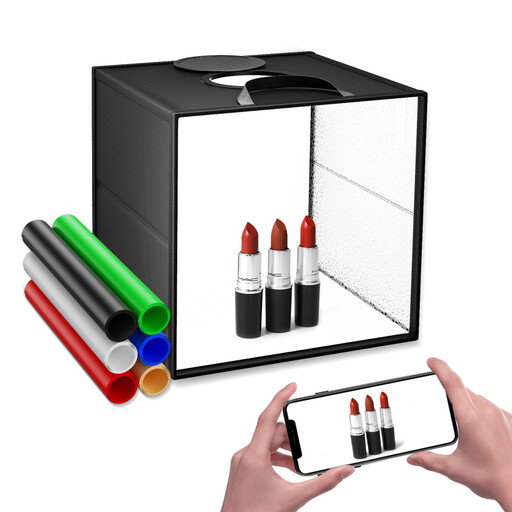
This selection includes a photography light box for small still-life subjects. It isn’t a softbox for a separate light, so it’s a different lighting solution from a light modifier used by a window.
 No image available
For small still-life subjects, this photography light box is a possible alternative if you’re looking for a compact light box rather than a softbox light.
The product title lists 120 LEDs, three colour temperatures and nine dimming levels.
It folds away and measures 30 cm; the title also lists six coloured backgrounds as included.
No. If the window provides enough light, first try placing a reflector on the shadow side, or using a diffuser when the light is direct and harsh. An additional light may be useful if you need more control over the amount or direction of the light.
First, check that the connection fits your specific light model and find out what’s included. Start by positioning the softbox to one side of the sculpture, then use test shots to assess the distance and angle. A grid can limit spill light if it’s included with the model or available separately; a softbox on its own isn’t a light.
If you’re buying a light modifier on its own, check whether you already have a compatible light and stand, or whether you’ll need to buy them separately. For online purchases by consumers in Germany, there is generally a 14-day right of withdrawal, as explained by the Verbraucherzentrale. Your statutory rights against the seller are separate from any voluntary guarantee.
Whether an electric light must carry CE marking depends on the EU regulations that apply to the specific device. For the Low Voltage Directive, the European Commission gives a scope of 50 to 1000 V AC or 75 to 1500 V DC. Check the information for the specific light model, and don’t automatically apply requirements for electrical equipment to a passive fabric softbox.