
Lieferung heute & morgen

Qualitätsgarantie

Willkommens-Angebote freischalten: KOSTENLOSE Lieferung | Bis zu 80 % RABATT | Kostenlose 30-Tage-JoyPlus-Testphase
App herunterladen
A small shelving unit can give you extra storage without taking up too much floor or worktop space. But compact furniture can vary considerably in size, materials, load capacity and assembly. If you focus only on looks or a low price, you may find after buying that the unit doesn’t fit the space you had in mind or isn’t suitable for what you plan to store on it.
With a shelving unit, width isn’t the only thing that matters. Depth, height, internal dimensions and the clearance around doors or worktops are important too. A 40 cm-wide model can take up very different amounts of space depending on its depth, whether it’s in a narrow kitchen, beside a bed or under a wall cupboard.
So before you buy, check:
A 2-tier shelf gives you two surfaces to store things on, but its permitted load may be limited. Don’t assume you can put heavy pans, jars of food or books on every shelf. Load limits should relate to the specific product and shouldn’t be inferred from general marketing claims.
For example, the 5five Blackwood 2-Tier Shelf has a stated total load capacity of 10 kg, or 5 kg per shelf. According to the product information, heavy items should go on the lower shelf. For other models, check the product page for the same information.
Words such as “natural”, “sturdy” or “high quality” don’t tell you much about how a product is made. A bamboo shelving unit can differ from another model in its frame, finish and fittings. For shelving made from MDF or chipboard, it’s also important to check whether the surfaces are coated or untreated.
Look for details of:
A kitchen shelving unit with easy-to-reach shelves is ideal for herbs and spices or kitchen utensils. A kitchen corner shelf, on the other hand, makes use of an unused corner on the worktop, under the sink or inside a cupboard. In the living room, a narrow bookcase can sit beside an armchair or against a narrow section of wall.
These options are often practical in hallways, bedrooms and home offices:
Open shelves give you quick access and work well for books, plants, herbs and spices, or decorative items. A shelving unit with rattan doors combines open and closed storage. Check how many compartments are actually open and whether the doors need enough room to swing open.
Closed compartments keep their contents out of sight, but they’re not automatically more practical for every room. In a small kitchen, a door in front of the shelving may need extra clearance. Open shelves are often simpler for decorative items or utensils you use regularly.
A freestanding shelving unit should stand on a flat, stable surface. Anti-tip protection is particularly important in homes with children or pets. Don’t use the unit for climbing or to hold on to. Where possible, place heavy items on the lower shelves to keep the centre of gravity low.
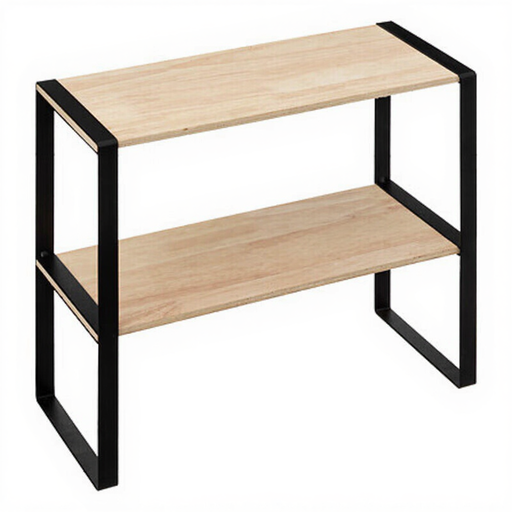
Why this product suits these needs: Its compact, freestanding design makes it a handy side shelf, bedside table or extra surface in a home office.
The product information lists the dimensions, material, load limit and safety advice. Before buying, check the detailed description for a different measurement.
Two shelves on a compact footprint; stated total weight of 1.81 kg and straightforward self-assembly.
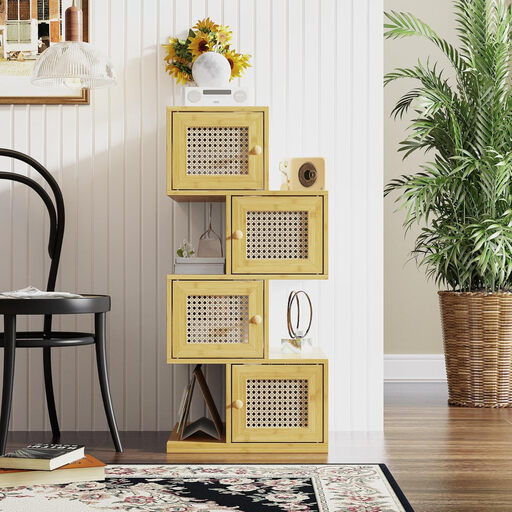
Why this product suits these needs: This taller unit combines open compartments with rattan doors, making it a good fit for a living room, bedroom, hallway or office.
Its 85 cm height and shallow 25.4 cm depth make it easier to plan where it will go. Remember to allow for wall clearance and consider anti-tip protection before setting it up.
Four compartments, according to the product description; a combination of a bamboo frame and enclosed rattan doors.
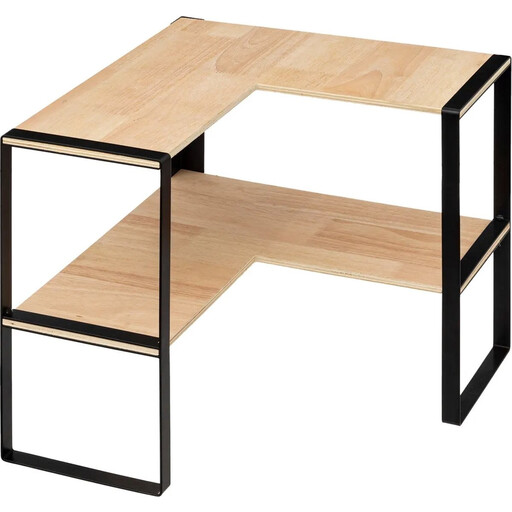
Why this product suits these needs: Its square shape is designed for corners, kitchen worktops, cupboards and the space under the sink.
The stated external dimensions help you check whether it will fit in a corner or cupboard. If you plan to store heavy pans or food supplies, check the actual load capacity before filling it.
Two shelves; steel and plywood construction; the product information says it’s suitable for jars of herbs and spices, food containers and pans.
We’ve put together a complete, regularly updated list of products that meet these strict selection criteria and fully comply with the safety regulations in force in the EU.
Before assembly, check all the parts against the product description. Start by tightening the screws only slightly, then level the unit on a flat surface. Once it’s in position, fully tighten the fittings. If the manufacturer recommends securing a freestanding unit to the wall, do so – particularly in a home with children or pets.
For many coated or smooth surfaces, a lightly dampened cloth is all you need. Untreated wood, bamboo and composite boards shouldn’t be left exposed to moisture for long periods. In the kitchen, remember to clean away steam and grease regularly too.
It depends on the material, construction and assembly. Always follow the load limit given for the specific product. Heavy items should generally be placed on the lower shelf. The 5five Blackwood 2-Tier Shelf is rated for 5 kg per shelf.
A shallow depth can be useful in hallways, bedrooms or narrow alcoves. Before buying, measure the depth you need for your books, boxes or kitchen utensils. Make sure doors, drawers and walkways can still be used freely.
Place it on a level surface, keep heavy items on the lower shelves and use the wall fixing supplied or recommended by the manufacturer, or a suitable anti-tip kit. Children shouldn’t climb on the shelves or use the unit to hold on to.