
Lieferung heute & morgen

Qualitätsgarantie

Willkommens-Angebote freischalten: KOSTENLOSE Lieferung | Bis zu 80 % RABATT | Kostenlose 30-Tage-JoyPlus-Testphase
App herunterladen
A smart body fat scale with app connectivity can be a useful tool for tracking fitness goals and developing a better understanding of your body composition. However, the market is flooded with models whose marketing promises often create more confusion than clarity. Before you make a decision, it's crucial to understand the common pitfalls that can lead to an unsuitable purchase.
This guide will help you identify the key features and find a smart scale that truly meets your needs.
Many buyers focus on superficial features and overlook critical technical details. Pay attention to these three points to avoid a wasted investment:
To make an informed decision, you should focus on the technical fundamentals. These three parameters are crucial for the functionality and reliability of your future scale.
Modern body fat scales use Bioelectrical Impedance Analysis (BIA). This process sends a weak, imperceptible electrical current through the body. Because fat, muscle, and water conduct electricity differently, the scale can calculate your body composition from the measured resistance (impedance). There are two basic systems:
The method of data transfer significantly impacts user convenience.
For households with multiple people, automatic user recognition is an important feature. The scale automatically assigns the measured weight to the correct profile. Also, pay attention to the maximum weight capacity (typically 150 kg to 180 kg) and a sufficiently large platform made of tempered safety glass for a stable and secure footing.
Based on the criteria mentioned, we have identified several models that offer a suitable solution for different user groups.
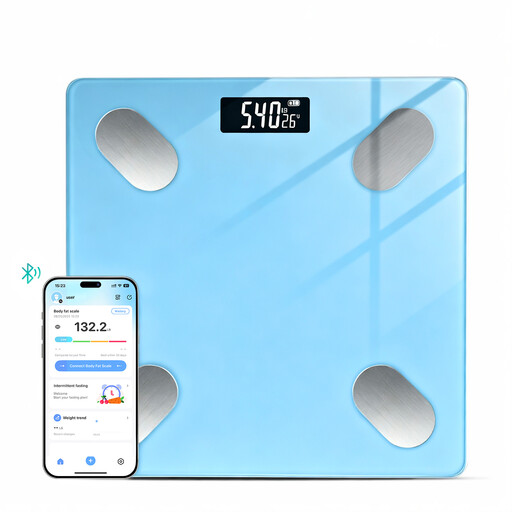
Why This Fits Their Persona: This model is ideal for users who want to track their health data easily and without a large investment. It offers all the basic functions to get started with more conscious health management.
The scale focuses on 13 essential body metrics, thus avoiding "metric inflation." The simple Bluetooth connection with the OKOK app is reliable and easy for beginners to set up.
Tracks 13 metrics including BMI and muscle mass. Supports multiple user profiles with automatic recognition. Operates on 2xAAA batteries (not included).

Why This Fits Their Persona: Perfect for families looking for one scale for all members. The special mode for weighing babies or pets and support for up to 10 user profiles make it a versatile household companion.
The ITO glass surface ensures uniform conductivity without visible metal electrodes, improving measurement consistency. The app is designed for managing multiple profiles, solving the problem of isolated data within the family.
Analyzes 25 body metrics, including heart rate. Features a baby and pet mode. High weight capacity up to 200 kg. Batteries (3xAAA) are included.
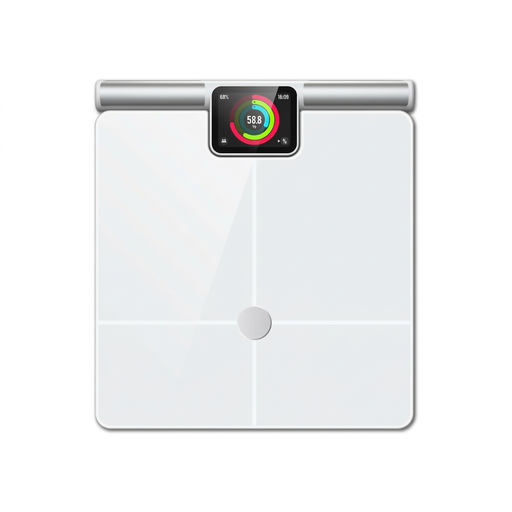
Why This Fits Their Persona: For athletes and fitness professionals who need detailed, segmental body analysis to optimise training and nutrition plans. The high measurement accuracy is essential for monitoring specific progress.
This model justifies its 56 metrics with advanced 8-electrode technology and dual-frequency BIA, which enables precise segmental analysis. The Wi-Fi and Bluetooth connectivity ensures reliable data synchronisation.
Professional 5-compartment body analysis. Measures 56 comprehensive body metrics. Dual connectivity with Wi-Fi and Bluetooth for automatic synchronisation. Batteries (4xAAA) are included.
We have compiled a complete, up-to-date list of products that fully meet these strict selection criteria and German safety regulations.
1. How accurate is a home body fat scale? A body fat scale for home use does not provide medically exact absolute values, but it is a very good tool for tracking trends and relative changes. Accuracy is significantly influenced by consistent measurement conditions. For reliable trend analysis, you should always weigh yourself at the same time of day, under similar conditions (e.g., in the morning after getting up and before breakfast), and on a hard, level surface.
2. What's the difference between a 4-electrode and an 8-electrode scale? A 4-electrode scale measures body resistance only in the lower body (between the feet) and extrapolates the values for the rest of the body. An 8-electrode scale uses additional sensors in a handheld unit to analyse the arms, legs, and torso separately. This results in a more accurate and detailed segmental analysis, which is particularly beneficial for athletes.
3. Do I need a scale with Wi-Fi, or is Bluetooth enough? That depends on your preference for convenience. A Bluetooth scale requires your smartphone to be nearby with the app open to synchronise the data. A scale with Wi-Fi connects independently to your home network and uploads the data automatically. This is more convenient if you don't want to connect with your smartphone every time or if multiple people in the household use the scale.