
Lieferung heute & morgen

Qualitätsgarantie

Willkommens-Angebote freischalten: KOSTENLOSE Lieferung | Bis zu 80 % RABATT | Kostenlose 30-Tage-JoyPlus-Testphase
App herunterladen
A smart floor lamp can do more than just provide light—it can transform your living room into a dynamic backdrop, sync with your music, or automatically adjust to daylight. But the market is flooded with models whose smart features cause more frustration than joy in practice. Before you invest, it's crucial to understand the common pitfalls that often only become apparent after the purchase.
As your Joybuy Product Recommendation Officer, I'll help you separate the wheat from the chaff. We'll focus on the critical features that distinguish a reliable smart lamp from a useless one.
Many products advertise impressive features but fail in their basic execution. Pay special attention to these three weaknesses:
WiFi floor lamp that constantly loses its network connection isn't smart; it's an annoyance. Control via app or voice becomes impossible, and the lamp loses its main benefit. The cause is often low-quality Wi-Fi modules or poorly programmed firmware.LED RGB floor lamp models disappoint with pale colours and low brightness. Instead of a vibrant red, you get a washed-out pink, and the maximum brightness is barely enough to illuminate a reading corner. Good living room mood lighting must be able to deliver both intense colours and functional white light.Alexa floor lamp or Google Assistant only works sporadically? A poor software experience renders the entire product unusable.To avoid these pitfalls, you should carefully examine three technical aspects. These determine the reliability and long-term value of your smart floor lamp.
The type of connection is crucial for stability.
The quality of the light is determined by several values.
mood lighting, 300-500 lm may be sufficient. If the lamp is also intended to serve as a reading or main light source, at least 1000 lm is recommended. Having a good dimmable floor lamp is essential here.gaming lamp. This is the key to a true colour-changing floor lamp effect.A good smart lamp offers flexible control options. Check if the model is seamlessly compatible with the voice assistants you use, such as Amazon Alexa or Google Assistant. Read reviews of the manufacturer's app: Is it intuitive? Is it updated regularly? Does it offer useful features like schedules, scenes, or music synchronisation? A Govee floor lamp is often a good example of a well-thought-out ecosystem.
Here are three models that represent a considered choice for different user profiles based on objective features.
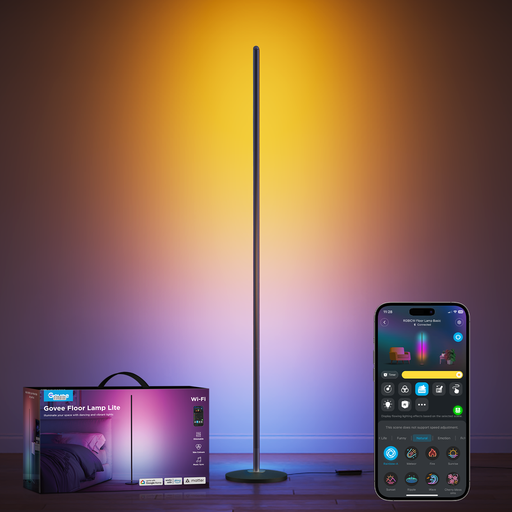
Why This Fits Their Persona: Ideal for users who want to create dynamic light scenes for gaming, movies, or parties. Control via the mature Govee Home App and compatibility with Alexa and Google Assistant offer maximum flexibility.
The RGBIC technology prevents pale, uniform colours, instead enabling vibrant, segmented colour gradients. The stable Wi-Fi connection and the established Govee ecosystem bypass the typical compatibility and connectivity issues.
RGBIC technology for multi-colour effects; integrated music synchronisation; extensive scene modes in the app.
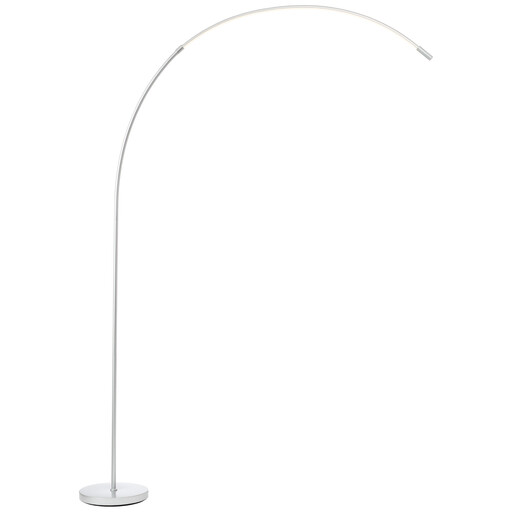
Why This Fits Their Persona: Perfect for anyone seeking a modern design object with smart functionality. The arch shape is a stylish accent in the living room, while the light control allows for adjustment to any mood—from cosy to focused.
This model focuses on high-quality white light tones (CCT) and a solid brightness of 1300 lumens, rather than on low-quality RGB effects. Control is reliably handled via a touch dimmer directly on the device, which eliminates app or connection problems.
CCT function for stepless adjustment of colour temperature (3000-6500 K); continuously dimmable via touch; elegant design made of aluminium.
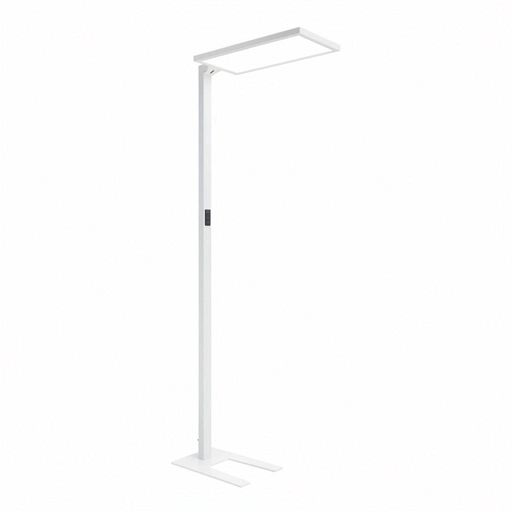
Why This Fits Their Persona: This is professional office lighting for the home office. Its smart features are designed for productivity and energy efficiency, not entertainment. It ensures standard-compliant, glare-free illumination of the workspace.
This model completely avoids the "gimmick" trap. The integrated sensors are reliable tools for automation. With an extremely high light output of up to 12,600 lumens and a UGR value of <19 (low glare), it solves the problem of insufficient light quality.
Integrated daylight and motion sensor; very high brightness for professional demands; separately controllable direct and indirect light.
We've compiled a complete, up-to-date list of products that fully meet these strict selection criteria and local safety standards.
1. How much power does a smart LED floor lamp consume? Consumption is typically very low. Most models have a power consumption between 10 and 25 watts. With 5 hours of daily use and an electricity price of 30 cents/kWh, the annual costs are often only between 5 and 15 euros. You can find exact details in the product specifications under "Wattage".
2. Do I always need a bridge or a hub for a Wi-Fi floor lamp? No, a bridge or hub is generally not required for a pure Wi-Fi floor lamp. It connects directly to your router. A hub is only needed for other wireless standards like Zigbee or Z-Wave.
3. Can I also operate a smart floor lamp with a normal light switch? Yes, most smart lamps can be turned on and off with a conventional wall switch. However, they often lose their "smart" settings (e.g., the last colour or brightness) and revert to a default mode. For full functionality, control via the app, voice, or an integrated switch is intended.