
Lieferung heute & morgen

Qualitätsgarantie

Willkommens-Angebote freischalten: KOSTENLOSE Lieferung | Bis zu 80 % RABATT | Kostenlose 30-Tage-JoyPlus-Testphase
App herunterladen
A smart LED bulb should do more than simply provide light: app control, dimming, adjustable colour temperature and voice commands via Alexa or Google Assistant are now standard features for many smart home users. At the same time, models differ considerably in terms of fitting, wireless standard, brightness and installation requirements.
If you only look at a high wattage or the number of available colours, you could easily buy a bulb that does not fit your existing light fitting or is impractical in everyday use. The following points will help you avoid common selection mistakes.
For LED bulbs, wattage mainly describes power consumption. The luminous flux, measured in lumens, determines the actual brightness. Depending on its design, a Smart LED bulb with 4.5 watts can produce around 350 to 470 lumens, while a 6-watt model can reach up to 850 lumens.
As a rough guide:
The statement “equivalent to a conventional 40-watt bulb” is therefore only a comparison value. The stated lumen rating remains the decisive factor.
A Wi-Fi LED bulb often connects directly to the router, but many models require a 2.4 GHz Wi-Fi network. A network configured exclusively for 5 GHz may prevent the initial setup. Bluetooth bulbs, on the other hand, can usually be paired directly with a smartphone.
With several lights, a Bluetooth Mesh bulb may be a sensible choice. Compatible bulbs communicate with one another. However, voice control or remote access from outside the home may require a gateway, depending on the model. The terms “Bluetooth”, “Bluetooth Mesh” and “Wi-Fi” should therefore not be treated as interchangeable.
A decorative LED filament bulb with visible filaments looks different in an open pendant or wall light than a compact standard bulb. Before buying, compare the fitting, diameter and overall height:
The distance to the lampshade is also important. A G125 globe bulb can have a diameter of around 125 millimetres and a height of more than 160 millimetres.
As well as lumens, the beam angle is relevant. An angle of around 200 degrees distributes light broadly throughout the room. Models with 360 degrees are particularly suitable for lights where the bulb is visible from all sides.
The CRI or Ra value describes colour rendering. A value of Ra ≥ 80 is standard for the indoor bulbs considered here and provides a useful guide for living areas. For a desk lamp, you should also check whether the brightness is suitable for the activity and the size of the room.
A dimmable LED bulb with warm white to cool white light will generally offer a range of around 2700 to 6500 Kelvin:
An RGB+CCT LED bulb combines these white tones with coloured light. This is useful for scenes and decorative lighting, but does not automatically replace bright room lighting. You should therefore check whether the stated lumen rating applies to white light, coloured light or both operating modes.
With smart models, dimming is often controlled via the app or voice commands. A traditional wall dimmer is not automatically compatible and can cause flickering or malfunctions.
For running costs, consumption in watt-hours is what matters. A 6-watt bulb uses around 6 kWh over 1,000 hours of operation. You should also consider the energy efficiency class, stated lifespan and permitted ambient temperature.
Many models have an IP20 rating and are intended exclusively for dry indoor areas. Fully enclosed light fittings can restrict heat dissipation. The manufacturer's instructions on ventilation and use in enclosed fittings should therefore be read before installation.
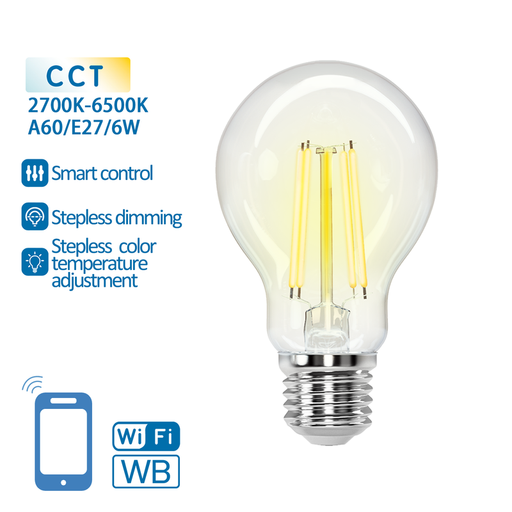
Why this product suits this profile: E27 fittings are widely used in German household lights. This model offers 850 lumens, 6 watts, adjustable white light from 2700 to 6500 Kelvin, plus app and voice control via Alexa or Google Home.
The lumen rating is clearly highlighted alongside the power consumption. Setup requires a 2.4 GHz Wi-Fi network; according to the product details, no additional gateway is required.
E27 base, 850 lumens, 2700–6500 Kelvin and dimming via app or voice control.
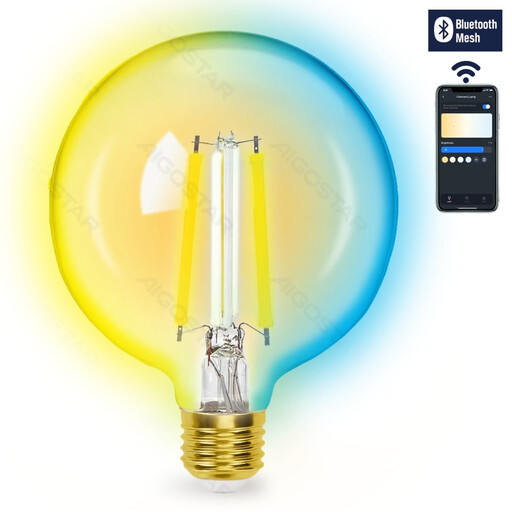
Why this product suits this profile: The large vintage globe shape with visible filament is ideal for open pendant, wall and table lights. With 806 lumens and adjustable colour temperature, it combines decorative styling with practical illumination.
The specifications state the diameter, height, 2.4 GHz Wi-Fi requirement and IP20 indoor rating. This makes it easier to check the available space and operating environment before buying.
806 lumens, 1–100% dimming range, 2700–6500 Kelvin and Bluetooth Mesh for group control.
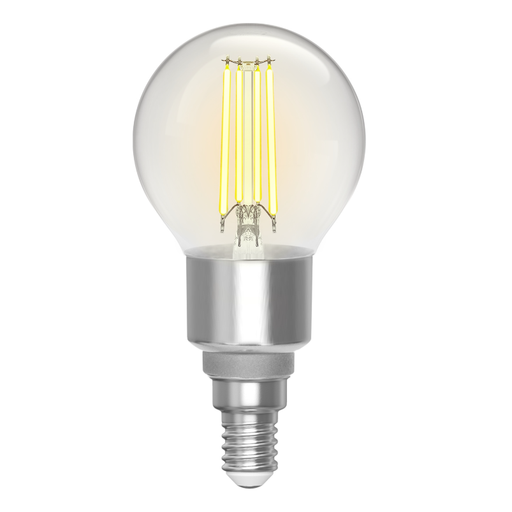
Why this product suits this profile: The compact E14 design is intended for chandeliers, small bedside lamps and multi-arm lights. RGB+CCT provides coloured light as well as white tones between 2700 and 6500 Kelvin.
The small G45 shape reduces the risk of a large bulb touching the lampshade or adjacent fittings. The Wi-Fi connection for Alexa and Google Assistant is designed for 2.4 GHz.
E14 fitting, RGB+CCT, app control and compatibility with Alexa and Google Assistant.
We have put together a complete, regularly updated list of products that fully meet these strict selection criteria and the safety regulations applicable in the EU.
First, insert the bulb into the correct fitting with the power switched off. Then switch on the power, install the manufacturer's app and put the model into pairing mode. For Wi-Fi models, your smartphone should be connected to a 2.4 GHz network. You can then configure the brightness, colour temperature, schedules and voice assistants.
The product specifications for the models mentioned often state around 15,000 operating hours, while some variants offer up to 25,000 hours. The actual service life depends on factors including operating time, heat dissipation, switching frequency and compliance with the specified ambient temperature.
Yes, a small amount of standby power may be used if the wireless connection remains active. The technical specifications for some models state values of up to 0.5 watts. If you want to cut off the power completely, you can switch the light off at the wall switch; however, app or voice control will then not be available.