
Lieferung heute & morgen

Qualitätsgarantie

Willkommens-Angebote freischalten: KOSTENLOSE Lieferung | Bis zu 80 % RABATT | Kostenlose 30-Tage-JoyPlus-Testphase
App herunterladen
A smart LED bulb can be controlled via an app, voice command or remote control. However, not every model is suitable for every light fitting or Wi-Fi network. Buying mistakes are often caused not by the LED technology itself, but by unclear information about the fitting, brightness, wireless standard or dimming functionality.
An E27 LED bulb has a larger screw thread than an E14 LED bulb. An LED GU10 spotlight, on the other hand, is fitted using two pins and is designed for spotlights or ceiling systems. Before buying, remove the old bulb and check the fitting directly.
The shape also matters: a G120 globe bulb may be too large for a small table or wall light, while a G45 candle bulb is better suited to decorative lights.
With a smart LED bulb, brightness is usually adjusted via the app, voice control or the supplied remote control. A conventional rotary or slider dimmer on the wall, however, can cause flickering or connection problems. Details such as ‘dimmable LED bulb’ should therefore always be read together with the permitted control method.
Many Wi-Fi LED bulbs require a 2.4 GHz network during setup. If only a 5 GHz network is used, the initial connection may not work. Other models communicate via Bluetooth Mesh or require a gateway for certain functions. If you are looking for smart lighting without a hub, check whether the bulb connects directly to your home Wi-Fi or smartphone.
Heat generation must also be taken into account with enclosed light fittings. According to the product specifications, some models are not suitable for fully enclosed lights.
Brightness is measured in lumens. Around 350 to 400 lumens is more suitable for decorative or supplementary lighting. With many everyday bulbs, 806 lumens is roughly equivalent to a conventional 60-watt incandescent bulb. For lighting a larger room, 1,500 lumens or more may be useful, provided the light fitting and room size are suitable.
Colour temperature is measured in Kelvin:
An RGB+CCT LED bulb combines coloured light with adjustable shades of white. RGB alone does not replace flexible white-light control when different lighting moods are needed in everyday use.
An LED bulb with app control typically allows you to set schedules, groups and scenes. With an Alexa-compatible bulb or Google Home-compatible bulb, you should check the specific app integration. Voice control may depend on having a compatible account, speaker and device generation.
An LED bulb with remote control is practical if not every member of the family is expected to use a smartphone. It can also be a useful alternative when the Wi-Fi connection is temporarily unavailable. Group functions are helpful when using several bulbs, for example in a light fitting with multiple sockets.
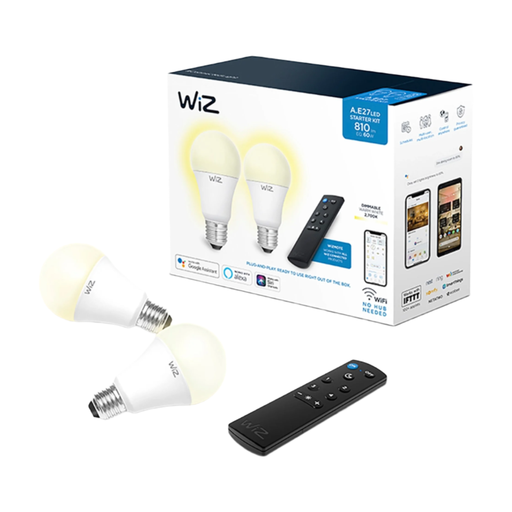
Why this product suits the profile: The set includes two E27 bulbs and a remote control. This allows you to equip a room without buying several components separately.
Control does not depend solely on a smartphone. The set also supports app, voice and remote control, and connects without an additional hub via 2.4 GHz Wi-Fi.
Two A60-E27 bulbs with 806 lumens each, 2,700 K and adjustable brightness; stated service life of up to 25,000 hours.
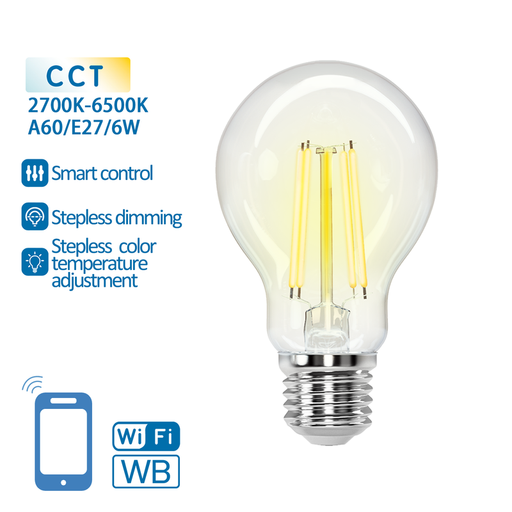
Why this product suits the profile: The E27 A60 bulb combines app control with variable colour temperature and voice operation for living or work areas.
The product specifications state 2,700 to 6,500 K and a direct connection to 2.4 GHz Wi-Fi without an additional hub. It is not designed for use with a conventional wall dimmer.
Stated power consumption of 6 W, 850 lumens, 360-degree illumination and support for Alexa and Google Home.
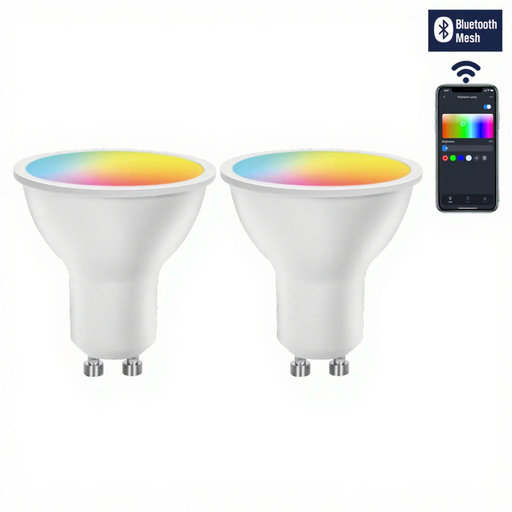
Why this product suits the profile: The two-piece GU10 set is suitable for spotlights, ceiling lights and rooms where colourful scenes or grouped control are required.
The fitting and dimensions are clearly specified as GU10 and D50 × H53 mm. Brightness is adjusted via the app or voice assistant, not a conventional wall dimmer.
RGB plus warm white from 2,700 to 6,500 K, dimming from 1 to 100 per cent and Bluetooth Mesh for grouped devices.
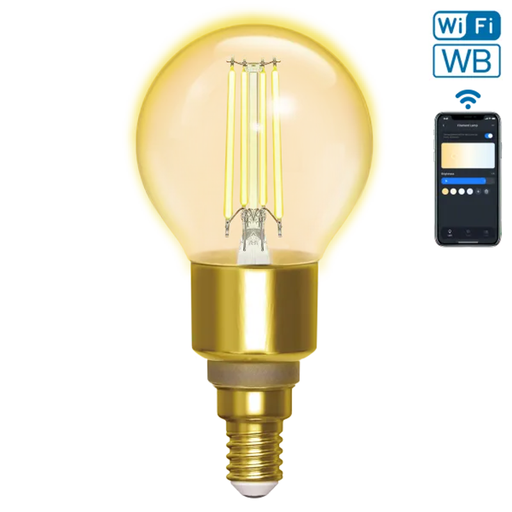
Why this product suits the profile: The compact G45 shape and E14 fitting are designed for bedside lamps, chandeliers and decorative lights.
The technical specifications state 350 to 400 lumens and advise against using a physical wall dimmer. A 2.4 GHz Wi-Fi network is required for setup.
4.5 W power consumption, adjustable shades of white from 2,700 to 6,500 K, plus app and voice control via AigoSmart, Alexa and Google Assistant.
We have put together a complete, regularly updated list of products that fully meet these strict selection criteria and the safety regulations applicable in the EU.
A group function is worthwhile when using several bulbs. Schedules can automate everyday operation; however, actual electricity consumption depends on power rating, usage time and standby consumption. A 4.5 W bulb uses 4.5 kWh over 1,000 operating hours in theory, plus any possible standby consumption.
That depends on the model. Wi-Fi bulbs can connect directly to the router. Bluetooth Mesh bulbs initially communicate via Bluetooth; remote access or certain voice functions may require additional smart home hardware. The product description should therefore explicitly state ‘without hub’ or specify the gateway requirement.
For different models, manufacturers may state a service life of up to 25,000 hours, for example. This is a technical guideline, not a guarantee for every application. Heat, frequent switching, an unsuitable light fitting or an incompatible dimmer can affect how long the bulb remains usable.
Running costs depend on power consumption. With an 8.5 W bulb, 1,000 operating hours equates to 8.5 kWh. For an accurate calculation, you need your own electricity tariff, daily operating time and standby consumption.