
Lieferung heute & morgen

Qualitätsgarantie

Willkommens-Angebote freischalten: KOSTENLOSE Lieferung | Bis zu 80 % RABATT | Kostenlose 30-Tage-JoyPlus-Testphase
App herunterladen
A smart LED bulb with an E27 or E14 fitting can be installed in many existing light fixtures. However, not every smart LED bulb is suitable for every household. Unclear information about the fitting, network compatibility or dimming often leads to unsuitable purchases.
Before buying, you should therefore look beyond RGB colours or a claimed long lifespan. Technical compatibility, the required light output and the control method are what really matter.
E27 is the larger Edison screw fitting and is commonly used in floor lamps, table lamps and ceiling lights. E14 is the smaller fitting, often found in chandeliers, wall lights and decorative bedside lamps.
By contrast, the designations C35, C37, G45 or G95 describe the shape or size of the bulb. They do not replace the fitting specification. Check the light fixture first, then compare the bulb’s dimensions. An E14 LED bulb may be electrically compatible, but its height or diameter could still prevent it from fitting inside a narrow shade.
With many smart bulbs, brightness is adjusted via an app, Bluetooth Mesh, Wi-Fi or voice control. A traditional wall dimmer is often unsuitable. This can cause flickering, buzzing or connectivity problems.
If you are looking for a dimmable LED bulb for an existing dimmer installation, you must check explicitly whether the product is approved for this use. With the smart models featured here, dimming is handled through the relevant smart home controls. The wall switch should only be used to turn the power supply on or off.
An RGB+CCT LED bulb can produce coloured light and also adjust the colour temperature from warm white to cool white. For everyday use, however, brightness in lumens is also important. A decorative E14 model producing around 350 to 470 lumens is more suitable for smaller light fixtures or use with multiple bulbs. An E27 LED bulb with around 806 lumens can provide more general brightness from a single fitting.
Check the following:
Many models are rated IP20 and are therefore intended exclusively for dry indoor areas. Bathrooms, outdoor areas and damp rooms require a suitable light fixture with the appropriate IP rating.
Brightness is measured in lumens (lm). Wattage, on the other hand, primarily indicates power consumption. According to the product data, for example, a 4.5-watt model may produce the same luminous flux as a conventional 40-watt incandescent bulb. This comparison is a general guide and should not be taken to mean that the light distribution is identical.
For flexible use, a range of 2700 to 6500 Kelvin is practical:
A CRI value of Ra ≥ 80 is specified for several of the models mentioned. It describes how accurately colours are rendered under the relevant bulb. For living spaces and decorative applications, this is a useful basis for comparison.
A Wi-Fi LED bulb usually connects directly to the router. The Wi-Fi models mentioned require a 2.4 GHz network for set-up. Bluetooth can make the initial pairing easier, but it does not always replace the Wi-Fi connection.
A Bluetooth Mesh LED bulb can be connected to other compatible devices. This is particularly useful when several lights are installed in the same room. Whether a gateway is required depends on the specific model and the functions you want to use. Direct app control and remote access when you are away from home are not necessarily the same thing.
The designations Alexa LED bulb and Google Assistant LED bulb should also be checked more closely. The key points are the app actually supported, whether a hub is required and which functions are available, such as switching on and off, dimming, colour-temperature adjustment and grouping.
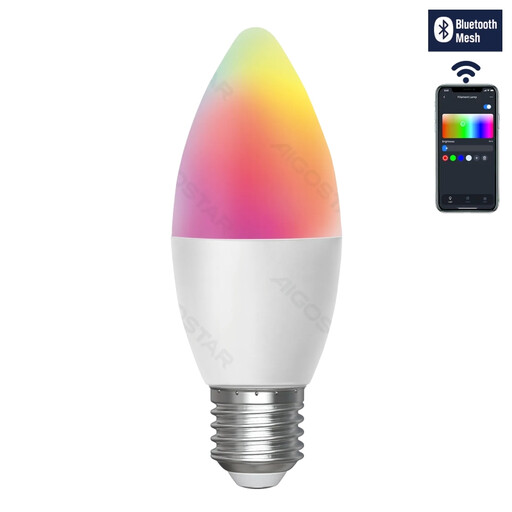
Why this product suits this profile: This E27 bulb combines app control, RGB colours and adjustable white light in a compact candle-shaped design.
The product data explicitly states the fitting, 220–240 V, app-based dimming and the range from 2700 to 6500 K.
4.9 W, 420 lm, RGB+CCT and Bluetooth Mesh; according to the product description, brightness can be adjusted from 1 to 100%.
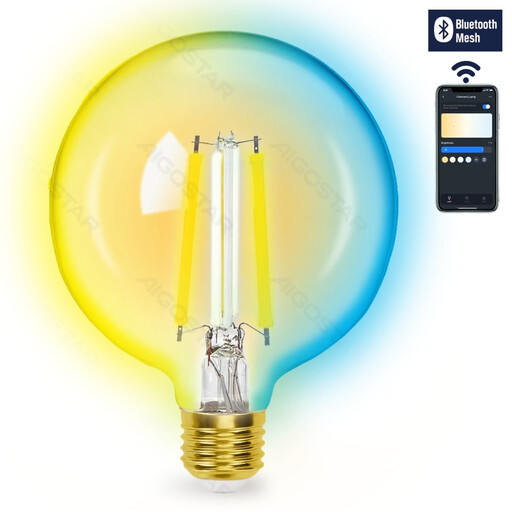
Why this product suits this profile: The large G125 glass design is made for exposed light fixtures, combining a vintage look with adjustable white light.
The technical specifications state 806 lm, the E27 fitting, the CCT range and a control system that must not be used with external dimmers.
6 W, 806 lm, 2700–6500 K, Bluetooth Mesh 5.0 and stated control via the AIGOSMART app, Alexa or Google Assistant.
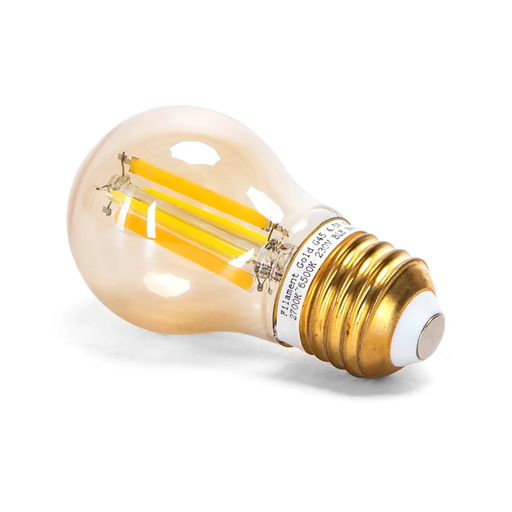
Why this product suits this profile: The compact E14 design is suitable for smaller light fixtures where an E27 LED bulb would be too large.
The fitting and dimensions are specified as E14 and G45. According to the product information, a compatible gateway is required for voice control or remote access.
Bluetooth Mesh, RGB+CCT, 2700–6500 K and app dimming; the product data states around 350–400 lm and a height of approximately 82 mm.
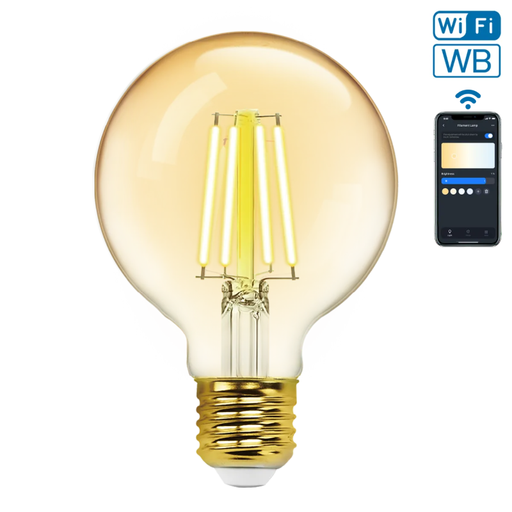
Why this product suits this profile: The direct Wi-Fi connection is ideal for users who want to get started without an additional gateway.
Connectivity is specified as 2.4 GHz Wi-Fi plus Bluetooth. For set-up, your home network should support the stated frequency.
E27, G80, 6 W, approximately 806 lm, adjustable white light from 2700 to 6500 K, plus app, Alexa and Google Assistant control.
We have put together a complete, regularly updated list of products that fully meet these strict selection criteria and the safety regulations applicable in the EU.
For a rough cost calculation, the following formula is sufficient:
Power in kW × operating hours × electricity price = electricity costs
A 4.5-watt bulb uses around 4.5 kWh over 1,000 hours of operation. The actual cost depends on your electricity tariff and how the bulb is used. An energy-efficient LED bulb reduces consumption compared with a similar incandescent bulb. However, you should also take the standby consumption of connected models into account.
Check the marking on the light fixture or compare the screw fitting with an existing bulb. E27 is the larger standard fitting, while E14 is the smaller fitting for compact and decorative lights. The bulb’s diameter and height must also be suitable for the fixture.
Depending on the product, Bluetooth models can be controlled directly via an app. However, remote access, voice control or certain automations may require a gateway or Wi-Fi connection. You should therefore read the network configuration details for the specific model.
Depending on the version, the product data for the models mentioned specifies around 15,000 to 25,000 operating hours along with defined switching cycles. These are manufacturer specifications and depend, among other things, on ambient temperature, ventilation, operating duration and correct installation. With IP20 bulbs, moisture and fully enclosed, poorly ventilated light fixtures should be avoided.