
Lieferung heute & morgen

Qualitätsgarantie

Willkommens-Angebote freischalten: KOSTENLOSE Lieferung | Bis zu 80 % RABATT | Kostenlose 30-Tage-JoyPlus-Testphase
App herunterladen
A smart LED ceiling light allows you to control brightness, colour temperature and, in some cases, colours via an app or voice command. However, not every model is suitable for every ceiling or smart home system. Additional costs often arise because important technical details are overlooked before purchase.
This buying guide explains which specifications matter for a smart LED ceiling lamp, an LED recessed spotlight or a classic LED ceiling light, and which models are suitable for different usage scenarios.
With a recessed spotlight, it is not just the visible diameter that matters. The crucial factor is the ceiling cut-out diameter. A model requiring an opening of 200 to 220 mm will not automatically fit an existing 150 mm opening.
Before ordering, you should measure:
A recessed spotlight that is too small or too large can create additional work during renovation and removal.
Many products use Bluetooth Mesh and require a compatible gateway for remote access or voice control. Without a hub, local operation may be possible, while control when you are away from home will not work.
A smart LED ceiling light with app control should therefore always be assessed based on the following points:
RGB or RGBW colours are suitable for accent lighting and scenes. For reading, cooking or concentrated work, however, white-light brightness is more important. Pay attention to the luminous flux in lumens, rather than just the advertised number of colours.
For example, a model may display many shades but provide lower brightness in white light. For living spaces, the CRI value is also relevant. A value of Ra ≥80 is specified for the products mentioned and describes colour rendering under the respective product conditions.
The wattage describes power consumption, not brightness directly. Luminous flux is measured in lumens. As a general guide:
For running costs:
Consumption in kWh = power in kW × operating hours.
An 18 W light uses 18 kWh over 1,000 operating hours in theory. The actual cost depends on your electricity tariff and how long the light is used. The energy efficiency class should be checked on the product data sheet. Several of the Aigostar models described here are listed as having energy efficiency class F.
A CCT LED ceiling light allows you to choose between warm and cooler white light. Typical ranges such as 3000K to 6500K cover warm white through to daylight-like light. Some models range from 2700K to 6500K.
Colour temperature should not be confused with brightness. A higher Kelvin value means a cooler light colour, not automatically more light.
The protection rating must be suitable for the intended location. IP20 is designed for dry indoor areas and is not suitable for bathrooms, damp cellars or areas exposed to splashing water. A light with IP54 offers greater protection against dust and splashing water, but it does not replace a professional assessment of the installation conditions.
For permanently connected lights operating at 220–240 V, installation should be carried out by a qualified electrician or an appropriately competent person in accordance with applicable regulations. The power supply must be disconnected at the circuit breaker before installation, cleaning or maintenance.
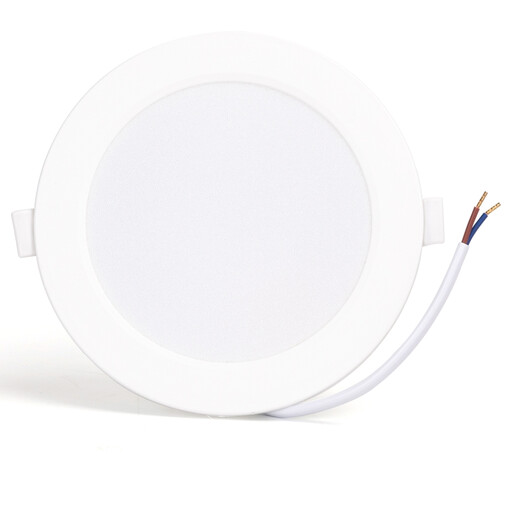
Why this product suits this profile: This compact model requires a cut-out diameter of 100 to 110 mm and delivers 600 lm at 6 W. This makes it suitable for hallways, smaller rooms or several individually planned ceiling light points.
The specified cut-out diameter, 120° beam angle and CCT range of 2700K to 6500K make planning easier. Bluetooth Mesh requirements and the IP20 protection rating still need to be taken into account.
6 W power consumption, dimmable colour temperature and a stated lifespan of up to 30,000 hours.
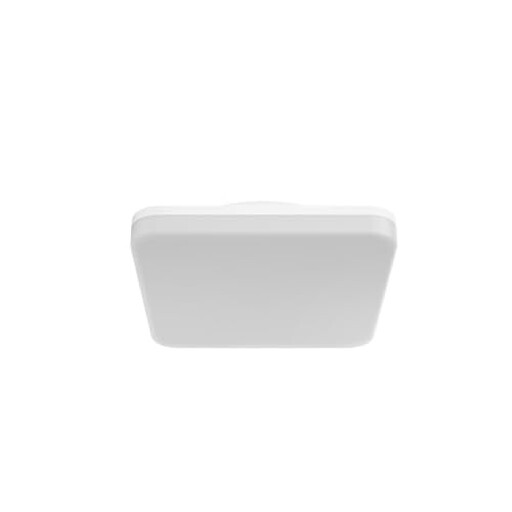
Why this product suits this profile: This light combines Wi-Fi, Matter, RGBW and continuously variable dimming. It is an interesting option for users who want to integrate a light into an existing system with Apple Home, Google Home, SmartThings, Alexa or Home Assistant.
Matter compatibility and 2.4 GHz Wi-Fi connectivity are clearly specified. With IP54, the light is also intended for certain indoor areas exposed to splashing water; local installation conditions must still be checked.
Up to 1,800 lm, RGBW, 2700K to 6500K, app and voice control, plus no separate gateway required for Hama Home integration.
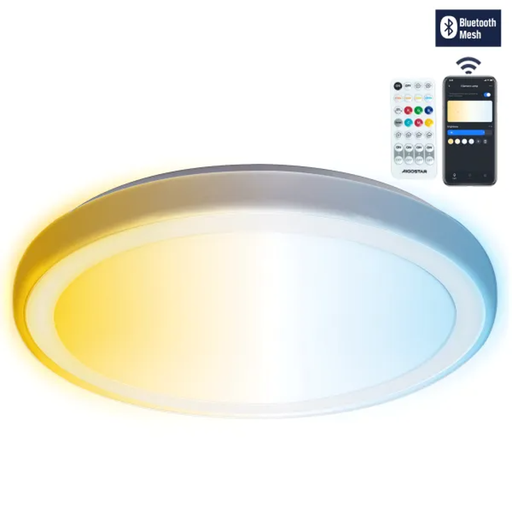
Why this product suits this profile: With 36 W and 3960 lm, this surface-mounted light is designed for larger indoor areas such as living rooms, offices or retail spaces, provided the room size and lighting plan are suitable.
The specifications state the luminous flux, 120° beam angle, colour temperature and installation type. This makes it easier to compare the light with the room size and existing ceiling connection.
3960 lm, CCT from 3000K to 6500K, Bluetooth Mesh, 120° beam angle and a stated IP20 protection rating for dry indoor areas.
We have put together a complete, regularly updated list of products that fully meet these strict selection criteria and the safety regulations applicable in the EU.
For a direct connection to 220–240 V, installation should be carried out by a qualified electrician in accordance with applicable electrical regulations. With recessed spotlights, the cut-out diameter, heat dissipation and position of insulation material must also be taken into account.
Lifespan depends, among other things, on operating hours, ambient temperature, switching cycles and heat dissipation. The Aigostar recessed lights mentioned are specified as lasting up to 30,000 hours and supporting 15,000 switching cycles. This is a product specification, not a guarantee for every individual usage scenario.
The cost depends on power consumption, operating time and the electricity price. A 6 W light uses 6 kWh over 1,000 operating hours in theory, while a 36 W light uses 36 kWh. A gateway or continuous standby consumption may also add to the cost. The technical specifications for some models state standby consumption of up to 0.5 W.