
Lieferung heute & morgen

Qualitätsgarantie

Willkommens-Angebote freischalten: KOSTENLOSE Lieferung | Bis zu 80 % RABATT | Kostenlose 30-Tage-JoyPlus-Testphase
App herunterladen
A smart LED ceiling light should do more than simply illuminate a room. Many shoppers expect straightforward set-up, flexible colour temperatures and a reliable connection to Apple Home, Google Home, Amazon Alexa or Home Assistant. In practice, however, unclear information about networks, brightness and protection ratings often leads to unsuitable purchases.
Some lights use Bluetooth Mesh and require a compatible hub for remote control or connection to multiple devices. This is not necessarily a disadvantage, but it does affect the installation effort and ongoing system costs. If you are looking for an LED ceiling light with Wi-Fi that does not require an additional hub, make sure to check explicitly whether the light can connect directly to a 2.4 GHz Wi-Fi network.
Matter is not a blanket synonym for every type of smart home compatibility either. What matters is which platforms are actually supported and whether the manufacturer’s app is still required for certain functions.
Power consumption in watts describes energy usage, not the amount of light directly. For comparisons, the luminous flux in lumens is the key figure. Depending on its design and electronics, an 18 W LED can produce noticeably different light from an 18 W light from another model.
Also check whether the stated lumen figure applies to white light, coloured light or a maximum setting. With an RGBW ceiling light, the figures may vary depending on the selected colour.
A light designed for the living room is not automatically suitable for the bathroom. The IP rating describes how well an enclosure is protected against foreign bodies and moisture. IP20 is intended for dry indoor areas. IP54 provides protection against dust in harmful quantities and splashing water, but not against immersion or powerful jets of water.
For permanently connected ceiling lights, installation in Germany must be carried out by a qualified electrician in accordance with the applicable regulations. Before installation, cleaning or maintenance, disconnect the power supply at the consumer unit.
For living rooms and bedrooms, even general lighting is important. A model with a maximum output of 1,800 lumens may be suitable for small to medium-sized rooms, while larger rooms or work areas require more light. If there are several spotlights, the beam angle is also relevant: a wide angle distributes light over a larger area, while a narrow angle creates more focused accents.
A dimmable LED ceiling light with adjustable colour temperature can provide warm white light for the evening and more neutral or cooler light for focused tasks. Typical ranges, for example, are between 2,700 K and 6,500 K. The wider the range, the more choice you have when creating the desired lighting atmosphere.
The CRI or Ra value is relevant when assessing colour rendering. A value of Ra 80 or higher is common for many residential lights. It describes how naturally colours appear compared with a reference light source. However, it is not a measure of brightness or energy consumption.
Before buying, check:
A smart ceiling light with Matter can simplify integration into different systems. Nevertheless, you should check the specific device support offered by the relevant platform before buying several lights for a smart home project.
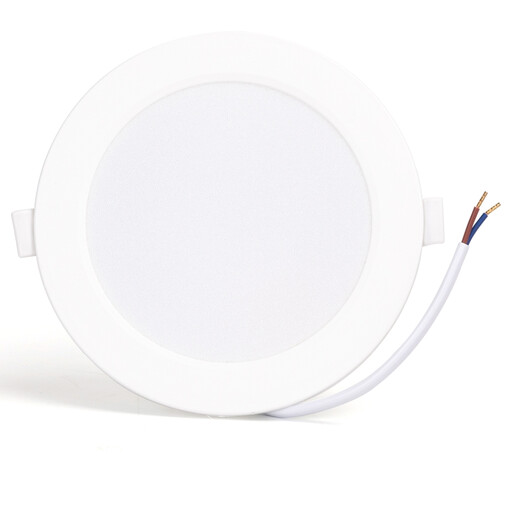
Why this product suits this profile: With 6 W, 600 lumens and adjustable colour temperature, this compact recessed spotlight is suitable for hallways, smaller rooms or existing ceiling cut-outs.
The specifications state that it uses Bluetooth Mesh, has an IP20 rating and requires a hub connection for remote control. This makes it easier to plan for the additional system requirements before buying.
Adjustable colour temperature from 2,700 K to 6,500 K; 120-degree beam angle; designed for dry indoor areas.
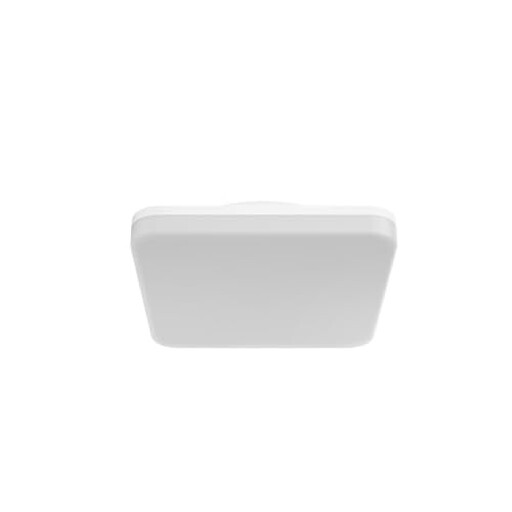
Why this product suits this profile: This hardwired ceiling light combines Matter support with app and voice control. It is designed for living rooms, bedrooms, kitchens and certain damp areas.
The product specifications state Matter support, a direct 2.4 GHz Wi-Fi connection via the Hama Home app and an IP54 rating. However, the limitations of this protection rating should still be considered for the specific installation location.
18 W, up to 1,800 lumens, RGBW and 2,700–6,500 K; continuously dimmable and listed as compatible with Apple Home, Google Home, Alexa, SmartThings and Home Assistant.
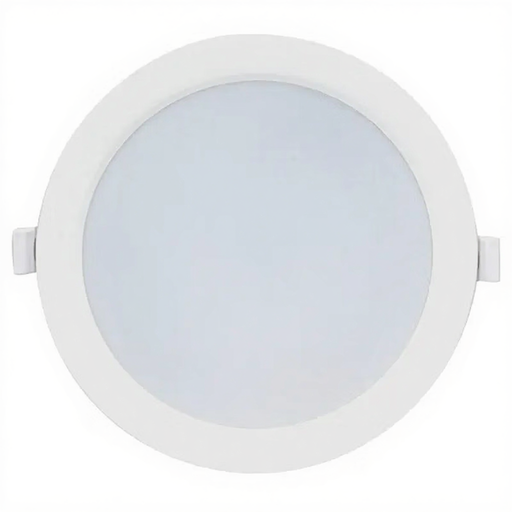
Why this product suits this profile: This slim recessed spotlight is ideal for users who want to combine RGBW, white tones and app control in an existing ceiling cut-out.
With its IP20 rating, this model is expressly intended for dry indoor areas. For bathrooms or areas exposed to condensation, choose a light with a suitable protection rating instead.
1,430 lumens, RGBW 5-in-1 light, 2,700–6,500 K and control via Bluetooth and Wi-Fi through the Haodeng app.
We have put together a complete, regularly updated list of products that fully meet these strict selection criteria and the safety regulations applicable in the EU.
That depends on the model. A Wi-Fi light can connect directly to the router, while Bluetooth Mesh products may require a hub for remote access or automations. With Matter lights, you should also check whether your home has a compatible Matter controller.
The costs depend on power consumption, daily usage time and the electricity price. A simple calculation is: wattage divided by 1,000, multiplied by the operating hours and the price per kilowatt-hour. If the light is frequently dimmed, actual consumption may be below the maximum stated power consumption. However, this does not provide a reliable basis for promising specific savings.
The manufacturer states the service life in operating hours, but it depends on temperature, switching cycles, electronics and usage. With permanently integrated LEDs, the light source usually cannot be replaced separately. As well as checking the stated number of hours, you should therefore review the warranty terms, spare-part information and the possibility of future repairs or complete light recycling.