
Lieferung heute & morgen

Qualitätsgarantie

Willkommens-Angebote freischalten: KOSTENLOSE Lieferung | Bis zu 80 % RABATT | Kostenlose 30-Tage-JoyPlus-Testphase
App herunterladen
A smart LED ceiling light should do more than simply switch on and off. Many shoppers want dimmable lighting, adjustable colour temperature, RGBW colours and control via an app or voice assistant. At the same time, products can differ considerably in terms of connection, network standard, brightness and installation size.
However, focusing only on wattage or a high number of colours can result in buying a light that is unsuitable for your existing ceiling, smart home environment or intended room. The following criteria will help you avoid common purchasing mistakes.
Descriptions such as “16 million colours” or “160,000 colours” primarily refer to the available shades. They say little about whether the light will illuminate a room sufficiently. The decisive factors are luminous flux in lumens, beam angle and the position of the light.
A light with around 600 to 800 lumens may be sufficient for hallways or small rooms. Living areas, kitchens or offices often need considerably more light, depending on the size of the room. An RGBW LED ceiling light should therefore also offer a suitable white-light mode.
Not every app-controlled light works automatically with every voice assistant. With Bluetooth Mesh, a compatible hub or gateway is often required if you want to operate the lighting while away from home or use voice control with Alexa and Google Assistant.
For Wi-Fi models, you should check whether a 2.4 GHz network is required. Matter lights can make integration with compatible systems easier, but they also require a suitable smart home system and correct setup.
With an LED recessed spotlight, the visible diameter is not the only important factor. The key measurement is the ceiling cut-out size. Available models may require openings of 100 to 110 mm, 120 to 130 mm, 150 to 160 mm or approximately 200 to 210 mm.
Before ordering, you should also check the installation depth, connection type and space available for the driver. When renovating, it is sensible to measure the existing opening before selecting a new smart LED spotlight.
Wattage describes electrical consumption, not brightness directly. Luminous flux is specified in lumens. A 9 W model with 780 lumens should be assessed differently from a 36 W light with 3,960 lumens.
For energy-efficient LED indoor lighting, shoppers should consider luminous flux, power consumption and energy efficiency class together. The reference models, for example, are listed with classes E or F. A stated service life of around 30,000 hours is a product feature, but it is not a guarantee of the actual lifespan under all operating conditions.
A light with CCT allows you to choose between warm and cooler white light. Typical ranges run from 2,700 or 3,000 K to 6,500 K. Warm white is often suitable for living rooms and bedrooms, while more neutral or cooler settings can be used in work areas.
A CRI or Ra value of at least 80 describes colour rendering under the specified conditions. For applications where colour accuracy is important, particular attention should be paid to the manufacturer’s colour-rendering information.
IP20 lights are intended for dry indoor areas and are not suitable for locations exposed to splashing water. For kitchens, cellars or bathrooms, a light with a higher IP rating may be more appropriate. The Hama model in this selection is rated IP54, while several Aigostar models have an IP20 rating.
Connection to 220–240 V should be carried out in accordance with the installation instructions. Work on mains voltage must be performed by a qualified electrician. Before installation, cleaning or maintenance, switch off the power supply at the fuse box.
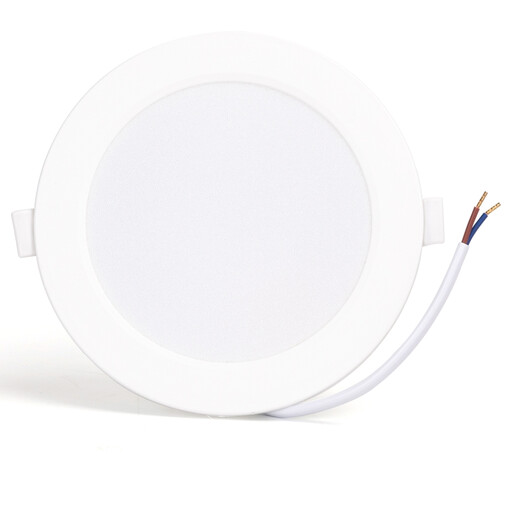
Why this product suits the profile: This compact model is designed for hallways, smaller rooms and individual light points. It offers 600 lm, 6 W of power and an adjustable colour temperature from 2,700 K to 6,500 K.
The specified cut-out size, luminous flux and colour temperature make planning easier. An opening of 100 to 110 mm is required for installation.
Bluetooth Mesh, dimming function, ≤0.5 W standby consumption and a stated service life of 30,000 hours.
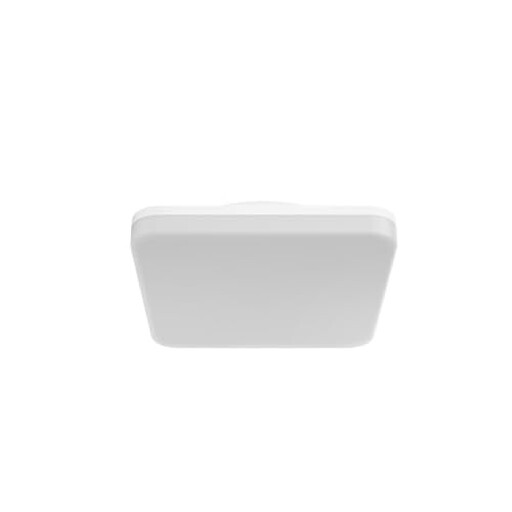
Why this product suits the profile: This light is aimed at households looking to combine Matter, Wi-Fi, app control and voice operation in a single ceiling light.
Compatibility with Matter, Apple Home, Google Home, Samsung SmartThings, Alexa and other systems is clearly specified.
18 W, up to 1,800 lm, RGBW, 2,700 to 6,500 K, continuously dimmable and IP54 splash protection.
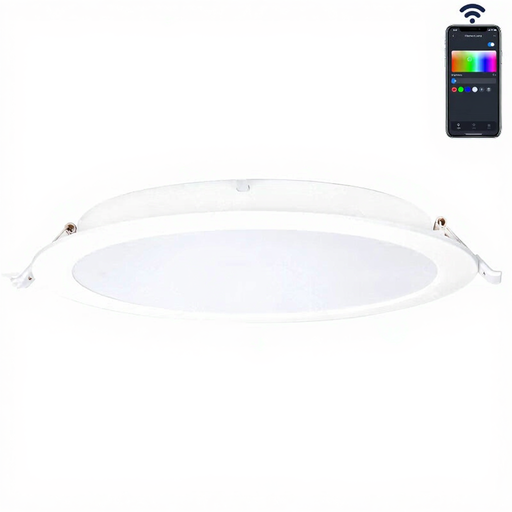
Why this product suits the profile: This spotlight combines 1,760 lm, RGB colours and CCT adjustment for rooms, retail spaces or hallways with multiple light points.
The Bluetooth Mesh connection, cut-out size of 200 to 220 mm and IP20 suitability for dry indoor areas are clearly specified.
Dimmable, CCT from 2,700 K to 6,500 K, 120° beam angle, timer function and a stated service life of 30,000 hours.
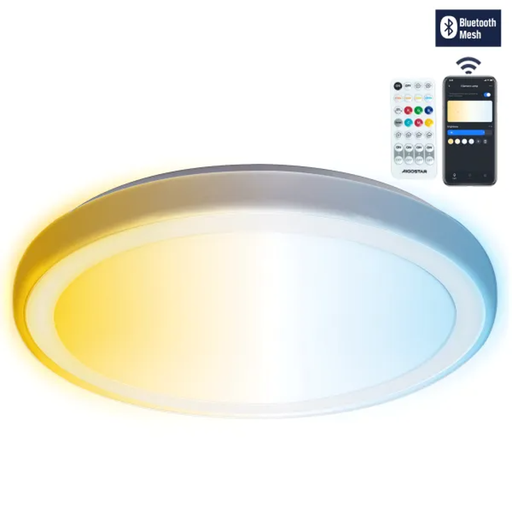
Why this product suits the profile: This round ceiling light is designed for living rooms, offices and retail areas with a central light point.
The luminous flux of 3,960 lm and beam angle of 120° provide clear planning information rather than focusing solely on wattage.
36 W, CCT from 3,000 K to 6,500 K, Bluetooth Mesh, 220–240 V and a diameter of 495 mm.
We have put together a complete, regularly updated list of products that fully meet these strict selection criteria and the safety regulations applicable in the EU.
First, the light must be professionally connected to the mains. It is then paired using the designated app, Bluetooth Mesh or Wi-Fi. With Bluetooth Mesh models, a gateway may be required for remote access and voice control. Wi-Fi models are often connected via a 2.4 GHz network. The exact procedure depends on the individual instructions.
Several models state a service life of up to 30,000 hours and up to 15,000 switching cycles. These figures are technical manufacturer specifications and depend, among other things, on operating time, ambient temperature, ventilation and mains conditions. A light should not be covered with insulation material if the installation instructions warn that this could cause heat to build up.
For a simple calculation, use: power in kilowatts × operating hours × electricity price. For example, an 18 W light uses 0.18 kWh when operated for ten hours. To calculate the actual cost, you need to take the current electricity tariff, usage and standby consumption into account. Dimming functions can affect the actual energy requirement during operation, but they do not replace checking the stated power consumption.