
Lieferung heute & morgen

Qualitätsgarantie

Willkommens-Angebote freischalten: KOSTENLOSE Lieferung | Bis zu 80 % RABATT | Kostenlose 30-Tage-JoyPlus-Testphase
App herunterladen
An LED ceiling light should illuminate a room evenly, take up little space and work reliably day to day. But choosing one involves more than just looking at its shape and wattage. Unclear brightness information, a lack of suitability for damp areas or controls that don’t meet your needs can all lead to the wrong purchase.
Wattage describes power consumption, not brightness. Luminous flux, measured in lumens, is a more useful figure for comparing lights. A 48 W LED ceiling light can produce different amounts of light depending on its design and efficiency. For larger rooms, check the stated lumen output as well as the wattage.
An IP44 LED ceiling light for the bathroom is generally suitable for areas exposed to splashing water. However, an IP44 rating does not mean the light can withstand a direct jet of water or be installed anywhere in a bathroom. Keep it at a suitable distance from showers and baths, and follow local installation requirements. If in doubt, have it connected by a qualified electrician.
RGB lighting, a starry-sky effect and a remote control can offer extra options. For everyday use, though, even light distribution, a suitable colour temperature and easy-to-reach controls matter more. Also check whether the remote needs batteries, whether there’s a memory function and whether the light returns to your preferred setting after a power cut.
Colour temperature is measured in kelvins:
A warm-to-cool white LED ceiling light gives you more flexibility if you use a room differently at different times of day. If you’re choosing a dimmable ceiling light, also check whether it’s controlled by remote, wall switch or app.
A low-profile design is particularly practical for rooms with low ceilings. A flat LED ceiling light around 3 to 5 cm high sits close to the ceiling and is less likely to get in the way. Check the diameter or the length and width when choosing a size.
Round models suit many room layouts. A round ceiling light generally distributes light evenly in all directions. According to product information, a 120-degree beam angle can help provide broad light coverage. For larger rooms, choose a light based on its lumen output, the room size and your preferred brightness—not just its design.
Lights with acrylic or plastic covers can diffuse the light. Metal frames offer a different look and are often more rigid. For a wooden ceiling light, check the combination of wood, metal and cover, as well as the care instructions.
Many LED ceiling lights have a non-replaceable LED light source. This can make installation easier, but it also usually means replacing the entire light if it develops a fault. Figures such as ‘up to 50,000 hours’ come from the manufacturer and aren’t a guarantee under every operating condition. Actual lifespan is affected by operating time, ambient temperature and electrical installation.
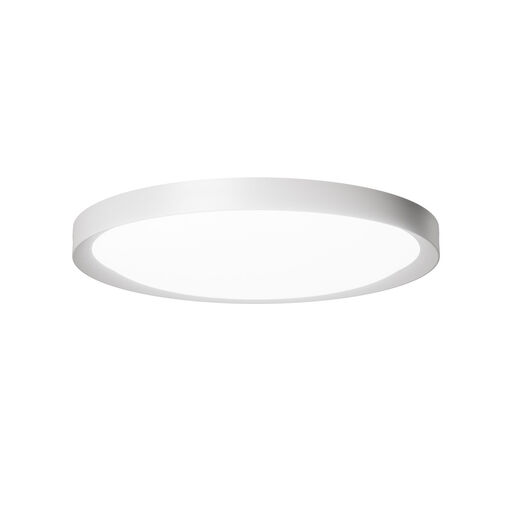
Why this product suits this profile: The choice of wattage makes it easier to find the right fit for a hallway, bedroom, office or living area. Its round design is understated.
According to the product information, it’s available in 36 W, 48 W and 72 W versions, with warm-white or cool-white options. This means you don’t have to choose based on wattage alone.
According to the product information: IP44 rating, 120-degree beam angle and integrated LED light source.
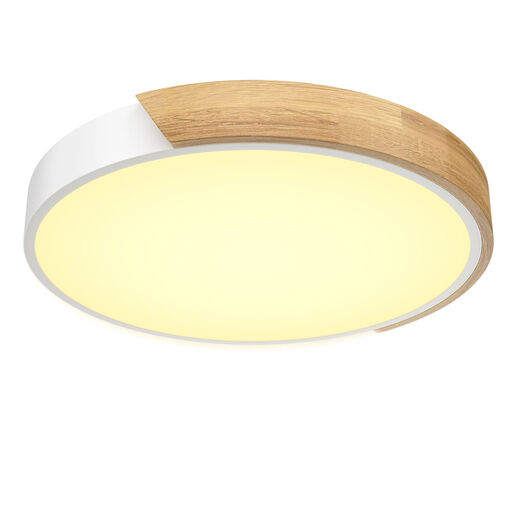
Why this product suits this profile: The lacquered oak frame brings a natural look, while its low profile measures just 5 cm high according to the product information. It’s a good fit for living rooms and bedrooms with low ceilings.
The product description gives specific sizes and wattages, as well as a 120-degree beam angle. This makes it easier to match the light to your room dimensions and lighting needs.
According to the product information: acrylic cover, several sizes and a dimmable 96 W version with remote control.
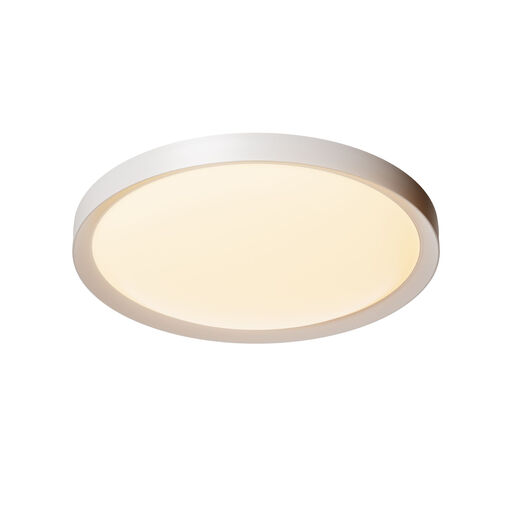
Why this product suits this profile: At just 3 cm high according to the product information, and with an IP44 rating, this model is worth considering for low ceilings and certain damp areas.
The IP rating is stated explicitly rather than being described only as ‘suitable for the bathroom’. You’ll still need to check that it’s suitable for the exact installation location.
According to the product information: 36 W, 48 W or 72 W, 120-degree beam angle and integrated LED technology.
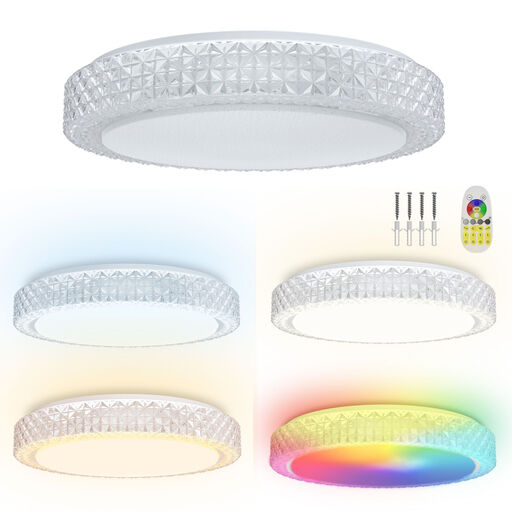
Why this product suits this profile: The choice of white tones, RGB colours, dimming and a decorative starry-sky effect makes it suitable for living rooms, bedrooms or children’s rooms.
The product description clearly lists the controllable lighting options and remote control. This makes it easier to check whether the features suit the way you plan to use the light.
According to the product information: 60 W, 4,200 lm, 2,800 to 6,500 K, RGB function and memory function.
We’ve put together a complete, regularly updated list of products that meet these strict selection criteria and fully comply with the safety regulations in force in the EU.
It depends on the room size, ceiling height, wall colour and how you use the room. For an informed choice, consider the stated lumen output, beam angle and preferred colour temperature together. Work areas generally need a different level of brightness from bedrooms.
Lifespans are often stated as up to 50,000 hours. This figure comes from the product information. Actual lifespan depends on factors including operating time, heat dissipation, mains quality and installation. With integrated LEDs, individual bulbs generally can’t be replaced.
A ceiling light with a remote control is useful if you regularly adjust the colour temperature and brightness. A smart LED ceiling light with Bluetooth Mesh or app control can also offer extra automation options. Before buying, check compatibility, which app you’ll need, the range and whether you can still use the wall switch.