
Lieferung heute & morgen

Qualitätsgarantie

Willkommens-Angebote freischalten: KOSTENLOSE Lieferung | Bis zu 80 % RABATT | Kostenlose 30-Tage-JoyPlus-Testphase
App herunterladen
Switching to smart lighting is more than just a trend—it's an upgrade for both home comfort and energy efficiency. In particular, smart LED downlights offer an elegant and modern way to illuminate rooms with flexibility. However, the market can be confusing, and not every product delivers on its promises. Before you invest, it's crucial to understand the common pitfalls that can lead to disappointment and unnecessary expenses.
As your Joybuy Product Recommendation Officer, I'm here to help you understand the technical specifications and make an informed decision that perfectly matches your needs.
Many buyers focus on price or design, overlooking crucial technical details. These three mistakes are especially costly:
To avoid these issues, you should check three core technical aspects before buying. These are the primary factors that determine the reliability and convenience of your new lighting system.
The way your smart downlights communicate is fundamental.
The quality of the light has a direct impact on your well-being. Pay attention to the following values:
A practical but often overlooked point: will the downlight actually fit in your ceiling?
Based on the criteria above, we have identified several products suitable for different needs and use cases.
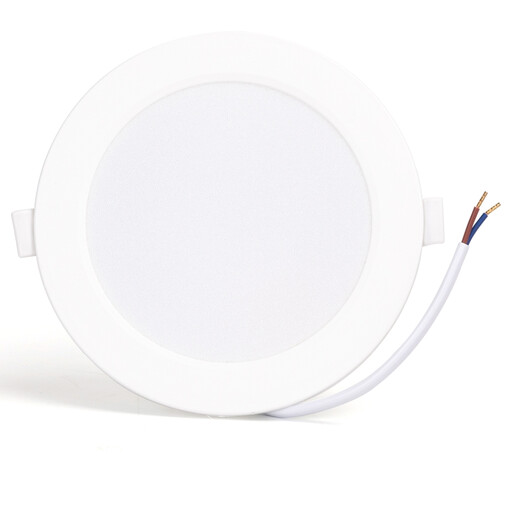
Why This Fits Their Persona: Ideal for starting out in the world of smart homes. The 3-pack offers excellent value, allowing you to equip an entire room, like a home office or a teenager's bedroom, without breaking the bank.
It relies on stable Bluetooth Mesh technology, bypassing the problem of overloaded Wi-Fi networks. It offers full RGB and CCT functionality, so there's no need to compromise on features.
A cost-effective, all-in-one package for a single room. These app-controlled downlights allow for easy grouping and synchronisation.
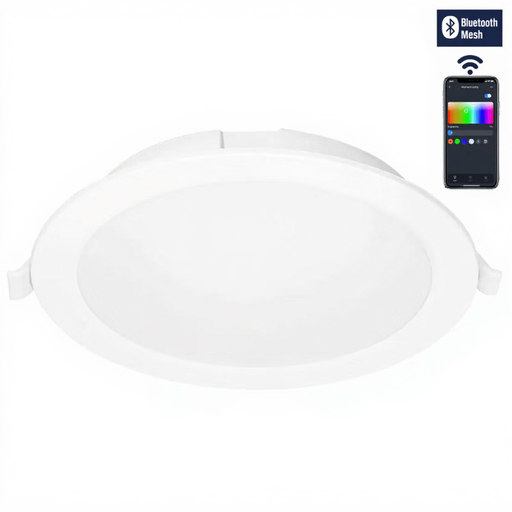
Why This Fits Their Persona: For users seeking a balanced mix of brightness and full functionality for living rooms, kitchens, or open-plan areas. The higher power output provides solid ambient lighting.
With a CRI of Ra≥80 and flicker-free dimming, it avoids the pitfall of poor light quality. The Bluetooth Mesh technology ensures reliable control even when multiple units are installed.
Powerful light output (1430 lm) with full RGB and CCT control. Its low-profile design (25.5 mm) makes it suitable for ceilings with limited space.
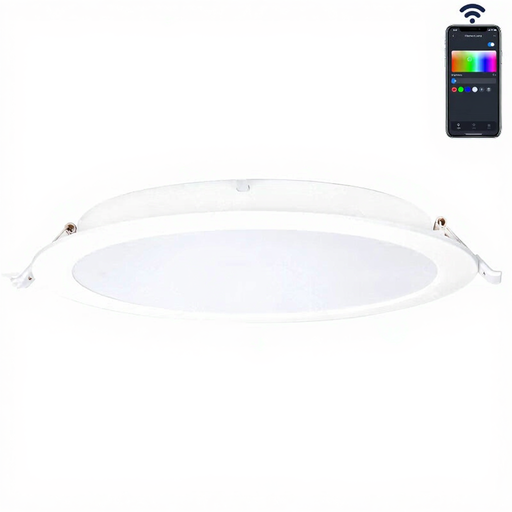
Why This Fits Their Persona: Perfect for large, open-plan living areas, lofts, or offices where high ambient brightness is required. This model can serve as the primary light source, replacing several weaker spotlights.
It solves the problem of inadequate illumination that arises from using underpowered spotlights in large rooms. The stable Bluetooth Mesh network is essential when installing many powerful lights.
Very high light output of 1760 lm for maximum brightness. Despite its high power, it retains full flexibility with RGB and CCT control.
We have compiled a complete, up-to-date list of products that fully meet these strict selection criteria and safety standards.
1. Do smart LED downlights always require a bridge or a hub? Not necessarily. Many Bluetooth Mesh lights can be controlled directly via a smartphone app as long as you are within Bluetooth range. However, for features like remote control (away from home) or voice control via assistants like Alexa and Google, a compatible Bluetooth gateway (also called a hub) is typically required. This acts as a bridge between the lights' Bluetooth network and your Wi-Fi router.
2. What is the lifespan of smart LED downlights? The lifespan of LEDs is measured in operating hours and is significantly longer than that of conventional bulbs. Models like those from Aigostar Smart Home often specify a lifespan of 30,000 hours. With an average daily use of four hours, this translates to a theoretical lifespan of over 20 years, making them a cost-effective long-term solution.
3. Can I dim smart LED downlights with a standard wall dimmer switch? No, and this is a critical point. Smart lights must not be connected to a conventional, external dimmer switch. Doing so can damage the light's internal electronics and lead to malfunctions. Brightness must be controlled exclusively via the corresponding app, a remote control, or voice commands. The standard wall switch should only be used to turn the power supply on and off.