
Lieferung heute & morgen

Qualitätsgarantie

Willkommens-Angebote freischalten: KOSTENLOSE Lieferung | Bis zu 80 % RABATT | Kostenlose 30-Tage-JoyPlus-Testphase
App herunterladen
A smart LED downlight lets you control your lighting via an app, voice command or automation. However, LED downlights vary considerably in cut-out diameter, control standard, light output and moisture protection. If you focus only on RGB colours or a high wattage, you could end up with incompatible ceiling cut-outs, no gateway support or lighting that isn’t right for your space.
With recessed lights, the outer diameter isn’t the only measurement that matters. The key measurement is the size of the ceiling cut-out. For example, a model with a diameter of 145 mm may need a cut-out of 120 to 130 mm, while a larger downlight may require a cut-out of 200 to 220 mm.
Before you buy, measure:
A slim LED downlight is useful when there’s limited space above the ceiling. However, its low profile doesn’t remove the need for the prescribed ventilation. Always follow the manufacturer’s instructions for installation and heat dissipation.
A Bluetooth Mesh downlight can connect multiple lights. Depending on the model, however, you may need a gateway for remote access, app control when you’re away from home or voice commands. Some lights can only be controlled through their dedicated app.
Compatibility with smart home platforms isn’t automatic, either. An Alexa-compatible LED light should be explicitly listed as compatible with Alexa or with the required hub or gateway. For example, an Aigostar GU10 model is listed as offering WiFi app control and Alexa compatibility. This is a different technical solution from a Bluetooth Mesh system.
An RGB+CCT LED spotlight combines coloured light with adjustable shades of white. For everyday room lighting, though, colour temperature, luminous flux and colour rendering matter more than the number of colours available.
An LED downlight with a colour temperature of 3000K–6500K covers everything from warm white to cool white. 3000 K is often suitable for living areas, while higher values can be used for work areas or brighter general lighting. The stated CRI or Ra value indicates how naturally colours appear under the light. Several of the models listed here have an Ra of at least 80.
The IP code indicates the level of protection:
An IP20 LED downlight for a living room or hallway may be suitable for these dry spaces. For a bathroom, you’ll also need to consider the installation zone, moisture levels and the specific installation conditions. An IP44 model isn’t automatically approved for every position in a bathroom.
Lights connected directly to 220–240 V must only be installed after the power supply has been switched off. Electrical connections should be made by a qualified electrician or someone who is suitably authorised.
Wattage describes electrical consumption; it doesn’t tell you how bright a light will be on its own. For comparison, look at the luminous flux in lumens. A 6 W model with 600 lm is designed for smaller areas or for use as part of a group of distributed spotlights. An 18 W model with up to 1760 lm may be intended for larger ceiling areas.
A 120° beam angle spreads light relatively widely, which can be useful in hallways and for even general lighting. For focused accent lighting, you’ll need different optics or adjustable lights.
A dimmable LED downlight can be controlled via an app, voice control, an integrated switch or an external leading-edge or trailing-edge dimmer. These methods aren’t interchangeable.
So, check:
According to the product details, the Aigostar Smart Downlight 18W with Bluetooth Mesh is dimmed via the app; it isn’t designed to work with an external wall dimmer.
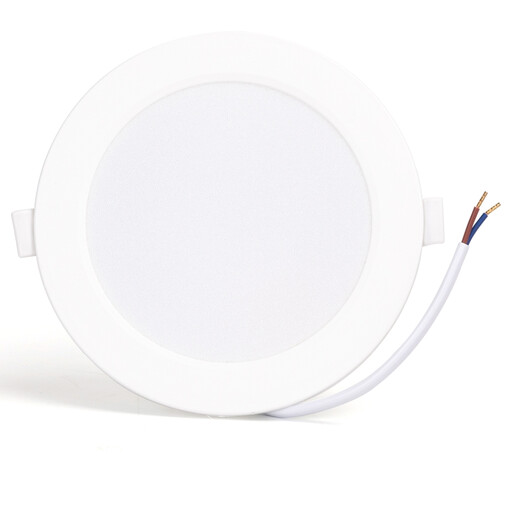
Why it suits this profile: With 600 lm and a cut-out size of 100 to 110 mm, it’s suitable for smaller rooms, hallways or use in a group of distributed lights.
The specifications list luminous flux, colour temperature, cut-out size and Bluetooth Mesh connectivity separately.
2700K to 6500K, a 120° beam angle and a stated lifespan of 30,000 hours.
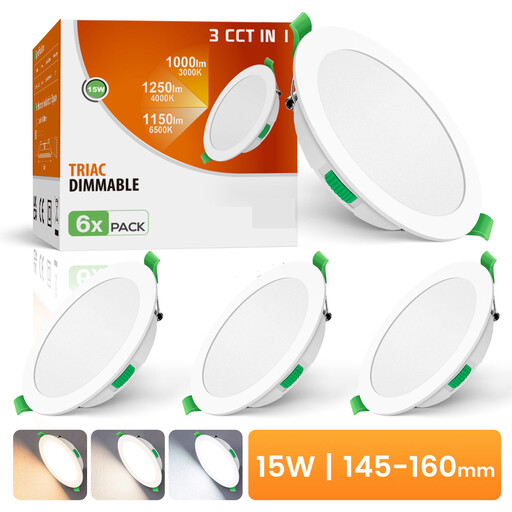
Why it suits this profile: A set of six lights, each producing 1200 lm, with a choice of 3CCT settings and IP44 protection, is suited to renovations involving multiple recessed lights.
The required cut-out size of 145 to 160 mm and compatibility with phase-control dimmers are clearly specified.
Choose 3000K, 4000K or 6500K using the switch, plus IP44 protection for certain damp indoor areas.
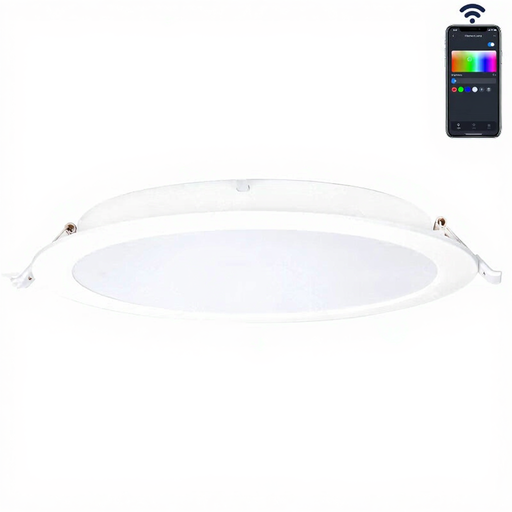
Why it suits this profile: With 1760 lm, RGB colours and a colour temperature range of 2700K to 6500K, it’s suitable for larger rooms, group control and changing the mood of your lighting.
The product description takes the need for a gateway into account, while the IP20 rating clearly limits use to dry indoor spaces.
Bluetooth Mesh, a timer function, voice control with compatible equipment and a 120° beam angle.
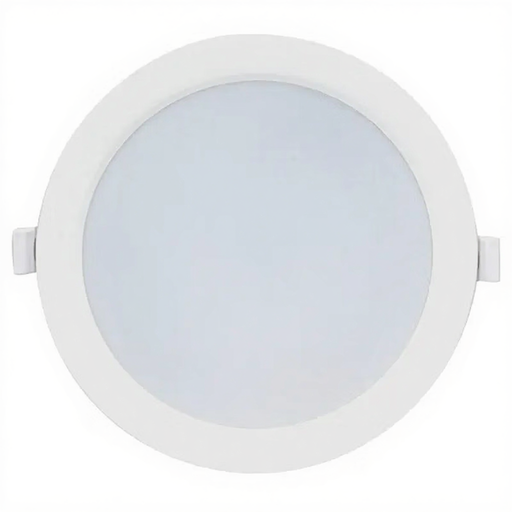
Why it suits this profile: This light offers 1430 lm, a cut-out size of 150 to 160 mm and app control via Bluetooth and WiFi, according to the product details.
Rather than describing control as universally compatible, the product details link it to the app, connection and indoor use.
RGBW 5-in-1 specification, 2700K to 6500K and dimming via app or voice control.
We’ve put together a complete, regularly updated list of products that meet these strict selection criteria and fully comply with the safety regulations in force in the EU.
Not always for a local connection. However, a compatible hub may be needed for remote access, certain app features or voice control. Before you buy, check the network configuration details and whether a gateway is required.
The stated lifespan depends on the model and its operating conditions. Several Aigostar models are rated for 30,000 hours. This is a product specification, not a guarantee that the light will last for the same length of time in every installation. Heat, frequent switching and unsuitable installation can all affect operating conditions.
Running costs depend on the wattage, daily usage and electricity tariff. The calculation is: wattage ÷ 1000 × hours of use × electricity price. A 6 W spotlight uses 0.06 kWh over ten hours of use. If you have several LED ceiling spotlights, add together the wattage of all the lights and remember to factor in the standby consumption of connected models.