
Lieferung heute & morgen

Qualitätsgarantie

Willkommens-Angebote freischalten: KOSTENLOSE Lieferung | Bis zu 80 % RABATT | Kostenlose 30-Tage-JoyPlus-Testphase
App herunterladen
Smart LED lighting offers more than changing colours via your smartphone. Depending on the model, you can incorporate brightness, colour temperature, schedules, movement detection and voice commands into your daily routine. However, living rooms, kitchens, bedrooms, hallways, TV areas and gaming setups all have different requirements.
If you focus only on a high number of colours or buzzwords such as “intelligent”, you can easily overlook important details. Three common purchasing misconceptions are particularly relevant:
Brightness is measured in lumens (lm). A higher wattage alone does not indicate how bright a light actually is. Beam angle, room size and installation height are also relevant for general lighting.
With a smart LED bulb or dimmable LED lamp, you should distinguish between the following functions:
For living rooms and bedrooms, a combination of warm white light and dimmed ambient lighting is often sufficient. In a work area or kitchen, a verifiable lumen rating is more important than the number of available colour effects.
App control depends on the product and may use a manufacturer’s app, Bluetooth or Wi-Fi. Bluetooth is often suitable for local setup, while Wi-Fi can enable control within your home network or remotely. Check whether the device supports 2.4 GHz Wi-Fi only.
Matter-compatible lighting can simplify integration with several smart home platforms. Nevertheless, check which functions are actually available via Matter before buying. Scenes, music synchronisation and special effects may still be limited to the manufacturer’s app.
For voice control, specific details such as Alexa-compatible lamp, Google Assistant or Apple Home are more informative than general smart home advertising. If you already have a system in place, you should also check whether a bridge or hub is required.
For permanently installed lights rated at 220–240 V, installation should be carried out in accordance with the product instructions and applicable safety requirements. In Germany, installation of ceiling lights will often benefit from, or require, a qualified electrician.
Look out for:
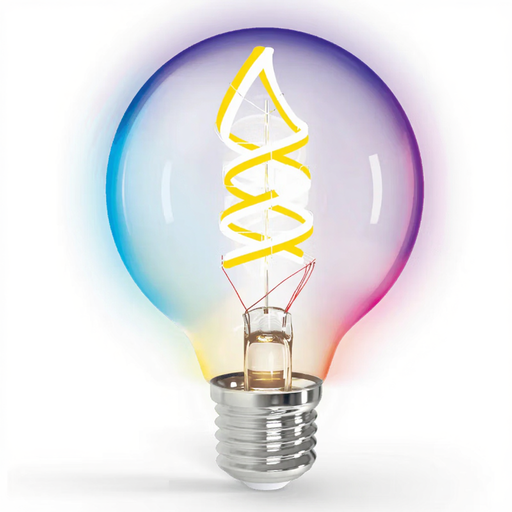
Why this product suits the profile: The E27 design fits many existing light fittings. App and voice control via 2.4 GHz Wi-Fi, together with RGBW functions, make it suitable for getting started with smart home applications.
The technical specifications state 420 lm, 4.9 W, an E27 base and the supported voice assistants. This makes it easier to check whether it is suitable for your existing light fitting.
E27 fitting, RGBW control, warm white light at 2700 K and 70 listed scenes in the app.
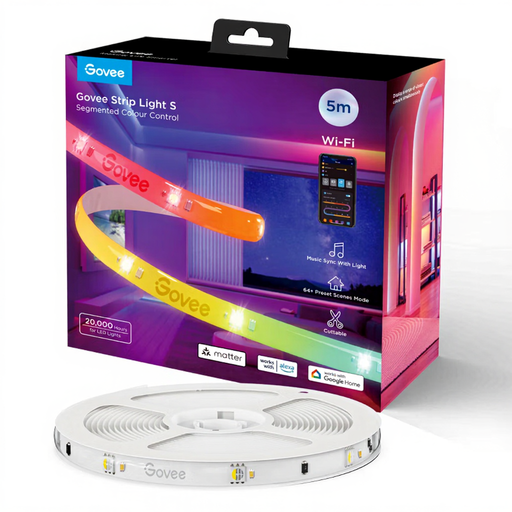
Why this product suits the profile: For TV walls, living rooms or gaming lighting, this strip offers segmented RGBIC control, Wi-Fi, Bluetooth and Matter support.
The specified 5 m length, 24 W power consumption and indoor-use note make planning and usage limits easy to understand.
Matter compatibility, segmented colour zones, 64 listed scenes and music synchronisation via the integrated microphone.

Why this product suits the profile: The battery-powered lights are suitable for kitchens, cupboards, shelves or hallways when there is no power connection and light is only needed when movement is detected.
The PIR detection range, 800 mAh battery, dimensions and three colour temperatures are all specified. This makes it easier to assess the installation location and charging requirements realistically.
Two lights, USB charging, tool-free adhesive installation and specified colour temperatures from 2800–7000 K.
We have put together a complete, regularly updated list of products that fully meet these strict selection criteria and the safety regulations applicable in the EU.
For central room lighting, consider a smart ceiling light or a recessed spotlight. For example, the Hama Smart WiFi Ceiling Light specifies 18 W, up to 1800 lm, RGBW, stepless dimming, Matter and IP54. According to the product specifications, installation should be carried out by a qualified electrician.
For indirect lighting behind a television or above a desk, an RGBIC LED light strip or the Govee Envisual TV Backlight T2 for 55–65-inch televisions are suitable options. If you are looking for a subtle light source for your bedside table, consider the Yeelight Vega RGB Night Light with USB-C charging and motion sensors. For small drawers or cupboards, a multi-piece sensor light set is more practical than permanently installed smart home lighting.
Sometimes. Bluetooth lights can often be controlled directly when you are nearby. Remote access, schedules and voice control usually require Wi-Fi or an additional bridge. Check the relevant product description before buying.
Costs depend on the wattage, daily operating time and electricity tariff. A simple guide is: Power in watts ÷ 1000 × operating hours × electricity price. A 5 W lamp running for four hours a day uses 0.02 kWh per day in theory. Standby consumption and the power supply should also be taken into account for products that remain connected to the network.
The manufacturer gives the lifespan in operating hours, but it depends on temperature, switching cycles, the power supply and usage. With permanently installed lights, you should also bear in mind that the LED module often cannot be replaced like an E27 bulb. Check the warranty, returns and spare parts information before buying.