
Lieferung heute & morgen

Qualitätsgarantie

Willkommens-Angebote freischalten: KOSTENLOSE Lieferung | Bis zu 80 % RABATT | Kostenlose 30-Tage-JoyPlus-Testphase
App herunterladen
Smart LED wall lighting can make a living room, bedroom or home office more flexible. Depending on the model, colours, brightness and scenes can be adjusted via app, voice control or directly on the panel. At the same time, eye-catching designs and extensive feature lists don’t automatically deliver the right solution.
Before buying, check how the lighting is mounted, which technical values are actually specified, and whether control integrates with your smart home system. The following tips help you avoid common misbuys when it comes to LED wall panels and modular LED lamps.
With modular LED lamps, individual elements can often be arranged in different ways. That doesn’t mean every starter kit can be expanded at will. What matters are compatibility within the product series, the maximum number of connected panels and the controller required.
An expansion pack is also usually not a standalone lighting system. When buying, make sure whether the power supply, controller and mounting accessories are included or need to be purchased separately.
App-controlled lighting is usually integrated via Wi‑Fi or a compatible smart home protocol. Check in advance whether the device works with your router, smartphone and preferred voice assistants. For some products, an active Wi‑Fi connection is also required for certain functions.
Operation without the app matters too. Touch areas or buttons on the panel can be practical when your smartphone isn’t available. If you change scenes frequently, also look for a clear app and stored presets.
Hexagonal LED panels and decorative LED lighting primarily create a visible lighting effect on the wall. Whether they illuminate an entire room sufficiently depends on luminous flux, layout and room size.
A low lumen value may be sufficient for background light or living room light décor, but not for focused work. For complete general lighting, you should combine smart wall lighting with a ceiling light or a suitable task light.
The luminous flux in lumens (lm) describes how much visible light a luminaire emits. The wattage mainly indicates electrical consumption. Two products with similar power draw can therefore differ in brightness.
For flexible use, colour temperature and the colour gamut are also relevant. Warm white light looks more restrained, while cooler white can be more suitable for certain everyday situations. According to the product information, some Nanoleaf light panels offer adjustable white tones between 1,500 and 4,000 Kelvin. RGBW models add coloured light scenes.
Also look for the term “dimmable”. A dimmable LED wall light can vary its brightness, whereas simple on/off control offers fewer options. The specific control method should be described clearly in the technical data or the user manual.
Many LED wall panels are fixed with adhesive strips. This can simplify installation, but it requires a clean, dry and sound surface. With delicate wallpaper, textured plaster or freshly painted walls there is a risk of residue or damage.
Before installation you should:
Some decorative lights, by contrast, require their own wall bracket. For the Atmosphera Rainbow LED Wall Neon, for example, the product description states that no wall mounting hardware is included; fixing must be matched to the wall type.
Smart wall lighting is not automatically suitable for bathrooms, balconies or outdoor areas. In the product information available, the Nanoleaf models are designated as indoor products and not water-protected. For wet rooms, the stated IP protection rating must explicitly match the intended area.
Also note the energy efficiency rating, cable length, connection type and the position of the power supply. In everyday use, these details often have a greater impact on suitability than extra colour effects.
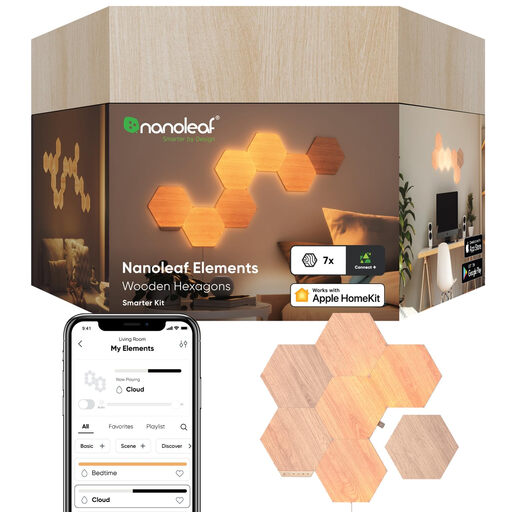
Why this product fits the profile: The 7‑panel starter set combines a wood-look finish with controllable white light and is suitable for buyers who want to start out with modular light décor.
The product data state indoor use, Wi‑Fi control, 14 watts and up to 154 lumens. This makes it easier to assess its role as ambient lighting realistically.
Wood-look design, adjustable arrangement, app, touch and voice control as well as adjustable white tones, according to the product description.
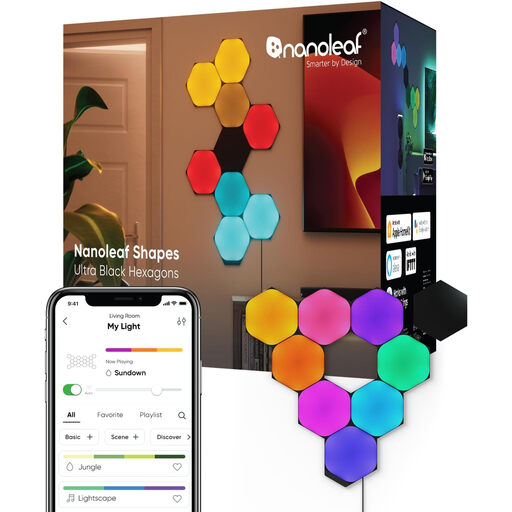
Why this product fits the profile: This set is aimed at users who want to combine RGBW colours, dimming and integration with popular voice assistants in a modular system.
The specifications explicitly state 9 panels, 42 watts, 1,500 lumens, Wi‑Fi, touch control and dimmability. That makes its lighting performance easier to gauge than with design-only descriptions.
RGBW light, dimmable, Wi‑Fi connectivity and support for Amazon Alexa, Google Assistant and Apple HomeKit, according to the product information.
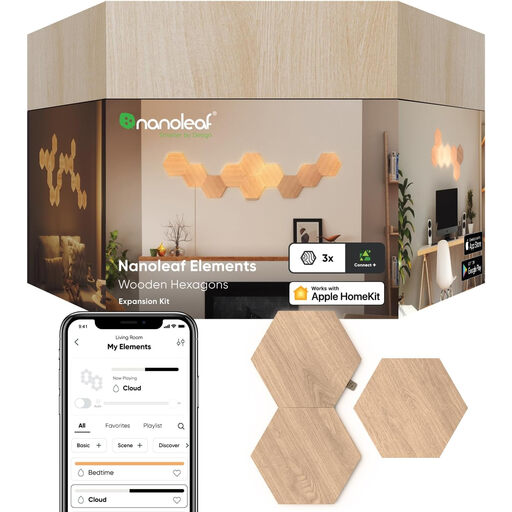
Why this product fits the profile: The 3‑piece expansion pack is intended for users who want to enlarge an existing Nanoleaf Elements system or extend a wall area in a targeted way.
Because it’s labelled as an expansion pack with 3 pieces, it should only be planned together with a compatible starter kit. That prevents an incomplete solo purchase.
Wood-look finish, modular form, app control, plus Wi‑Fi and Thread mentioned in the product description.
We’ve put together a complete, continually updated list of products that fully meet these strict selection criteria and the safety regulations in force in the EU.
Visible patterns, colourful scenes and an indirect orientation work well in the living room. In the bedroom, a more restrained colour temperature can be more sensible than constantly strong RGB effects. In the home office, decorative lighting shouldn’t cause reflections or overpower the screen. An additional, neutrally oriented task light often still makes sense.
Viewing distance also matters when planning. Large wall areas need more panels, while a small arrangement above a sideboard can already serve as an accent. Sketch the pattern before installation using paper templates or masking tape. This lets you account for sockets, furniture and sightlines without stressing the adhesive surfaces multiple times.
First connect the panels as instructed and attach them to the power supply. Then, integration usually takes place via a manufacturer app and Wi‑Fi. Check the supported operating systems and voice assistants before buying. With touch or button control, basic operation is often possible without the app.
Service life depends on the LED module, operating time, heat dissipation and power supply. A blanket durability claim can’t be stated responsibly without specific manufacturer data. As many LED panels have a permanently installed, non-replaceable light source, warranty terms, spare parts availability and returns policy should be checked before purchase.
Costs depend on power draw, daily usage and your electricity tariff. The simple calculation is: Wattage ÷ 1,000 × hours of operation × electricity price. A 42‑watt system that runs for three hours a day uses roughly 46 kWh per year on paper. Standby consumption and actual usage can shift the figure.