
Lieferung heute & morgen

Qualitätsgarantie

Willkommens-Angebote freischalten: KOSTENLOSE Lieferung | Bis zu 80 % RABATT | Kostenlose 30-Tage-JoyPlus-Testphase
App herunterladen
A smart Matter LED lamp E27 Retro combines visible filament styling with app control, dimmable light and smart home compatibility. For living rooms, bedrooms or dining rooms, that might sound straightforward enough. In practice, though, a few common misunderstandings can mean the lamp you buy doesn’t fit your light fitting, your Wi-Fi network or your preferred voice assistant.
The Matter logo alone doesn’t guarantee that every function will work identically in every smart home app. Before you buy, check whether the lamp works with Amazon Alexa, Google Assistant and Apple HomeKit – or with your own control hub. The supported features can also vary: dimming, colour light, schedules and scenes should be clearly listed in the product specifications.
A visible filament structure and tinted glass look decorative, but they don’t automatically provide enough light for reading or working. What matters is the luminous flux in lumens. A filament LED ST64 with 470 lm, for example, is often suitable for accent and ambient lighting, whereas a lamp with 800 lm or more can illuminate a larger area.
With a smart bulb that uses voice control, brightness is normally adjusted via the app or voice assistant. An existing classic wall dimmer isn’t automatically compatible. Combining the two can cause flickering, noise or malfunctions. That’s why your dimmable E27 lamp should only be used with a dimmer that’s expressly suitable – or controlled directly through the smart home function.
The E27 base is widely used in the UK. Even so, the bulb shape must fit your light fitting. An ST64 lamp is longer than an A60, while a G95 or G125 globe lamp is noticeably larger. With open pendant lights, the look also matters, whereas in small table lamps, the diameter and overall height are crucial.
So check the following:
Luminous flux is given in lumens (lm). For decorative lighting, 250 to 470 lm can be enough. A central room light usually needs more. With RGBW LED lamps, you should also distinguish between coloured RGB light and adjustable white light.
The practical details to look for are:
Many Wi-Fi LED lamps require a 2.4 GHz Wi-Fi network. If your smartphone is only connected to a 5 GHz network during setup, pairing can be tricky. With a Matter lamp, you should also check whether a Matter controller is present in your smart home system. The Hama Matter models in our selection connect directly to Wi-Fi according to the product details and don’t need an extra hub.
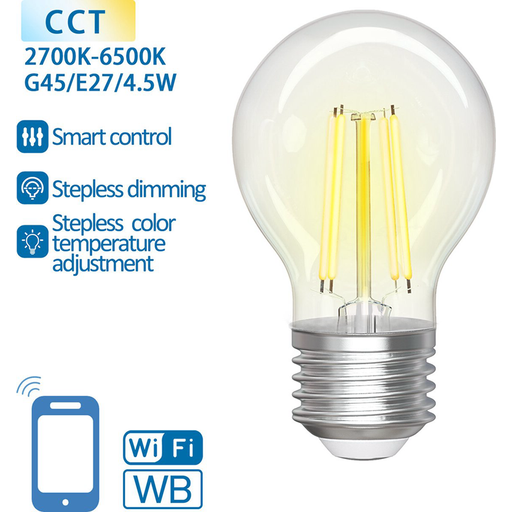
Why this product fits the profile: The compact G45 shape works well in smaller light fittings and offers app and voice control via Alexa and Google Assistant.
The specifications mention 2.4 GHz Wi-Fi, RGB+CCT, dimming from 1 to 100 per cent and a light output of 470 lm. This makes it easy to check the key buying criteria in advance.
E27 base, 2700–6500 K, app control and Wi-Fi/Bluetooth connectivity in a compact design.
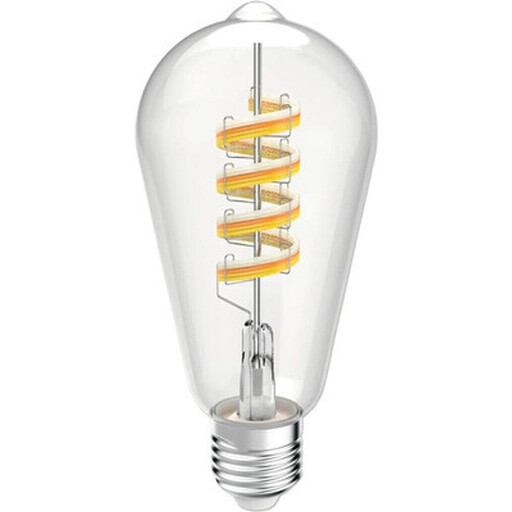
Why this product fits the profile: The ST64 glass shape with visible filament is aimed at users who want to combine retro styling with multiple smart home platforms.
The product details mention Matter, Wi-Fi without a hub, E27, 470 lm, 2700–6500 K and RGBW. This makes the protocol, light output and feature set much clearer to assess.
Matter support for Alexa, Google Assistant and Apple HomeKit, plus a 320° beam angle and app-based schedules.
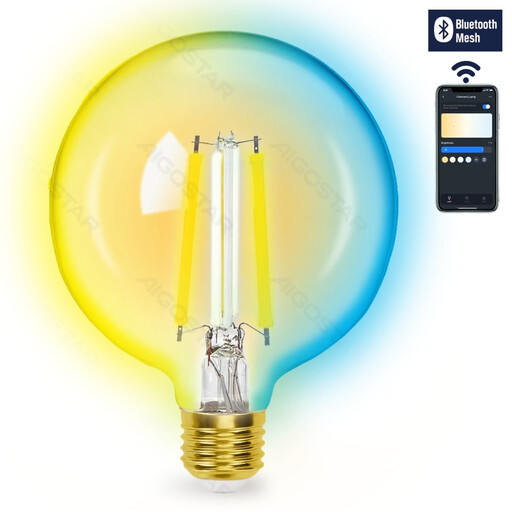
Why this product fits the profile: The large G125 globe is ideal for open pendant, wall and table lights where the bulb itself remains visible.
The product description highlights 2.4 GHz Wi-Fi, Bluetooth Mesh, dimming from 1 to 100 per cent and use without an incompatible external dimmer.
806 lm, adjustable white tones from 2700 to 6500 K, G125 globe shape and, according to the product details, around 15,000 hours of lifespan.
We’ve put together a full, regularly updated list of products that fully meet these strict selection criteria and the safety regulations in force in the EU.
Lamps that are suitable for indoor use and dry rooms should not be used with water, high humidity or unsuitable enclosed light fittings. Before cleaning or replacing the lamp, switch it off and let it cool down.
That depends on the specific model and smart home system. The Hama lamp described connects directly to Wi-Fi according to the product details and doesn’t need an extra hub. However, for Matter control, a compatible controller or suitable smart home hub may still be required.
The figures vary by model. For the products mentioned, around 10,000 to 15,000 hours or roughly 15,000 hours are quoted. The actual lifespan is influenced by factors such as operating time, ambient temperature, ventilation and how often the lamp is switched on and off.
The ongoing electricity costs depend on the wattage, daily usage and your electricity tariff. A simple calculation is: wattage ÷ 1000 × hours of use × electricity price. A 4.9 W lamp used for three hours a day uses less energy than a 20 W lamp over the same period. When comparing, also consider brightness and the area of use.