
Lieferung heute & morgen

Qualitätsgarantie

Willkommens-Angebote freischalten: KOSTENLOSE Lieferung | Bis zu 80 % RABATT | Kostenlose 30-Tage-JoyPlus-Testphase
App herunterladen
Rising energy costs and the desire for more everyday convenience are leading more and more households to seek out intelligent solutions. A smart plug with energy monitoring is a simple and effective entry point for making conventional devices smart, analysing energy consumption, and reducing costs. However, the market offers a wide variety of models with different technologies and features.
This article serves as a guide to help you navigate your options. We explain the key differentiating features and present a selection of models to make it easier for you to choose the right product.
To make the right choice, a few technical aspects are crucial. The following three points will help you define your requirements.
The way the plug communicates with your network is a fundamental criterion.
A smart plug only reaches its full potential through seamless integration into your existing system. Before buying, check for compatibility with the platforms you use. Common standards include:
Not every smart plug is suitable for every appliance. The maximum electrical load is specified in amperes (A) and watts (W).
Based on the criteria above, we have compiled a selection of models that cover different use cases.
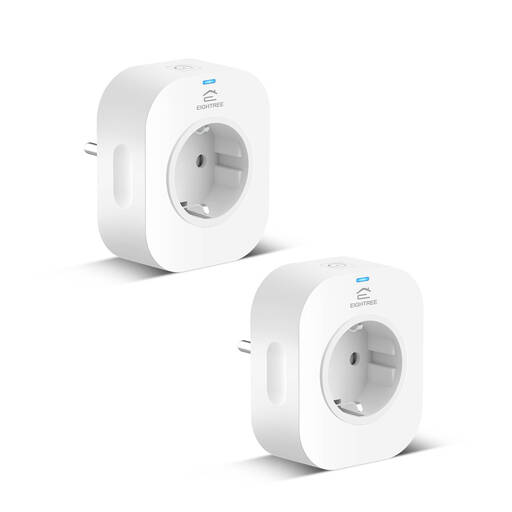
What makes this model stand out: This model is designed for exceptionally easy setup. Pairing is supported by Bluetooth, which allows the plug to be automatically detected in the Smart Life app. The app provides detailed charts on power consumption—broken down by day, month, and year—to help identify energy hogs in your household.
Advantages:
Who is this product for? Ideal for smart home beginners looking for a straightforward plug-and-play solution. Perfect for remotely controlling devices like lamps, fans, or the coffee machine while keeping an eye on energy consumption.
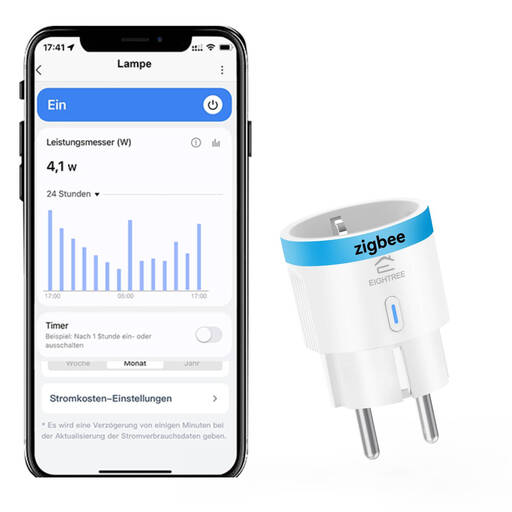
What makes this model stand out: This Zigbee plug uses the Zigbee 3.0 protocol and is aimed at users with an existing smart home hub. The key advantage is the local execution of automations. Schedules and scenes continue to work reliably even if the internet connection is interrupted. Integration into systems like Home Assistant via Zigbee2MQTT or ZHA is seamless.
Advantages:
Who is this product for? For advanced smart home users who already have a Zigbee gateway. Anyone who values maximum reliability, local control, and deep integration into open systems will find this to be a fitting solution.
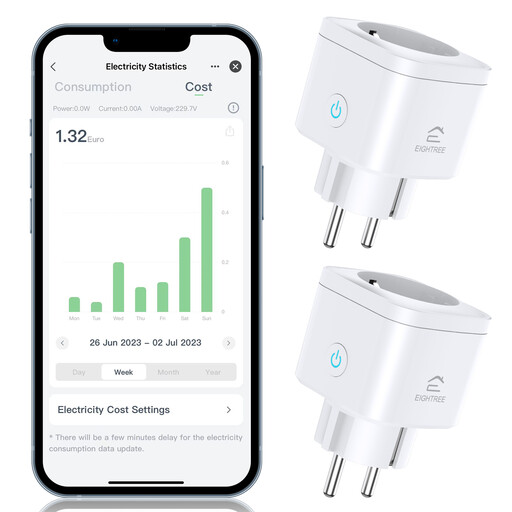
What makes this model stand out: Support for dual-band Wi-Fi (2.4 GHz and 5 GHz) makes this plug a standout. In environments with many Wi-Fi devices, the 5 GHz band can offer a more stable and faster connection. Another unique feature is the ability to export detailed consumption reports as a PDF, enabling deeper analysis of energy usage.
Advantages:
Who is this product for? For users in environments with congested 2.4 GHz networks or for those who prefer a future-proof solution with 5 GHz support. Also ideal for data-driven individuals who want to document and analyse their energy consumption in detail.
Every smart home is unique. If our featured models don't exactly match your requirements, you might find the right solution in our broader selection. Discover more devices for consumption monitoring and control.
Browse our Energy Monitor category.
A classic plug-in timer operates on a fixed, pre-set schedule. A smart plug offers significantly more flexibility: it can be controlled from anywhere via an app, operated by voice, and integrated into complex automations (e.g., "Turn off all lights when I leave the house"). It also allows you to monitor power consumption, which a conventional timer cannot do.
The sensors built into smart plugs are sufficiently accurate for home use to identify trends and high-consumption devices. They are not calibrated, lab-grade energy meters, but they provide reliable data on power (watts), voltage (volts), and current (amps). This information serves as a good basis for optimising your own consumption habits.
This depends on the appliance's power consumption. It is crucial to check the maximum load capacity of the smart plug. Models rated for 16A are designed for most household appliances up to 3680 watts, including washing machines, coffee makers, or fans. However, they are not designed for industrial equipment or very large heaters. Always compare your appliance's power rating with the maximum load of the plug.