
Lieferung heute & morgen

Qualitätsgarantie

Willkommens-Angebote freischalten: KOSTENLOSE Lieferung | Bis zu 80 % RABATT | Kostenlose 30-Tage-JoyPlus-Testphase
App herunterladen
Smart RGB+CCT LED lighting combines colourful light with adjustable white tones. Depending on the model, you can switch between warm white at 2700 K, neutral tones and daylight-like 6500 K. You can also control colours, brightness, schedules and groups via an app or voice control.
However, not every colour-changing LED light is suitable for every location. When it comes to smart LED garden lighting, solar recessed ground spotlights and smart bulbs, unsuitable purchases are often caused by unclear information about the IP rating, compatibility or actual power supply. This guide explains which parameters matter before you buy and which types of product suit different requirements.
RGB stands for red, green and blue LEDs. These can produce a wide range of colours. For practical lighting, however, the additional CCT range is crucial. CCT means “Correlated Colour Temperature” and describes the adjustable colour temperature from warm white to cool white.
An RGB+CCT light can therefore provide both colourful accents and white task or orientation lighting. With basic RGB products, white light is often less flexible or only available as a mixed colour.
The IP rating must suit the installation location. IP20 is intended exclusively for dry indoor areas. IP44 protects against solid foreign objects and splashing water, while IP65 protects against dust and water jets. IP67 permits temporary immersion under the specified test conditions.
Even with a higher IP rating, cables, power supplies and connectors must not simply be left in water. For example, a solar garden light with IP44 is suitable for sheltered flowerbeds and paths, but not for permanently wet hollows.
The operating time of solar-powered lights depends on sunlight, the time of year, orientation, battery capacity and light intensity. A cloudy day or a shaded solar panel reduces the available energy. Models with a separate panel offer greater flexibility when positioning the light in areas with difficult lighting conditions.
This dependency does not apply to mains-powered Wi-Fi garden spotlights. However, they require a suitable power supply and, for 230-volt products, professional installation.
Look at the combination of RGB+CCT, luminous flux and dimming range. Luminous flux is measured in lumens and describes the amount of light emitted. A decorative solar light with only a few lumens adds accents but cannot replace functional path lighting.
For indoor spaces, dimmable LED ceiling lights or recessed spotlights with app control are useful if you want to switch between ambient lighting, concentrated light and a colourful atmosphere. Also check whether brightness can only be adjusted via the app or whether conventional wall control is supported too. Some smart bulbs are not compatible with external dimmers.
Bluetooth Mesh lamps communicate within a mesh network. This allows several lights to be grouped and synchronised. A gateway may be required for remote access beyond the Bluetooth range.
Wi-Fi lights connect directly to the local network, often via 2.4 GHz. This is convenient for individual lights, but requires reliable Wi-Fi coverage in the garden. If you want to combine products from different manufacturers, look for Matter smart home lighting. Matter can simplify integration with platforms such as Apple Home, Google Home, Amazon Alexa, Samsung SmartThings or Home Assistant. Nevertheless, you should check the app, gateway requirements and supported voice assistants before buying.
A recessed spotlight requires a suitable cut-out and sufficient installation space. For 220–240-volt lights, installation should be carried out by a qualified electrician in accordance with local regulations. For outdoor use, you should also consider:
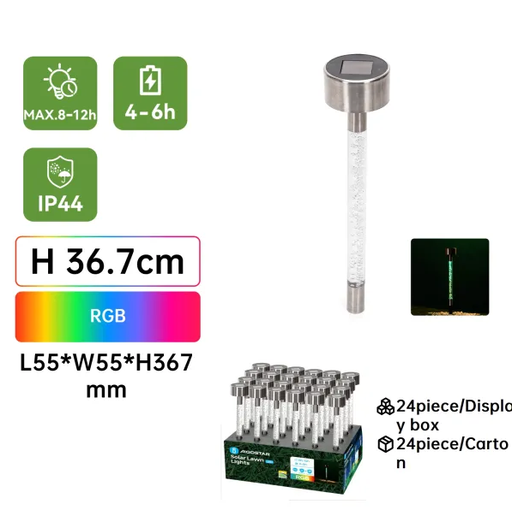
Why this product suits this profile: This solar garden light can be positioned in lawns, flowerbeds or alongside paths without a mains connection and is designed for decorative colour accents.
The specifications state the charging time, operating time and IP44 rating. This makes it easier to assess its suitability for outdoor use realistically.
RGB light, integrated Ni-MH battery, approx. 4–6 hours’ charging time and a stated illumination time of 8–12 hours under suitable conditions.
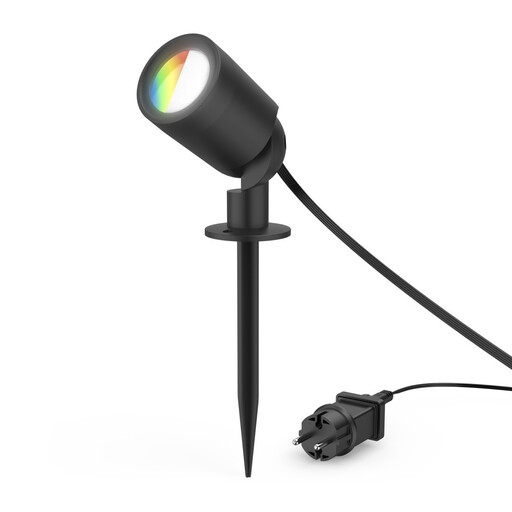
Why this product suits this profile: This Wi-Fi garden spotlight is designed for users who want to combine app, voice and Matter control in a permanently installed outdoor light.
The IP65 rating, 2.4 GHz Wi-Fi information and Matter compatibility make the technical requirements clear.
16 million colours, stepless dimming, adjustable beam angle, plus app, voice and Matter control.
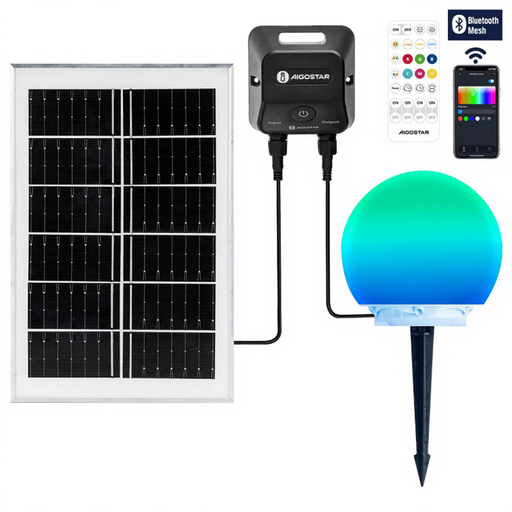
Why this product suits this profile: This model is suitable for larger outdoor areas where several lights need to be synchronised and positioned independently of the mains supply.
The separate solar panel can be angled towards the sun. The IP67 rating is relevant for the planned ground installation, but it does not replace correct installation.
20 W, RGB+CCT from 2700–6500 K, 5 W solar panel, 4000 mAh lithium battery and Bluetooth Mesh control for synchronising multiple lights.
We have put together a complete, regularly updated list of products that fully meet these strict selection criteria and the safety regulations applicable in the EU.
For dry indoor spaces, a smart GU10 LED bulb or dimmable LED ceiling light may be suitable. GU10 models can be fitted into existing sockets. Before buying, check the cap, installation depth, voltage and whether the light may be used in an enclosed housing.
For the garden, you need to distinguish between solar and mains operation. Solar recessed ground spotlights and solar garden lights require a suitable sunny position and regular panel cleaning. A mains-powered garden spotlight provides power regardless of the weather, but must be connected safely.
Bluetooth Mesh lights can generally be controlled locally via Bluetooth and a compatible app. Remote access, voice control or certain automations may require a gateway or internet connection. With Wi-Fi models, connecting to the local 2.4 GHz network is usually part of the setup process.
Their lifespan depends on the model, operating hours, heat dissipation and surroundings. Product specifications may state up to 25,000 or 30,000 hours, for example. This is a technical guideline, not a guarantee of identical service life in every installation scenario.
Yes. Individual models may have a low standby consumption of up to 0.5 W, for example. With several lights that remain permanently powered, this figure can add up over the course of a year. If you want to reduce consumption, check the schedules, group control options and the manufacturer’s information about standby operation.