
Lieferung heute & morgen

Qualitätsgarantie

Willkommens-Angebote freischalten: KOSTENLOSE Lieferung | Bis zu 80 % RABATT | Kostenlose 30-Tage-JoyPlus-Testphase
App herunterladen
Choosing the right lighting is crucial for a room's atmosphere. A smart RGB LED ceiling light offers flexible options that go far beyond simple on/off functionality. Whether for focused work, relaxing evenings, an immersive gaming session, or a party, you can create the perfect ambience for any situation with customisable colours and brightness levels.
This guide will help you understand the technical features and make an informed decision. We'll provide objective selection criteria and present a curated list of models with different specialised functions.
The technical specifications can seem complex at first glance. The following three points are particularly important when choosing the right ceiling light for your smart home.
The connection type determines how the light is controlled. The most common technologies are Wi-Fi and Bluetooth.
The terms RGB and RGBIC describe how the light displays colours.
Two key metrics determine the quality of light:
Based on the criteria mentioned, we have compiled a selection of models that cover a range of different needs.
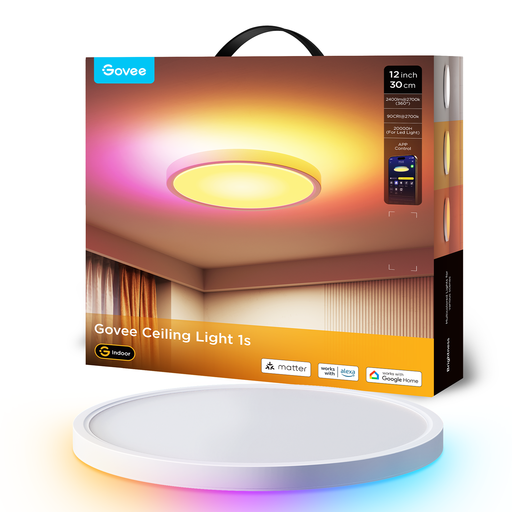
Why It Stands Out: This model from Govee combines a main light (RGB+WW) with a separate, upward-facing RGBIC backlight. This enables dual-zone lighting effects, projecting functional white light downwards and a coloured halo onto the ceiling. With up to 2400 lumens and an adjustable colour temperature from 2200 K to 6500 K, it is highly versatile.
Pros:
Who Is It For? Ideal for users looking to create an immersive atmosphere, especially in a gaming room or entertainment area. The combination of functional main light and atmospheric backlighting makes it very flexible.
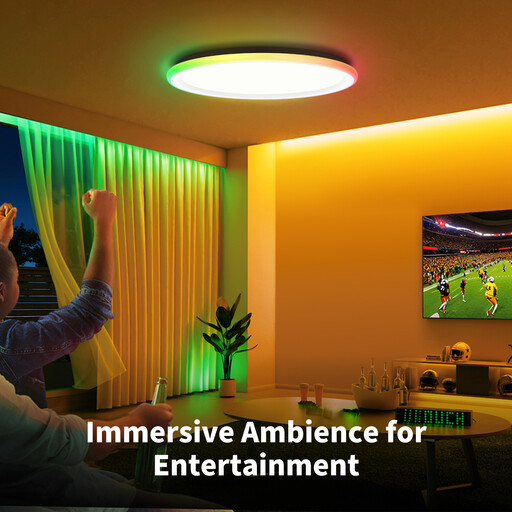
Why It Stands Out: The Yeelight ceiling light stands out with its SideGlow lighting, which casts a colourful glow sideways onto the ceiling, creating an indirect, room-filling atmosphere. A high colour rendering index of Ra90 ensures that colours appear natural and true-to-life under the white light.
Pros:
Who Is It For? A great choice for modern living rooms and bedrooms where both high-quality primary lighting and subtle, atmospheric accent lighting are desired.
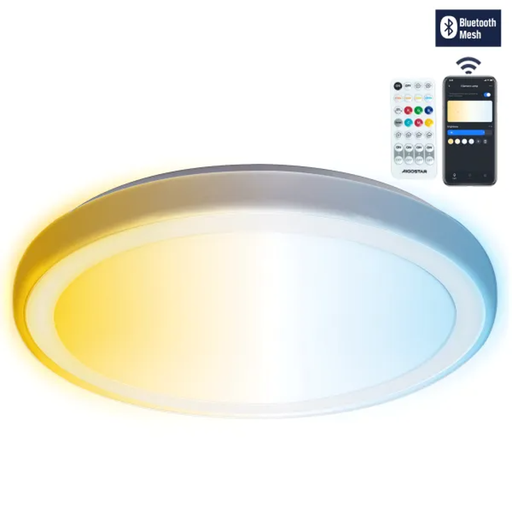
Why It Stands Out: This model from Aigostar uses Bluetooth Mesh as its network technology. It offers a very high brightness of 3960 lumens with a power consumption of 36 watts, making it ideal for illuminating larger rooms. The focus here is on powerful and adjustable white lighting.
Pros:
Who Is It For? Suitable for users looking for a very bright smart ceiling light for large living rooms, offices, or workspaces, who also value stable control over multiple lights. Colour features are not the main focus here.
If the models presented here don't exactly meet your requirements, or if you're looking for a light with a different focus, you can find a wider selection of lighting solutions for your home in our Bright Ceiling Lights category.
1. What is the difference between RGB and RGBIC in a ceiling light? An RGB light can only display a single colour at a time. An RGBIC light has individually controllable LED segments and can therefore display multiple colours simultaneously, enabling dynamic effects like gradients or animations.
2. Can I operate a smart ceiling light with a standard light switch? Yes, a standard light switch can turn the light on and off. However, this cuts the power supply. To use the smart features (e.g., dimming, colour change, app control), the light needs a constant power supply, meaning the switch must remain in the "on" position. Control is then managed via the app, a smart switch, or voice command. Using an external dimmer switch is generally not recommended.
3. How bright should a smart ceiling light be for the living room? For an average-sized living room (approx. 20-25 m?), a base brightness of around 2000 to 4000 lumens is recommended. More important than the maximum value, however, is that the light is dimmable. This allows the brightness to be flexibly adjusted for different activities—bright light for reading or working, and dimmed, warm light for a relaxing evening.