
Lieferung heute & morgen

Qualitätsgarantie

Willkommens-Angebote freischalten: KOSTENLOSE Lieferung | Bis zu 80 % RABATT | Kostenlose 30-Tage-JoyPlus-Testphase
App herunterladen
A smart RGB LED lamp can do much more than a conventional light: colours, brightness, shades of white and, in some cases, even lighting effects can be controlled via an app, voice commands, Bluetooth, Wi-Fi or a remote control. This flexibility is practical for living rooms, bedrooms, party rooms or a decorative corner. However, systems differ considerably in terms of connection, operation and light output.
If you only focus on a large number of colours or terms such as “Smart”, you may overlook important details. The following points will help you choose an LED lamp with dimming capability that is safe and suitable for your smart home.
A pure RGB light produces coloured light using red, green and blue LED components. This is usually sufficient for coloured ambient lighting. However, if you also want to read, cook or illuminate a room evenly, you should look for RGB+CCT or RGBW. These technologies also allow you to adjust the colour temperature of the white light, for example from warm 2700 K to cooler 6500 K.
A Wi-Fi LED lamp can generally be controlled directly via your home network and, depending on the system, may also be accessible when you are away from home. A Bluetooth Mesh lamp, on the other hand, initially communicates with compatible devices via Bluetooth. This can be useful for several lights in the same household, but requires a compatible ecosystem.
You should therefore check the following before buying:
For a smart light, dimmable does not necessarily mean that it will work with a conventional wall dimmer. Some models can only be dimmed via an app, voice command or remote control. You should check the existing dimmer particularly carefully when choosing a GU10 Smart LED. A conventional wall dimmer can cause malfunctions with lights that are not designed for this type of control.
The fitting must be compatible with your existing light. An E27 Smart LED is suitable for many table lamps, floor lamps and pendant lights. A GU10 lamp is designed for spotlights and certain ceiling systems. Diameter and height are also important: a large G120 globe lamp may take up too much space in an enclosed light fitting or small lampshade.
Luminous flux is measured in lumens. A lamp with 420 lm is suitable for decorative or focused lighting, while 1800 lm provides considerably more brightness. The brightness you actually perceive also depends on the lampshade, beam angle and position.
With an RGB+CCT lamp, you can adjust the white temperature as well as the colours. Warm white light is often suitable for relaxed living spaces, while neutral or cooler settings can be used in functional areas. The CRI or Ra value describes colour rendering. A value of Ra ≥ 80 is specified for the models mentioned here and provides a basic guide for private indoor use.
IP20 is intended for dry indoor spaces, not for balconies, bathroom areas exposed to splashing water or outdoor use. Light sources should not be installed in fully enclosed fittings if the manufacturer advises against it. Switch off the power supply before inserting or removing a lamp. If you notice unusual heat, cracks or discolouration, stop using the lamp.
The energy efficiency class is also worth considering. The rating is shown on the EU energy label and can be compared between models. For running costs, you should also consider power consumption in watts, daily usage time and the electricity price.
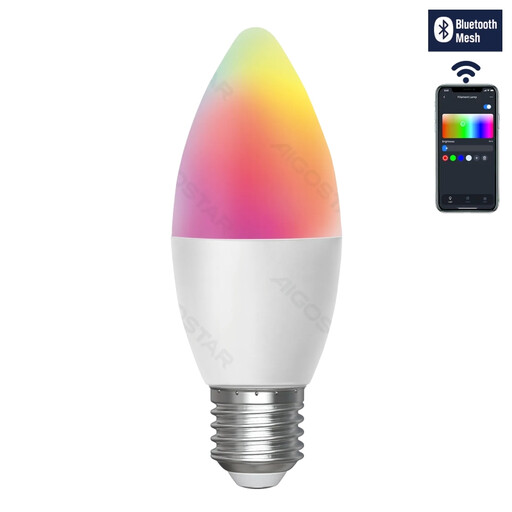
Why this product suits the profile: The E27 fitting is common in many household lights. Control via the AIGOSMART app, Amazon Alexa or Google Assistant gives you several ways to operate it.
The specifications state RGB+CCT, dimming from 1 to 100% and a colour temperature of 2700 to 6500 K. This gives a clearer picture of what “dimmable” means in practice.
4.9 W power consumption, 420 lm, Bluetooth Mesh and a stated lifespan of up to 25,000 hours.
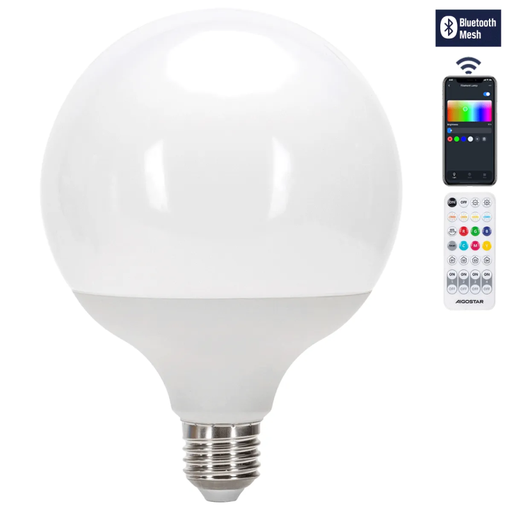
Why this product suits the profile: The large G120 shape is designed for visible lamp fittings and, with 1800 lm, provides greater light output for living areas.
The technical specifications state the fitting, dimensions of D120 x H165 mm, IP20 and Bluetooth Mesh. This lets you check in advance whether the light fits both mechanically and spatially.
RGB plus white light up to 6500 K, timer and group functions according to the product description, as well as Alexa control without a gateway in the configuration described.
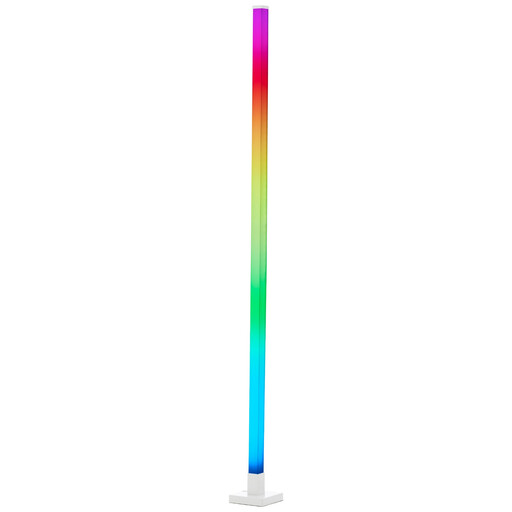
Why this product suits the profile: At 150 cm high, this light is suitable for living rooms, party areas or relaxation zones when no separate fitting is available.
It is operated using the supplied remote control. No app set-up is required, while brightness and effect speed can be adjusted directly.
Integrated music sensor, RGB colour changes, built-in dimming and 6.5 W power consumption at 125 lm.
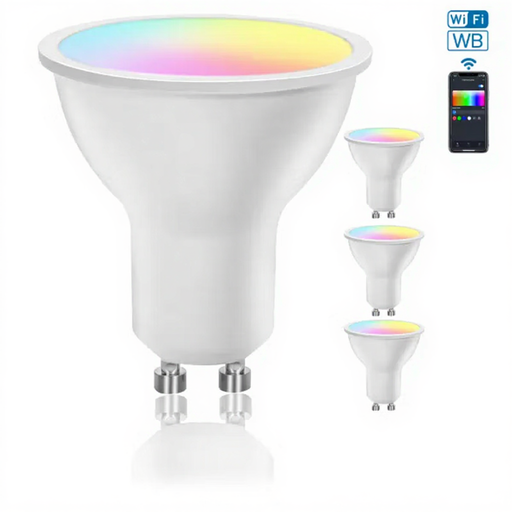
Why this product suits the profile: The set of four bulbs is ideal for households that want to control several GU10 spotlights together via an app.
The Wi-Fi connection and app control are explicitly specified. Before buying, you should still check the fitting, installation depth and the limitation compared with traditional wall dimmers.
RGB+CCT from 2700 to 6500 K, dimming from 1 to 100%, 420 lm and Alexa compatibility according to the product specifications.
We have put together a complete, regularly updated list of products that fully meet these strict selection criteria and the safety regulations applicable in the EU.
For app-controlled models, start by installing the manufacturer’s app. Then pair the lamp as described in the instructions and, for Wi-Fi models, connect it to your home network. Bluetooth Mesh lights generally require a compatible smartphone or system. Voice assistants are linked via the relevant app.
Lifespan depends on the model, operating time, heat dissipation and switching frequency. Several of the Aigostar models mentioned specify up to 25,000 operating hours and 12,500 switching cycles. These are product specifications and are not a guarantee for every usage situation.
Consumption mainly depends on the power rating in watts and how long the lamp is used. A 4.9 W lamp used for four hours a day would consume around 7.2 kWh per year in theory. There may also be a small amount of additional consumption in standby mode. For an accurate estimate, refer to the power consumption and electricity tariff for your household.