
Lieferung heute & morgen

Qualitätsgarantie

Willkommens-Angebote freischalten: KOSTENLOSE Lieferung | Bis zu 80 % RABATT | Kostenlose 30-Tage-JoyPlus-Testphase
App herunterladen
Smart RGB solar outdoor lighting can illuminate paths, exterior walls, balconies and patios without a mains connection. However, available models vary considerably in light output, battery capacity, controls and weather protection. If you focus only on terms such as ‘colourful’, ‘smart’ or ‘solar’, you could miss important details.
A figure such as 20 W or 35 W doesn’t automatically tell you how much light you’ll see. For practical comparison, luminous flux in lumens is more useful. A solar light with 200 lm is better suited to providing guidance and ambience, while 350 lm can illuminate a larger area. You should also consider the beam angle when lighting a path or exterior wall.
An RGB solar light can add colourful accents. For everyday use, though, neutral or warm white light is often more practical. An RGBCCT outdoor light combines RGB colours with adjustable white light. Check the stated colour temperature range, for example 2700 K to 6500 K. This lets you switch between a warm white ambience and cooler, more practical lighting.
The stated charging time applies under the conditions specified by the manufacturer. In Germany, shade, short winter days, cloudy weather and dirt on the panel can all affect the actual run time. A separate solar panel with a cable offers more flexibility than a built-in panel, as you can position it to face the sun.
IP65 outdoor lighting is protected against dust and water jets from different directions. This makes it suitable for many outdoor spaces, such as exterior walls, covered patios and garden areas. However, IP65 doesn’t mean the light can be left submerged in water. Connections, cable joints and the mounting position should also be suitable for outdoor use.
Battery capacity is measured in mAh. A higher capacity can mean longer operating times, but performance also depends on brightness, colour mode, temperature and control features. The models featured here include batteries rated at 4000 mAh and 8000 mAh.
The output of the monocrystalline solar panel also matters. A 5 W panel needs different conditions from a 12 W panel. Treat the manufacturer’s charging and operating time figures as a guide, not a guaranteed result in all weather.
Bluetooth Mesh lighting can connect several compatible lights. According to the Aigostar product details, more than 200 devices can be linked. This can be useful for controlling lighting across a garden, balcony or patio. Before buying, check:
With an app-controlled outdoor light, you should also consider the mounting height and the distance between devices.
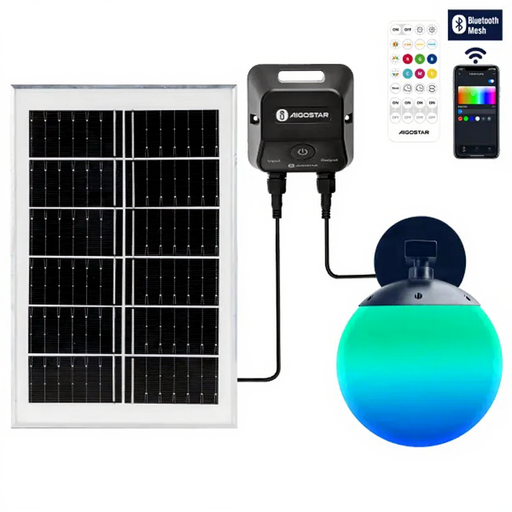
Why it suits this profile: This solar-powered outdoor wall light combines RGB and white light with a 4000 mAh battery. The separate 5 W solar panel, supplied with a 5 m cable, makes it easier to position by an exterior wall, balcony or patio.
The specifications state both the colour temperature range of 2700 K to 6500 K and the battery capacity. This makes it easier to choose a light to suit your preferred setting.
Bluetooth Mesh, RGB plus white light, a 5 m cable and, according to the product details, up to 24 hours of operating time.
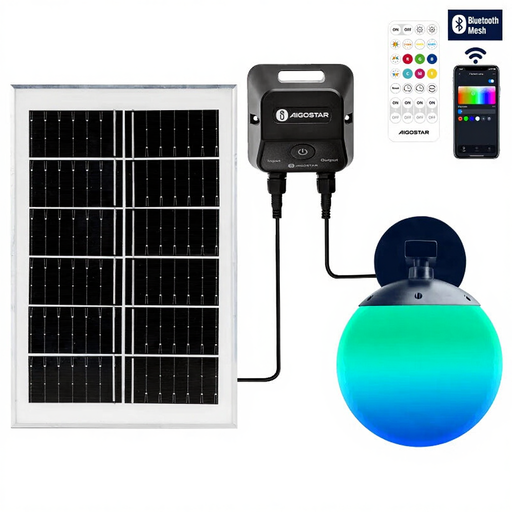
Why it suits this profile: This model is a good choice if you’re looking for a clearly stated IP65 rating, RGBCCT colour control and the option to link multiple lights for exterior walls or patios.
The product description specifies the protection rating, an operating temperature range of -10 °C to 50 °C, a charging time of 4 to 6 hours and a luminous flux of 200 lm.
IP65, RGB plus white light from 2700 K to 6500 K, a 5 m solar panel cable, and CE and RoHS details in the product description.
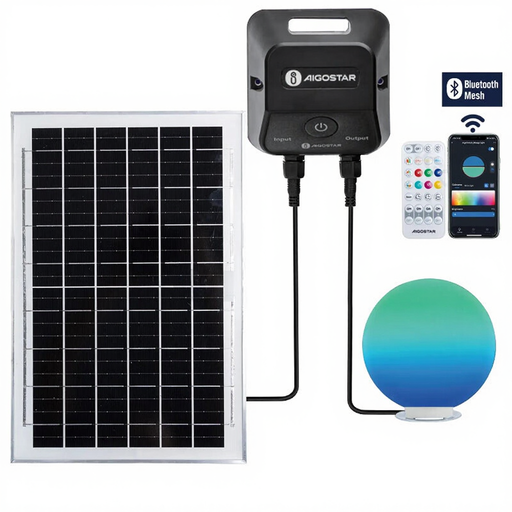
Why it suits this profile: This solar garden floor light is designed for larger areas, flower beds, seating areas or prominent paths. The 12 W solar panel and 8000 mAh battery are suited to those who need more light.
The specifications distinguish between a luminous flux of 350 lm, a 120° beam angle, IP65 protection and the cable lengths: 1 m at the panel and 3 m at the light.
350 lm, an 8000 mAh lithium battery, RGB plus white light from 2700 K to 6500 K, Bluetooth Mesh and a stated lifespan of 30,000 hours.
For consistent charging, install the solar panel somewhere that won’t be in permanent shade. Trees, overhanging parts of buildings and neighbouring properties can reduce its output. It’s a good idea to test the position at different times of day before fixing it in place.
You should also avoid installing solar-powered garden lighting where water collects. Position cable connections so they aren’t under constant strain. Battery performance may decrease at temperatures below the manufacturer’s stated range.
First, position the solar panel and charge the battery. Then install the relevant app, switch on the light and pair it via Bluetooth. If you’re setting up several devices, connect them to the Mesh network afterwards. The exact steps depend on the app and model.
Run time depends on battery capacity, brightness, colour mode, temperature and charge level. Manufacturer claims such as ‘up to 24 hours’ apply under certain conditions. In winter or after several cloudy days, the actual operating time may be shorter.
The light runs on energy stored in the battery, which is charged by the solar panel. This means it doesn’t need to be connected to the mains. However, you may need to pay for the initial purchase, replacement batteries or maintenance. Before buying, check whether the battery can be replaced and whether spare parts are available.
We’ve put together a complete, regularly updated list of products that meet these strict selection criteria and fully comply with the safety regulations in force in the EU.