
Lieferung heute & morgen

Qualitätsgarantie

Willkommens-Angebote freischalten: KOSTENLOSE Lieferung | Bis zu 80 % RABATT | Kostenlose 30-Tage-JoyPlus-Testphase
App herunterladen
Designing your garden or patio is an ongoing project. While atmospheric and functional lighting is central to the experience, implementation can be challenging, involving complex wiring, rising electricity costs, and limited control. Smart solar garden lights offer a modern solution, combining energy efficiency, flexibility, and simple installation.
This article serves as your guide. We'll explore how they work, highlight the key features to look for when making your choice, and present a selection of models designed for various outdoor applications.
Choosing the right garden lighting depends on your individual needs. Three key criteria will help you make an informed decision.
The type of connectivity is crucial for user convenience. While individual lights are often controlled by a simple remote, a solar light with app control offers significantly more flexibility. In this regard, Bluetooth Mesh lighting has proven to be particularly practical for outdoor use.
Unlike a direct Wi-Fi connection, where the signal is often weak in the garden, lights with Bluetooth Mesh create their own network. Each light acts as a signal repeater, passing commands to the next. This enables stable, synchronised control of a large number of lights over long distances—ideal for larger gardens and properties.
Modern outdoor LED solar lights offer much more than just a source of light. Look for the RGBCCT designation:
Since the lights operate off-grid, the performance of the solar panel and the capacity of the battery are crucial factors for their runtime.
Based on the criteria mentioned, we have compiled a selection of models that cover different outdoor lighting needs.

Why it stands out: This outdoor solar wall light combines direct and indirect light. The layered lighting effects (up and down) create a sophisticated look on house walls, masonry, or fences. The separate 5-metre cable for the solar panel offers maximum mounting flexibility.
Advantages:
Who is it for? For homeowners who want to enhance facades, entrance areas, or patio walls with dynamic and atmospheric lighting effects without having to run any cables.
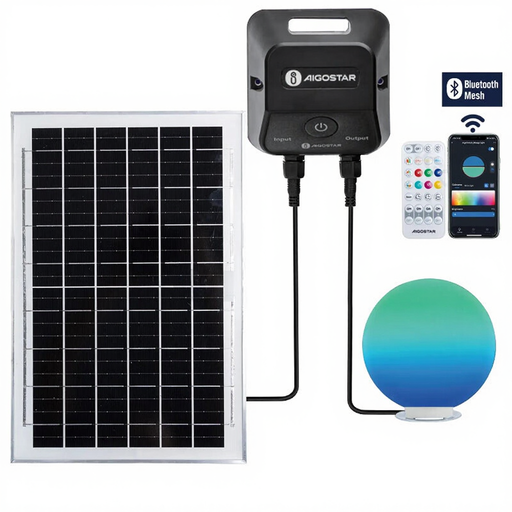
Why it stands out: As an outdoor solar floor lamp with a height of 50 cm, this model creates striking accents on patios, next to seating areas, or along pathways. With 350 lumens, it offers impressive brightness and is also suitable for illuminating larger areas.
Advantages:
Who is it for? Ideal for garden and patio owners looking for a freestanding, bright, and flexibly placeable light source to highlight specific areas or provide good ambient illumination.
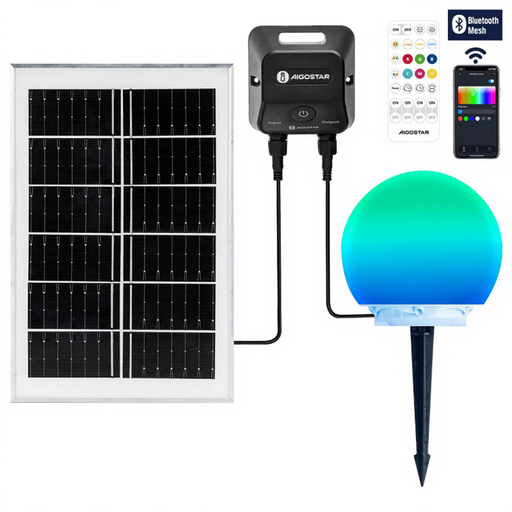
Why it stands out: This in-ground light is designed for discreet integration into the garden. Its flat, round design is perfect for marking pathways, illuminating flowerbed borders, or accenting the edges of a patio.
Advantages:
Who is it for? Perfect for anyone seeking subtle yet effective lighting for paths, driveways, or to define garden areas, who also values smart control options.
The models presented cover common use cases. If you haven't found the right solution for your specific project or are looking for other designs and features, it's worth exploring the wider range available.
Discover our entire range of Outdoor Light Bulbs.
A smart solar light consists of four main components: a solar panel, a battery, an LED light source, and a control module. During the day, the solar panel converts sunlight into electrical energy and charges the battery. A dusk-to-dawn sensor detects when it gets dark and automatically activates the light. Using the control module (e.g., Bluetooth), you can turn the light on and off and adjust its brightness and colour via a smartphone app.
Yes, modern monocrystalline solar panels are efficient enough to generate energy and charge the battery even on overcast days or in diffuse light. However, charging performance is highest in direct sunlight. For optimal all-night operation, positioning the panel in the sunniest possible location is recommended.
The main advantage of Bluetooth Mesh lies in its range and stability. Instead of each light needing an individual connection to your smartphone, the lights communicate with each other. Each light acts as a node and repeater, passing the signal on to the next one. This creates a large-scale, stable network that allows you to control dozens or even hundreds of lights simultaneously, even in large gardens where a Wi-Fi signal wouldn't be sufficient.