
Lieferung heute & morgen

Qualitätsgarantie

Willkommens-Angebote freischalten: KOSTENLOSE Lieferung | Bis zu 80 % RABATT | Kostenlose 30-Tage-JoyPlus-Testphase
App herunterladen
Creating atmospheric garden lighting presents several challenges for homeowners. Running power cables is complex, electricity costs are a concern, and conventional lights often offer limited control. Smart solar garden lights provide a modern solution, combining energy efficiency, simple installation, and flexible app-based control.
This article serves as your guide. It explains the key features of modern solar lights and presents a selection of models to help you make an informed purchasing decision.
The technology has evolved significantly in recent years. To find the right light for your needs, the following criteria are essential.
A central feature is the ability to have an app-controlled solar garden light. While basic models only have a dusk-to-dawn sensor, advanced systems use wireless technologies.
Bluetooth Mesh garden lighting is particularly noteworthy. With this technology, the lights communicate with each other to form a stable network. The signal is relayed from one light to the next, significantly extending control range across your entire garden. This allows you to reliably operate even distant lights via a smartphone app, create schedules, or set lighting scenes for the entire group.
Modern solar lights can do more than just shine. Look out for the following terms:
Since the lights remain outdoors year-round, high durability is essential. The IP rating indicates how well a light is protected against the ingress of foreign objects and water. For garden use, models with at least an IP44 rating (protection against splashing water) are suitable. A weatherproof solar ground light with IP65 or higher is even more robust, being fully dust-tight and protected against water jets.
The solar panel's efficiency and the battery's capacity determine how long the light will operate after a sunny day. High-quality monocrystalline solar panels and lithium iron phosphate (LiFePO4) batteries offer excellent efficiency and longevity, even in less-than-optimal weather conditions. This makes reliable garden lighting without mains power possible.
Based on the criteria above, we have compiled a selection of models that stand out for their technical features and applications.
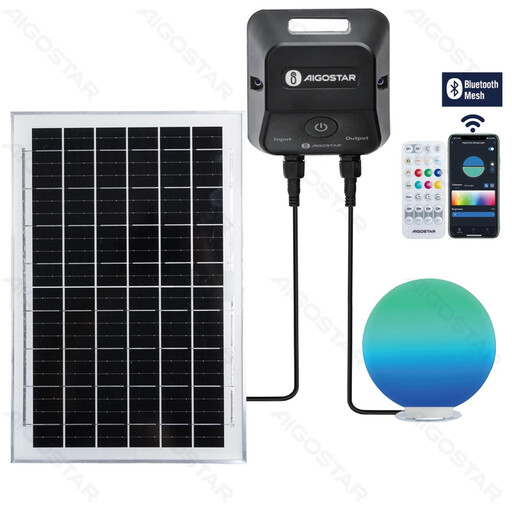
Why it stands out: This smart solar spotlight combines a high light output of 350 lumens with a powerful 10-watt solar panel and a large 8 Ah battery. This combination ensures bright and long-lasting illumination.
Advantages:
Who is it for? For users seeking powerful and targeted accent lighting for specific objects in the garden, who also value long, self-sufficient operating times.
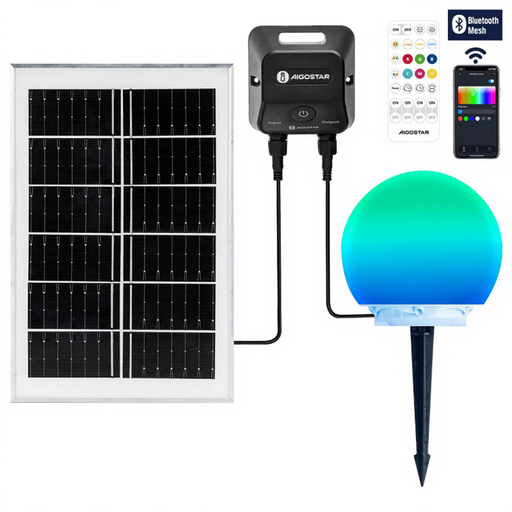
Why it stands out: The special feature of this model is its separate solar panel, connected to the light via a cable. This allows for flexible placement: the light can be positioned in the shade while the panel is aimed at the full sun.
Advantages:
Who is it for? Ideal for illuminating paths, patios, or flowerbeds where the desired lighting point is not in direct sunlight.
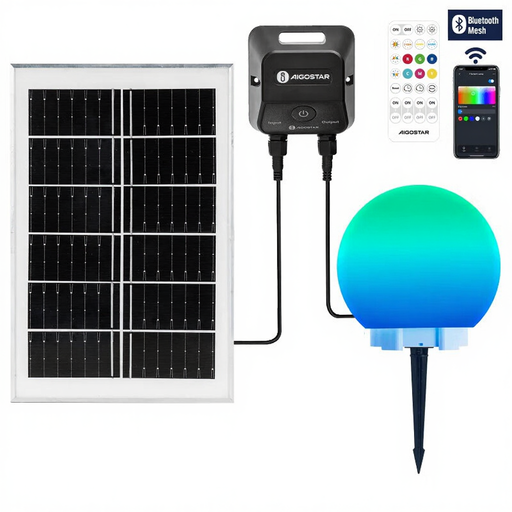
Why it stands out: This light is designed as a bollard light and can be easily and discreetly installed along paths or in flowerbeds using its ground stake. It blends seamlessly into the garden design.
Advantages:
Who is it for? Perfect for users who need an unobtrusive yet smart lighting solution for marking paths, driveways, or defining garden areas.
The models presented here offer a glimpse into the world of smart solar lighting. If you are looking for other designs, power levels, or specific features, you may find the right product in our broader selection.
? Discover more outdoor light bulbs for your porch here
1. How exactly does a smart solar light work? A smart solar light consists of a solar panel, a battery, an LED light source, and an intelligent control chip. During the day, the solar panel converts sunlight into electrical energy and charges the battery. A dusk-to-dawn sensor detects when it gets dark and automatically turns the light on. The smart chip enables connection to a smartphone app (e.g., via Bluetooth), which you can use to set colours, brightness, and schedules.
2. Do solar lights work on cloudy days or in winter? Yes, modern solar lights with high-efficiency monocrystalline panels can generate energy even in diffuse light, although more slowly than in direct sunlight. A fully charged, high-capacity battery can often power the light for several nights, bridging short periods with little sun. The actual runtime depends on the stored energy and the set brightness level.
3. What is the advantage of Bluetooth Mesh over a standard Bluetooth connection? A standard Bluetooth connection is only between two devices (e.g., a smartphone and one light) and has a limited range of about 10–15 metres. With Bluetooth Mesh, each light acts as a node in a network. The lights communicate with each other and relay commands. This allows you to cover a very large area and control dozens or even hundreds of lights simultaneously and reliably, far beyond the range of a single connection.