
Lieferung heute & morgen

Qualitätsgarantie

Willkommens-Angebote freischalten: KOSTENLOSE Lieferung | Bis zu 80 % RABATT | Kostenlose 30-Tage-JoyPlus-Testphase
App herunterladen
As a Joybuy Product Recommendation Officer, I see homeowners every day looking for ways to upgrade their gardens. Complex wiring and rising electricity costs are often major obstacles. A modern solution to this problem is the smart solar garden light. It combines the energy efficiency of solar technology with the convenience of smart control.
This article serves as a practical guide. It explains the key features to look for when making your selection and presents a few specific models that stand out for their functionality and design. Our goal is to provide you with an informed basis for your decision, so you can find the perfect smart solar garden lighting for your needs.
The range of smart solar lights is vast. To make the right choice, three technical aspects are particularly important.
The type of control defines how flexibly you can adjust your lighting. A solar light with app control is the standard here. However, the crucial question is the underlying technology:
For reliable and scalable wireless outdoor lighting, a system based on Bluetooth Mesh is generally superior.
Modern solar lights offer much more than simple illumination. Look for the RGBCCT designation to get maximum flexibility.
An RGBCCT garden lamp combines both functions, offering you the full spectrum of lighting possibilities.
The longevity of an outdoor light depends on its material and protection rating.
Based on the criteria above, we have compiled a few models that stand out for their technical features and versatile applications.
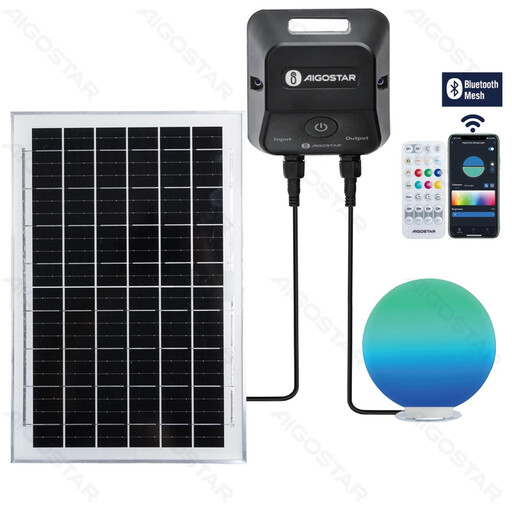
Why it stands out: This model is a powerful floodlight that, with a brightness of 350 lumens (equivalent to approx. 35W), can effectively illuminate larger objects like trees or sections of a facade. The large 10W monocrystalline solar panel and the 8Ah lithium iron phosphate battery ensure a reliable power supply and a long runtime.
Pros:
Who is it for? For garden owners looking for a powerful and smart lighting solution to specifically showcase architectural details, tall trees, or sculptures.
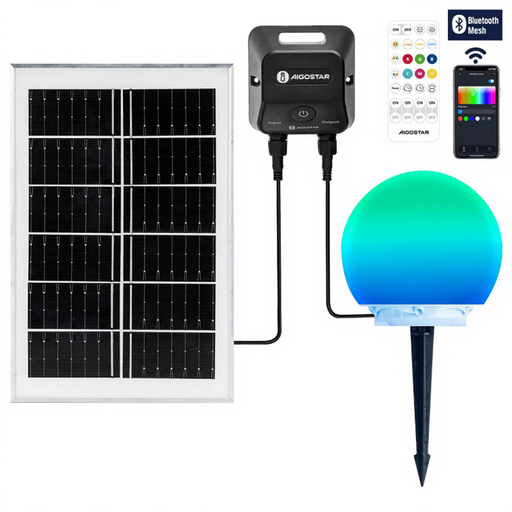
Why it stands out: This solar ground spike light is distinguished by its separate solar panel, which is connected to the light via a long cable. This allows for flexible placement: the light can be positioned in the shade under a bush, while the panel is mounted in a sunny spot. The design also creates a dual-layer light effect.
Pros:
Who is it for? Ideal for illuminating pathways, flowerbeds, and patio borders, especially in spots where the light itself is not exposed to direct sunlight.

Why it stands out: Designed as an outdoor solar wall light, this model offers an elegant solution for illuminating vertical surfaces. It combines direct and indirect light for an appealing visual effect on house walls, fences, or masonry. Here too, a separate solar panel ensures optimal energy harvesting.
Pros:
Who is it for? Perfect for homeowners who want to enhance their patio, entryway, or facade with smart, energy-self-sufficient accent lighting.
The models presented here specialize in smart solar technology. If you are looking for more wired or other lighting systems, you can find a wider selection in our category.
? Explore our entire collection of modern low-voltage outdoor lighting here.
1. How exactly do smart solar lights work? During the day, a solar panel converts sunlight into electrical energy and stores it in an integrated battery. A dusk-to-dawn sensor detects when it gets dark and automatically turns the light on. The "smart" component, usually a Bluetooth or Wi-Fi module, allows you to also control the light via a smartphone app to change colors, dim the brightness, or set schedules.
2. Can you control multiple solar lights at the same time? Yes, that is one of the main advantages of smart systems. Technologies like Bluetooth Mesh are designed to form a network of many lights. You can group them in the app and then control them in sync—for example, have all pathway lights change color simultaneously or turn the entire garden lighting on and off with a single tap.
3. How reliably do solar lights work in winter? The runtime of solar lights is directly dependent on the amount of sunlight they receive during the day. In winter, the days are shorter and sun exposure is weaker, which reduces charging performance. Therefore, the runtime may be shorter during the winter months. To optimize performance, you should always keep the solar panel clean and free of snow, and position it to capture as much of the low-lying winter sun as possible.