
Lieferung heute & morgen

Qualitätsgarantie

Willkommens-Angebote freischalten: KOSTENLOSE Lieferung | Bis zu 80 % RABATT | Kostenlose 30-Tage-JoyPlus-Testphase
App herunterladen
By Joybuy Product Recommendation OfficerDate: July 22, 2026
Designing outdoor lighting presents a challenge for many home and garden owners. How can you achieve atmospheric and functional lighting without undertaking extensive groundwork for cabling or driving up your electricity bill? While traditional solar lights offer a wireless solution, they are often severely limited in their features and controllability.
This article is for tech-savvy users looking for modern, energy-efficient, and wireless outdoor lighting. We will introduce the key features of smart solar lights and provide objective guidance to help you choose the right solution for your garden, patio, or balcony. The focus is on systems that can be controlled via an app and allow for flexible lighting scenes.
The selection of solar-powered outdoor lights is vast. To make an informed decision, several technical aspects are important.
The type of wireless connection is crucial for the stability and scale of your lighting system.
Modern solar lights with app control offer much more than just turning on and off. The lighting technology is a key differentiating feature.
Since solar lights operate autonomously, the performance of the solar panel and the capacity of the battery are crucial for the runtime, especially during the darker months.
Based on the criteria mentioned, we have compiled a selection of models that stand out for their technical features and applications.
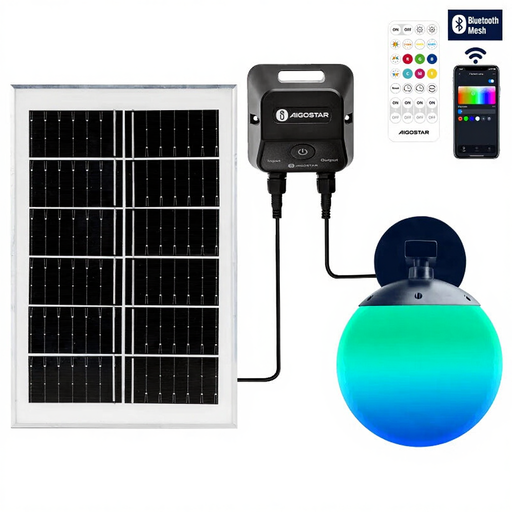
Why it stands out: This wall light creates an up-and-down lighting effect that architecturally highlights modern building fa?ades, walls, or entrance areas.
Advantages:
Who is it for? For homeowners seeking stylish and impactful accent lighting for their building exterior that is completely autonomous and app-controlled.
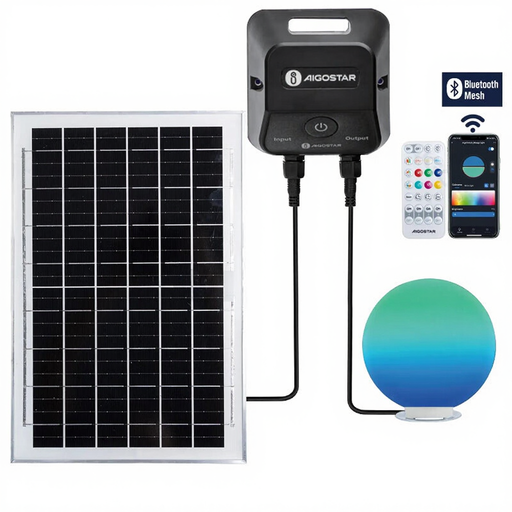
Why it stands out: As a tall (500 mm) pedestal light with a powerful 12W panel and 350 lumens of light output, it serves not only as a guidepost but also for area illumination of patios or seating areas.
Advantages:
Who is it for? For users who need a bright, freestanding, and flexible light source for larger areas like patios, driveways, or as a central feature in the garden.
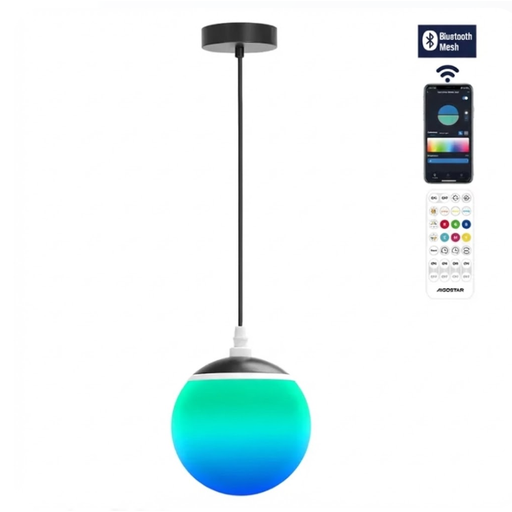
Why it stands out: The split design, separating the solar panel from the light fixture, is the unique feature of this model. It allows the light to be installed in shaded areas like covered patios, gazebos, or garden sheds, while the panel is placed in a sunny spot.
Advantages:
Who is it for? Ideal for illuminating covered outdoor areas where direct sunlight on the light fixture itself is not possible.
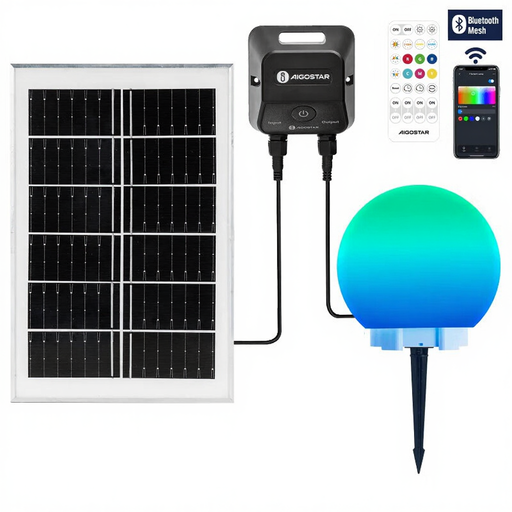
Why it stands out: This light is installed flush with the ground and serves as a subtle yet effective marker for paths, driveways, or patio edges. It is durable enough to be walked on.
Advantages:
Who is it for? For anyone looking for an unobtrusive, integrated lighting solution for orientation and for marking paths or architectural edges in the garden.
The models featured here offer a glimpse into the possibilities of modern solar outdoor lights with an app. If these specific types of lights don't exactly match what you're looking for, there is a wide range of other smart lighting products available.
Explore our entire range of multi-colour outdoor light bulbs to find the perfect solution for your project.
Control is managed wirelessly via a connection between your smartphone and the lights. For the models presented here, the AigoSmart App is used, which connects to the lights via Bluetooth. Within the app, you can control individual lights or groups to dim the brightness, change the light colour (both vibrant colours and white), create schedules, or activate predefined lighting scenes.
Modern solar lights with high-efficiency monocrystalline panels are capable of storing energy even on overcast days, although the charging performance is lower than in direct sunlight. The energy stored in the battery is usually sufficient to power the light for several hours or throughout the night. However, during the winter months with very few hours of sunshine, the runtime may be shorter.
The main advantage of Bluetooth Mesh lies in its range and stability. Instead of each light needing an individual connection to your smartphone, the lights communicate with each other. Each light acts as a node and a repeater. When you send a command to a light that is just within range, it relays the command to the next, more distant light. This creates a large-scale, stable network that is ideal for covering entire gardens without relying on a Wi-Fi router.