
Lieferung heute & morgen

Qualitätsgarantie

Willkommens-Angebote freischalten: KOSTENLOSE Lieferung | Bis zu 80 % RABATT | Kostenlose 30-Tage-JoyPlus-Testphase
App herunterladen
Finding the right outdoor lighting can be a challenge. Complex wiring, rising electricity costs, and limited design options are common hurdles. A modern solution to these problems is smart solar garden lighting. It combines the independence of solar power with the flexibility of intelligent control. This form of wire-free outdoor lighting not only ensures simple installation but also offers a wide range of options for creating lighting scenes directly via an app.
This article serves as a practical guide. It explains which technical features you should look for and presents a selection of models for various applications, providing you with an informed basis for your decision.
The selection of smart solar lights is vast. To find the right products for your garden, patio, or balcony, a few technical aspects are crucial.
The "smart" component is defined by its control method. While basic models often only offer a remote control, high-quality solar lights with app control allow for far more precise and convenient operation. A key term in this context is Bluetooth Mesh. Unlike a conventional Bluetooth connection that only links one device to another, Bluetooth Mesh garden lights create a network. Each light acts as a node, extending the signal's range. This enables stable and synchronised control of dozens or even hundreds of lights over a large area—ideal for expansive gardens.
Modern solar lights can do more than just turn on and off. Look for the RGBCCT designation. This specification stands for:
Colour-changing solar lights with adjustable white temperature offer maximum flexibility to adapt the lighting to any season, occasion, or time of day.
Since outdoor lights are exposed to the elements year-round, durability is a critical criterion. The protection level is indicated by the IP (Ingress Protection) code. For weatherproof garden lights, the following ratings are relevant:
Also, look for materials like weather-resistant ABS plastic and UV-stabilised polycarbonate (PC), which retain their shape and colour even after years of use.
Based on the criteria above, we have compiled a selection of Aigostar products that cover various applications.
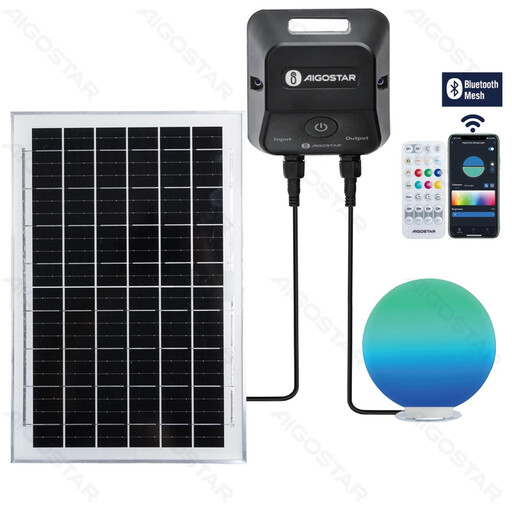
What makes it stand out: This high-performance solar ground spotlight with app control is designed for large-area illumination. Its 10W monocrystalline solar panel charges an 8Ah battery, which the manufacturer claims provides up to 24 hours of runtime.
Advantages:
Who it's for: Homeowners looking for powerful and flexible accent lighting for facades, large plants, or driveways, who want to avoid any wiring.
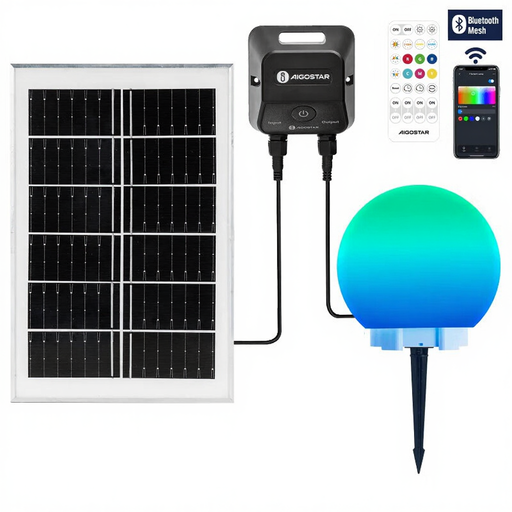
What makes it stand out: This compact light is designed as a path light or for subtly marking the edges of patios and flowerbeds. It is easily anchored in the ground with a stake and blends discreetly into its surroundings.
Advantages:
Who it's for: Garden owners who need discreet, smart, and solar-powered lighting for paths, flowerbeds, or the edges of patios and lawns.
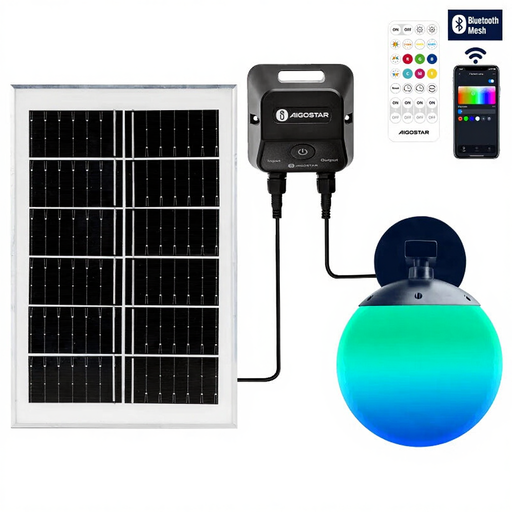
What makes it stand out: This smart solar wall light creates an architectural up-and-down lighting effect that provides a modern showcase for house walls, fences, or entrance areas. The installation is wireless and straightforward.
Advantages:
Who it's for: Users looking for stylish, low-maintenance, and energy-self-sufficient lighting for house facades, walls, balconies, or entrance areas.
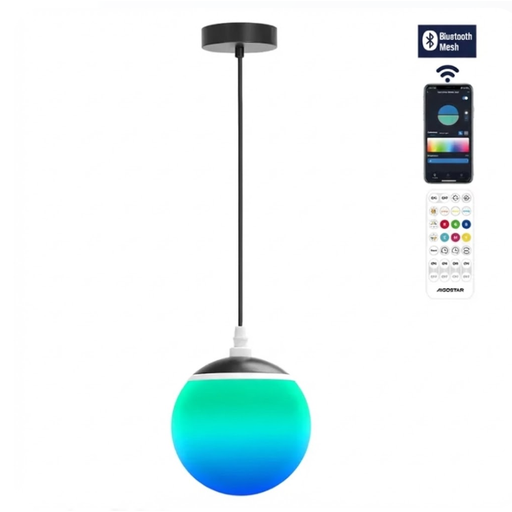
What makes it stand out: The unique feature of this outdoor solar pendant light is its split design. The solar panel can be placed in a sunny spot, while the light sphere itself hangs in the shade—ideal for gazebos, covered patios, or even garden sheds.
Advantages:
Who it's for: Users who need atmospheric lighting for covered outdoor areas like gazebos, pergolas, balconies, or canopies where direct sunlight on the light itself is not possible.
The models presented cover common use cases. However, if you are looking for other shapes, designs, or specific lighting moods, a wide range of alternatives is available.
→ Discover more products in the colourful lighting category here.
1. How reliably do solar lights work in winter? The performance of solar lights depends on sun exposure. During the winter months, with fewer hours of sunlight and a lower sun angle, the nightly runtime is reduced. Models with high-efficiency monocrystalline solar panels and large battery capacities have an advantage here. Additionally, many smart lights feature an intelligent power management mode that adjusts brightness based on the charge level to ensure illumination throughout the night.
2. What is the advantage of Bluetooth Mesh over Wi-Fi for garden lights? Wi-Fi signals often have a limited range outdoors and can be significantly weakened by walls and other obstacles. Bluetooth Mesh bypasses this problem, as the lights communicate with each other and relay the signal. The result is a more stable network with a greater range, specifically optimised for controlling many devices over a large area, and it also consumes less power than Wi-Fi.
3. Can I combine different types of smart solar lights in one system? Yes, as long as the lights use the same technology standard (e.g., Bluetooth Mesh) and are controlled by the same app (e.g., the AigoSmart app), you can combine different types of lights, such as ground spotlights, wall lights, and pendant lights, in one system. They can be grouped together in the app and controlled synchronously to create uniform lighting scenes throughout your entire outdoor space.