
Lieferung heute & morgen

Qualitätsgarantie

Willkommens-Angebote freischalten: KOSTENLOSE Lieferung | Bis zu 80 % RABATT | Kostenlose 30-Tage-JoyPlus-Testphase
App herunterladen
A new TV stand is meant to upgrade your living room, but the reality often looks different: the furniture seems lost in the space, cables hang down unattractively, or the surface is already sagging under the weight of the TV after just a few months. The selection is vast, and marketing promises don't make the decision any easier. Before you make a choice you'll later regret, you should know the three most common and costly pitfalls that buyers repeatedly fall into.
To avoid a bad purchase, focus on objective criteria instead of advertising messages. Three technical aspects are non-negotiable.
The foundation of any good TV unit is its construction. Pay attention to the maximum load capacity in kilograms specified in the product data sheets. This figure should be significantly higher than the weight of your TV and all planned additional devices.
The proportions must be right, for both aesthetic and practical reasons.
The choice of design should follow your usage habits. A modern TV stand often combines open and closed elements.
Instead of overwhelming you with an endless list, we have identified a few products that meet specific requirements and purposefully avoid the pitfalls mentioned.

Why This Fits Their Persona: Ideal for those who prefer a minimalist, uncluttered aesthetic with no visible feet or floor-level cable mess. The floating design creates an airy atmosphere and makes cleaning the floor easier.
The wall-mounted design necessitates thoughtful cable management through the wall or a cable raceway, elegantly solving the visible clutter problem. Its precise 140 cm width is perfectly proportioned for TVs up to 60 inches.
Space-saving, floating design for a modern look. The UV-coated door surface is low-maintenance and durable.

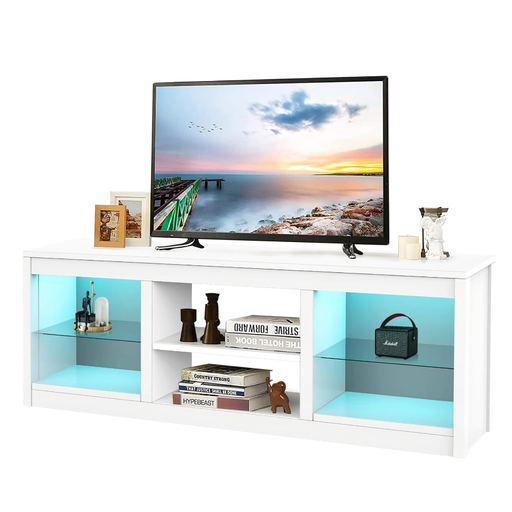
Why This Fits Their Persona: Designed for users who need more than just a place for their TV. This board offers dedicated space for consoles, an atmospheric lighting experience, and ample storage for games and accessories.
Its high load capacity of up to 72 kg (according to the manufacturer) prevents the stability trap. Integrated cable openings at the back directly address the cable chaos dilemma, while the generous compartments provide enough space even for large consoles.
Integrated RGB LED lighting with 7 colours and a remote control. A dedicated compartment for consoles like the PS5 and adjustable shelves for maximum flexibility.
Why This Fits Their Persona: For households where tidiness and ample closed storage are a priority. This piece of furniture conceals media devices, accessories, and DVDs behind doors, ensuring a consistently tidy living room.
The sturdy construction is explicitly designed for TVs up to 65 inches, thus avoiding the sizing and stability mistakes. The combination of open shelves and closed cabinets offers a practical solution for cable management, as cables can be routed internally to the devices.
Generous closed storage for a tidy appearance. The timeless, clean design in white complements many different interior styles.
We have compiled a complete, up-to-date list of products that fully meet these strict selection criteria and safety standards.
For a pleasing aesthetic and secure stability, the TV stand should extend beyond the TV on both sides. A good guideline is to choose a total width that is at least 20 cm greater than the width of your television. This gives the setup a visual anchor and prevents it from looking top-heavy.
Although the terms are often used interchangeably, there is a functional difference. A lowboard is specifically designed as a TV table and has a low height (typically under 50 cm) to ensure an optimal viewing height for the screen. A sideboard is generally taller and serves as a general storage unit in the living or dining room, but it can also be used as a TV unit if it has a suitable height and load capacity.
Usually not. Most TV boards with integrated LED lighting come with a standard power plug or a USB port that connects to a wall socket or a USB port on the TV. The installation is limited to plugging in the cable. Control is typically handled via an included remote, so no complex setup is required.